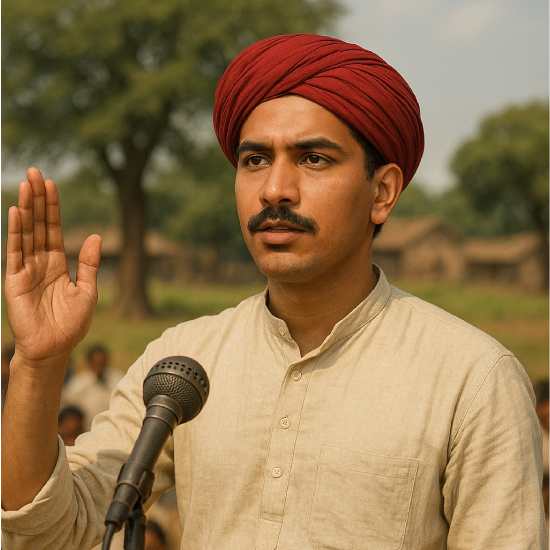
यशवंत फुले
(डॉ. यशवंत फुले)
| जन्म तिथि | 18 March 1873 |
| जन्म स्थान | 18 मार्च 1873 |
| पिता | जोतिबा फूले |
| माता | सावित्रीबाई फुले |
| जीवनसंगी | ससाने की पुत्री राधा |
| शिक्षा | चिकित्सा विज्ञान |
| राष्ट्रीयता | भारतीय |
| धर्म | हिन्दू |
| मृत्यु | 13 अक्टूबर 1906 |
जन्म एवं बचपन:-
पालन-पोषण करने वाली मां की महानता:-
यशवंत की शिक्षा:-
यशवंत का विवाह:-
यशवंत द्वारा चिकित्सकीय सेवा:-
संस्कारी एवं जिम्मेदार बेटा:-
तत्कालिन सामाजिक परिवेश:-
जन्मदात्री मां को बचाया जोतिबा ने:-
वंश का अंत:-
Birth and childhood:-
Kashibai gave birth to a beautiful child in 1873 at the Phule couple's house after some time. Savitri took great care of Kashibai and her child. Savitri had developed a special attachment to the child. Here Savitri once again took a revolutionary step, despite strong opposition from her family and relatives, she legally adopted Kashibai's child in 1874. The Phule couple named the child Yashwant. Then there was happiness in Savitri's life. She would dance around the house to fulfill Yashwant's needs. She would stay up all night to make sure that he did not wet her or that her blanket did not come off. In this way, Yashwant started growing up while being scolded and pampered.
The greatness of a nurturing mother:-
"Any woman with a big heart can adopt an orphan child of unknown parents and raise him like her own child, but it is rare to find a woman who raises a child born out of an immoral relationship of a widow like her own child. Savitribai adopted a child (whose father is not known) born out of an immoral relationship of a young Brahmin widow Kashibai. It is not right to say that she showed this courage only out of emotion and humanitarian feelings. Only a woman who is completely dedicated to her ideas can rebel like this by breaking the shackles of limits of caste, lineage, religion and tradition etc. That woman is Savitribai Phule."--Writer Indumati
Yashwant's education:-
Yashwant was admitted to school on time. Savitri was the embodiment of education. Therefore, she was always careful that Yashwant got a proper environment for education. There was no fear of ghosts or gods in the house. There was no trace of things like luck or bad luck. They were taught to trust their hard work and actions. Emphasis was laid on good conduct and honesty. In such an open environment at home, Yashwant, full of self-confidence, started receiving his education well. Savitri had showered her love on many children, but now she was seen as a loving but responsible mother. In 1893, Yashwant passed the matriculation examination. After this, he did a medical diploma and became a doctor. The glimpse of the values given by Savitri could be clearly seen in him.
Yashwant's marriage:-
04 February 1889: Phule's adopted son Dr. Yashwant got married to Sasane's daughter Radha.
Medical service by Yashwant:-
In 1897, when plague was spreading all over Maharashtra, Savitribai Phule, along with her adopted son Yashwant, opened a hospital in an open natural space in Sasane Mala in Hadapsar, Pune, to treat patients and also treated people considered untouchable. In her hospital, Savitribai herself took care of every patient, provided them with various facilities. Savitribai herself would take the patients to her (son Yashwant's) dispensary. Many people were cured of their diseases.
Cultured and responsible son:-
Savitri was working very hard in serving the patients. She would get them treated with the help of Yashwant and was trying her best to save their lives. Although Yashwant had requested her many times to take care of herself, she would laugh it off. She was obsessed with removing the sufferings of the society. A Mahar (untouchable) boy also fell prey to the plague, whom no one wanted to even touch. Savitribai herself carried him on her shoulders to her son Yashwant's clinic. Due to this, she herself fell prey to the disease. Yashwant got very angry. But even his anger filled Savitri with maternal love. She was proud of her son. But she was more relieved that he saved the lives of many people and gave them life. While fighting for others, she herself lost the battle of life. And due to this, she died on 10 March 1897.
Social environment of the time:-
Even in the 19th century, it was a tradition of Hindus to get married at a young age. That is why many women became widows at a young age at that time. According to religious traditions, women were not remarried. Widows had to cut their hair and live a very simple life. The Phule couple wanted to give such women their rights/respect. They started a movement with the help of barbers and saved the widows from cutting their hair.
Jyotirao saved the mother who gave birth:-
At that time, women were subjected to severe atrocities due to lack of social security, in which sometimes widows were physically exploited by the family members themselves. Widows were often forced to abort when they became pregnant, and many widows committed suicide due to the fear of having children.
At the same time, one such deceived Brahmin widow named Kashibai was thinking of ending her life due to the fear of disgrace if she became pregnant. She wanted to die by drowning in the river, but Jyoti Rao saved her. He brought her home respectfully. Savitribai also allowed that woman to stay in her house and also took good care of her.
End of the lineage:-
Yashwant ji remained childless and while serving the society, he died on 13 October 1906. Later, his life partner also died in anonymity and poverty.