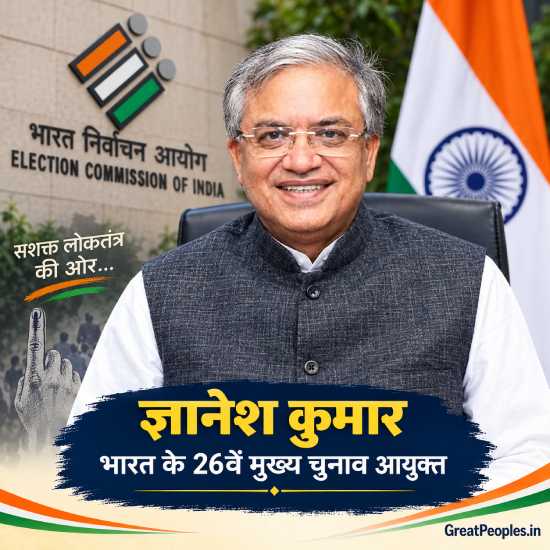
ज्ञानेश कुमार
(कहवा मैन)
| जन्म तिथि | 27 January 1964 |
| उम्र | 62 वर्ष (2026 तक) |
| राशि | कुंभ (Aquarius) |
| जन्म स्थान | मिधकुर, आगरा, उत्तर प्रदेश |
| निवास स्थान | दिल्ली, भारत |
| पिता | डॉ. सुभोद कुमार गुप्ता |
| माता | श्रीमती सत्यवती गुप्ता |
| भाई | उपेंद्र जैन — आईपीएस अधिकारी |
| बहिन | रोली जैन — पीएचडी धारक |
| कद | 5 फीट 8 इंच |
| वजन | लगभग 80 किलोग्राम |
| वैवाहिक हि. | विवाहित |
| जीवनसंगी | अनुराधा कुमार |
| बच्चे | पुत्र अर्णव कुमार, मेधा रूपम, अभिश्री कुमार |
| शिक्षा | क्वींस कॉलेज, वाराणसी — यूपी बोर्ड में टॉप किया (1979) |
| विश्वविद्यालय | हार्वर्ड विश्वविद्यालय (HIID) से पर्यावरण अर्थशास्त्र में पोस्टग्रेजुएट |
| योग्यता | आईआईटी कानपुर — सिविल इंजीनियरिंग (1985 बैच) |
| पेशा | भारत के 26वें मुख्य चुनाव आयुक्त |
| राष्ट्रीयता | भारतीय |
| धर्म | हिंदू |
ज्ञानेश कुमार जीवनी ——
भारत के 26वें मुख्य चुनाव आयुक्त
भारत विश्व का सबसे बड़ा लोकतंत्र है, और इस लोकतंत्र की आधारशिला स्वतंत्र, निष्पक्ष एवं पारदर्शी चुनाव प्रक्रिया है। इस प्रक्रिया की संरक्षक संस्था भारतीय निर्वाचन आयोग है, जिसका नेतृत्व मुख्य चुनाव आयुक्त करता है। ज्ञानेश कुमार भारत के 26वें मुख्य चुनाव आयुक्त के रूप में इस पद पर आसीन हुए हैं। उनका जीवन एक साधारण परिवार से निकलकर देश के सर्वोच्च प्रशासनिक और संवैधानिक पदों तक पहुँचने की प्रेरणादायक कहानी है। एक इंजीनियर से आईएएस अधिकारी बने ज्ञानेश कुमार का प्रशासनिक सफर पाँच दशकों में फैला हुआ है, जिसमें उन्होंने केरल में जिला प्रशासन से लेकर केंद्र सरकार के सबसे संवेदनशील मंत्रालयों तक में महत्वपूर्ण जिम्मेदारियाँ निभाई हैं। अनुच्छेद 370 का निष्प्रभावीकरण, राम जन्मभूमि तीर्थ क्षेत्र ट्रस्ट का गठन, इराक में फँसे भारतीयों को वापस लाना, और अब मुख्य चुनाव आयुक्त के रूप में देश के चुनावी तंत्र का संचालन — उनके करियर के कुछ ऐसे पड़ाव हैं जो उन्हें एक असाधारण प्रशासक के रूप में चिह्नित करते हैं। प्रस्तुत जीवनी में ज्ञानेश कुमार के जीवन, शिक्षा, प्रशासनिक करियर, उपलब्धियों, विवादों और मुख्य चुनाव आयुक्त के रूप में उनके योगदान का विस्तृत विवरण प्रस्तुत किया गया है।
प्रारंभिक जीवन और पारिवारिक पृष्ठभूमि——
ज्ञानेश कुमार का जन्म 27 जनवरी 1964 को उत्तर प्रदेश के आगरा शहर में हुआ था। उनका परिवार मूल रूप से आगरा के मीडकुर निवासी था, लेकिन उनके पिता की नौकरी के कारण परिवार आगरा में बस गया। उनके पिता डॉ. सुभोद कुमार गुप्ता एक चिकित्सक थे, जो मुख्य चिकित्सा अधिकारी के पद से सेवानिवृत्त हुए थे। उनकी माता श्रीमती सत्यवती गुप्ता हैं। ज्ञानेश कुमार का परिवार शिक्षा और चिकित्सा के क्षेत्र में गहराई से जुड़ा रहा है। उनके परिवार में 28 सदस्य डॉक्टर हैं, जो चिकित्सा के पेशे से जुड़े हुए हैं। हालाँकि, ज्ञानेश कुमार ने पारिवारिक परंपरा को तोड़ते हुए इंजीनियरिंग और प्रशासनिक सेवा का मार्ग चुना।
ज्ञानेश कुमार का विवाह हुआ और उनके तीन संतानें हैं। उनकी बड़ी बेटी मेधा रूपम उत्तर प्रदेश के कासगंज जिले की जिलाधिकारी (डीएम) हैं। उनकी दूसरी बेटी अभिषर्पि भारतीय राजस्व सेवा (आईआरएस) की अधिकारी हैं, और उनके पति अक्षय लाबरू आईएएस अधिकारी हैं। उनके दामाद मनीष बंसल भी आईएएस अधिकारी हैं। उनके पुत्र अर्णव कुमार अभी अपनी पढ़ाई कर रहे हैं। उनके भाई मनीष कुमार आईआरएस अधिकारी हैं, और उनकी बहन रोली इंदौर (मध्य प्रदेश) में एक विद्यालय चलाती हैं। रोली के पति उपेंद्र जैन आईपीएस अधिकारी हैं। इस प्रकार, ज्ञानेश कुमार का परिवार प्रशासनिक सेवाओं और शिक्षा के क्षेत्र में गहराई से जुड़ा हुआ है।
शिक्षा का सफर: यूपी बोर्ड से हार्वर्ड तक——
ज्ञानेश कुमार की शैक्षणिक यात्रा असाधारण प्रतिभा और परिश्रम का प्रतीक है। उनकी प्रारंभिक शिक्षा गोरखपुर, लखनऊ और कानपुर के विद्यालयों में हुई। उन्होंने उत्तर प्रदेश बोर्ड की हाई स्कूल (कक्षा 10) परीक्षा वर्ष 1979 में और इंटरमीडिएट (कक्षा 12) परीक्षा वर्ष 1981 में उत्तीर्ण की, और दोनों परीक्षाओं में उन्होंने टॉप किया। उन्होंने लखनऊ के प्रतिष्ठित कॉल्विन तालुकदार कॉलेज में अध्ययन किया, जहाँ उन्हें उनकी शैक्षणिक प्रतिभा के लिए जाना जाता था।
इंटरमीडिएट के बाद ज्ञानेश कुमार ने संयुक्त प्रवेश परीक्षा (जेईई) उत्तीर्ण की और भारतीय प्रौद्योगिकी संस्थान, कानपुर (आईआईटी कानपुर) में प्रवेश लिया। उन्होंने वहाँ से सिविल इंजीनियरिंग में बी.टेक की डिग्री प्राप्त की। आईआईटी कानपुर के आधिकारिक पूर्व छात्र प्रोफाइल के अनुसार, वे बीटी/सीई स्नातक वर्ग 1985 से संबद्ध हैं। इंजीनियरिंग की पढ़ाई पूरी करने के बाद उन्होंने सिविल सेवा परीक्षा की तैयारी शुरू की। इस बीच, उन्होंने हाउसिंग एंड अर्बन डेवलपमेंट कॉरपोरेशन (हुडको) में भी कुछ समय तक काम किया।
ज्ञानेश कुमार की शिक्षा इंजीनियरिंग तक सीमित नहीं रही। उन्होंने इंस्टीट्यूट ऑफ चार्टर्ड फाइनेंशियल एनालिस्ट्स ऑफ इंडिया (आईसीएफएआई) से बिजनेस फाइनेंस का अध्ययन किया और हार्वर्ड विश्वविद्यालय के हार्वर्ड इंस्टीट्यूट फॉर इंटरनेशनल डेवलपमेंट (एचआईआईडी) से पर्यावरण अर्थशास्त्र में अध्ययन किया। इस प्रकार, उनकी शिक्षा में तीन अलग-अलग विषयों — सिविल इंजीनियरिंग, बिजनेस फाइनेंस और पर्यावरण अर्थशास्त्र — का समावेश है, जो उनके बहुआयामी व्यक्तित्व को दर्शाता है।
नवंबर 2025 में, आईआईटी कानपुर ने अपने 66वें स्थापना दिवस समारोह के दौरान ज्ञानेश कुमार को प्रतिष्ठित पूर्व छात्र पुरस्कार (डिस्टिंग्विश्ड एलुमनाई अवार्ड) से सम्मानित किया। यह पुरस्कार 1989 में स्थापित किया गया था और यह समाज और राष्ट्र के प्रति उत्कृष्ट उपलब्धियों और योगदान को मान्यता देता है।
प्रशासनिक करियर: आईएएस अधिकारी के रूप में पदार्पण——
ज्ञानेश कुमार ने वर्ष 1988 में भारतीय प्रशासनिक सेवा (आईएएस) परीक्षा उत्तीर्ण की और केरल कैडर के आईएएस अधिकारी बने। उनके प्रशासनिक करियर की शुरुआत केरल से हुई, जहाँ उन्होंने उप कलेक्टर के रूप में पदभार संभाला। उन्हें पथनमथिट्टा में सब कलेक्टर के रूप में नियुक्त किया गया। इसके बाद उन्होंने केरल में कई महत्वपूर्ण पदों पर कार्य किया, जिनमें कोच्चि नगर निगम के नगर आयुक्त, केरल राज्य सहकारी बैंक के प्रबंध निदेशक, एर्नाकुलम के जिला कलेक्टर, गोश्री आइलैंड्स डेवलपमेंट अथॉरिटी के सचिव, त्रिवेंद्रम हवाई अड्डा विकास सोसाइटी के प्रबंध निदेशक और नई दिल्ली में केरल हाउस के रेजिडेंट कमिश्नर के पद शामिल हैं। केरल में अपने कार्यकाल के दौरान उन्होंने वामपंथी और कांग्रेस दोनों सरकारों के अधीन कार्य किया, जो उनकी राजनीतिक तटस्थता और पेशेवर दक्षता को दर्शाता है।
केरल में अपने कार्यकाल के दौरान ज्ञानेश कुमार ने एक महत्वपूर्ण उपलब्धि हासिल की — वर्ष 2014 में इराक में आईएसआईएस संकट के दौरान फँसे 183 भारतीयों को सुरक्षित वापस लाने में उन्होंने महत्वपूर्ण भूमिका निभाई। इनमें 83 मलयाली नर्सें भी शामिल थीं। यह उनकी संकट प्रबंधन क्षमता और भारतीय नागरिकों के प्रति उनकी प्रतिबद्धता का प्रमाण है।
केंद्रीय स्तर पर प्रशासनिक जिम्मेदारियाँ——
ज्ञानेश कुमार ने केंद्र सरकार में भी कई महत्वपूर्ण पदों पर कार्य किया। उन्होंने रक्षा मंत्रालय में संयुक्त सचिव के रूप में वर्ष 2007 से 2017 तक कार्य किया, जो संयुक्त प्रगतिशील गठबंधन (यूपीए) सरकार के कार्यकाल के दौरान था। इसके अलावा, उन्होंने गृह मंत्रालय में संयुक्त सचिव और अतिरिक्त सचिव के रूप में भी महत्वपूर्ण जिम्मेदारियाँ निभाईं।
अनुच्छेद 370 का निष्प्रभावीकरण और जम्मू-कश्मीर का पुनर्गठन——
ज्ञानेश कुमार के करियर का सबसे महत्वपूर्ण और संवेदनशील अध्याय उनके गृह मंत्रालय में कार्यकाल के दौरान सामने आया। वर्ष 2018 से 2021 तक गृह मंत्रालय में अपनी तैनाती के दौरान, उन्होंने अनुच्छेद 370 को निष्प्रभावी करने और जम्मू-कश्मीर को दो केंद्र शासित प्रदेशों में पुनर्गठित करने की प्रक्रिया में महत्वपूर्ण भूमिका निभाई। वे उस 'क्रैक टीम' का हिस्सा थे जिसे कश्मीर में अनुच्छेद 370 को हटाने के लिए कानूनी और प्रशासनिक रास्ता खोजने का काम सौंपा गया था। उन्होंने जम्मू-कश्मीर पुनर्गठन विधेयक का मसौदा तैयार करने में भी महत्वपूर्ण भूमिका निभाई। यह भारत के संवैधानिक इतिहास का एक ऐतिहासिक निर्णय था, जिसने जम्मू-कश्मीर की विशेष स्थिति को समाप्त कर दिया।
राम जन्मभूमि तीर्थ क्षेत्र ट्रस्ट का गठन——
गृह मंत्रालय में अपने कार्यकाल के दौरान, ज्ञानेश कुमार को अयोध्या में राम मंदिर निर्माण से जुड़ी संस्था — श्री राम जन्मभूमि तीर्थ क्षेत्र ट्रस्ट — के गठन की जिम्मेदारी भी सौंपी गई। सर्वोच्च न्यायालय के फैसले के बाद इस ट्रस्ट का गठन किया गया था, और ज्ञानेश कुमार ने इस प्रक्रिया में महत्वपूर्ण प्रशासनिक भूमिका निभाई। उन्हें इस ट्रस्ट के गठन से जुड़े प्रशासनिक और कानूनी पहलुओं को संभालने की जिम्मेदारी दी गई थी।
संसदीय कार्य मंत्रालय और सहकारिता मंत्रालय——
गृह मंत्रालय के बाद, ज्ञानेश कुमार ने संसदीय कार्य मंत्रालय के सचिव के रूप में कार्य किया। इसके बाद वे सहकारिता मंत्रालय के सचिव के रूप में नियुक्त हुए, जहाँ उन्होंने मई 2022 से जनवरी 2024 तक कार्य किया। सहकारिता मंत्रालय का गठन वर्ष 2021 में किया गया था, और ज्ञानेश कुमार इस मंत्रालय के शुरुआती सचिवों में से एक थे। उन्होंने 31 जनवरी 2024 को सहकारिता मंत्रालय के सचिव के पद से सेवानिवृत्ति प्राप्त की।
चुनाव आयुक्त के रूप में नियुक्ति (मार्च 2024)——
ज्ञानेश कुमार की सेवानिवृत्ति के बाद उनका सार्वजनिक जीवन समाप्त नहीं हुआ, बल्कि एक नए और अधिक महत्वपूर्ण अध्याय की शुरुआत हुई। सेवानिवृत्ति के केवल दो महीने बाद, 14 मार्च 2024 को उन्हें भारतीय निर्वाचन आयोग में चुनाव आयुक्त के रूप में नियुक्त किया गया। उन्होंने 15 मार्च 2024 को चुनाव आयुक्त के रूप में पदभार संभाला। यह नियुक्ति उस समय की गई जब देश में 18वीं लोकसभा के चुनाव की घोषणा होने वाली थी। उनके साथ डॉ. सुखबीर सिंह संधू को भी चुनाव आयुक्त नियुक्त किया गया था। चुनाव आयुक्त के रूप में पदभार संभालने के दूसरे ही दिन, 16 मार्च 2024 को निर्वाचन आयोग ने 2024 के लोकसभा चुनाव का कार्यक्रम जारी कर दिया।
चुनाव आयुक्त के रूप में अपने कार्यकाल के दौरान, ज्ञानेश कुमार ने 18वीं लोकसभा के चुनाव और जम्मू-कश्मीर, हरियाणा, महाराष्ट्र, झारखंड और दिल्ली विधानसभा चुनावों के संचालन में महत्वपूर्ण भूमिका निभाई। यह भारत के चुनावी इतिहास का एक व्यस्त और चुनौतीपूर्ण दौर था, जिसमें विश्व के सबसे बड़े लोकतांत्रिक चुनाव का संचालन शामिल था।
मुख्य चुनाव आयुक्त के रूप में नियुक्ति (फरवरी 2025)——
17 फरवरी 2025 को, विधि एवं न्याय मंत्रालय ने ज्ञानेश कुमार को भारत का अगला मुख्य चुनाव आयुक्त नियुक्त करने की अधिसूचना जारी की। राष्ट्रपति द्रौपदी मुर्मू ने 17 फरवरी 2025 को उनकी नियुक्ति को औपचारिक रूप से अनुमोदित किया। उन्होंने 19 फरवरी 2025 को निर्वाचन सदन, नई दिल्ली में भारत के 26वें मुख्य चुनाव आयुक्त के रूप में पदभार संभाला। उन्होंने राजीव कुमार का स्थान लिया, जिनका कार्यकाल 18 फरवरी 2025 को समाप्त हो गया था।
ज्ञानेश कुमार मुख्य चुनाव आयुक्त और अन्य चुनाव आयुक्त अधिनियम, 2023 के तहत नियुक्त होने वाले पहले मुख्य चुनाव आयुक्त हैं। यह अधिनियम 2023 में पारित किया गया था, जिसने मुख्य चुनाव आयुक्त और अन्य चुनाव आयुक्तों की नियुक्ति की प्रक्रिया में बदलाव किए। इस अधिनियम के तहत, तीन सदस्यीय चयन समिति में भारत के मुख्य न्यायाधीश के स्थान पर एक केंद्रीय कैबिनेट मंत्री को शामिल किया गया, जिससे सरकार को तीन सदस्यीय समिति में दो सदस्य हो गए।
मुख्य चुनाव आयुक्त के रूप में पदभार संभालने के बाद, ज्ञानेश कुमार ने अपने पहले संदेश में कहा कि "राष्ट्र निर्माण का पहला कदम मतदान है" और "भारत का प्रत्येक नागरिक जिसने 18 वर्ष की आयु पूरी कर ली है, उसे मतदाता बनना चाहिए और सदैव मतदान करना चाहिए।" उन्होंने यह भी कहा कि "भारत के संविधान, निर्वाचन कानूनों, नियमों और उनके अंतर्गत जारी निर्देशों के अनुसार, निर्वाचन आयोग मतदाताओं के साथ था, है और सदैव रहेगा"। यह संदेश उनकी संवैधानिक प्रतिबद्धता और मतदाताओं के प्रति उनकी जिम्मेदारी को दर्शाता है।
उनका कार्यकाल 26 जनवरी 2029 तक निर्धारित है, जो अगले लोकसभा चुनावों की घोषणा से कुछ महीने पहले समाप्त होगा। यदि वे अपना पूरा कार्यकाल पूरा करते हैं, तो वे भारत के सबसे लंबे समय तक सेवा करने वाले मुख्य चुनाव आयुक्तों में से एक होंगे।
मुख्य चुनाव आयुक्त के रूप में कार्यकाल और निर्णय——
विशेष गहन पुनरीक्षण (एसआईआर)——
ज्ञानेश कुमार के मुख्य चुनाव आयुक्त के रूप में कार्यकाल का सबसे विवादास्पद और चर्चित पहलू विशेष गहन पुनरीक्षण (स्पेशल इंटेंसिव रिवीजन — एसआईआर) रहा है। यह मतदाता सूचियों के पुनरीक्षण की एक प्रक्रिया है, जिसे दो दशकों से अधिक समय के बाद देश में फिर से लागू किया गया था। एसआईआर के तहत, देश भर में 12 करोड़ से अधिक मतदाताओं के नाम मतदाता सूचियों से हटाए जाने की सूचना मिली। इसका प्रभाव कई राज्यों के चुनावों में देखा गया। महाराष्ट्र में नाम जोड़े गए, जबकि बंगाल में कुल 92 लाख मतदाताओं के नाम हटा दिए गए, जिनमें मृत या अनुपस्थित के रूप में चिह्नित लोग भी शामिल थे।
एसआईआर प्रक्रिया में "तार्किक विसंगति" (लॉजिकल डिस्क्रेपेंसी) श्रेणी का उपयोग किया गया, जिसकी विपक्षी दलों और चुनाव पर्यवेक्षकों ने कड़ी आलोचना की। उनका तर्क था कि यह श्रेणी बंगाल में पहले इस्तेमाल की गई, लेकिन महाराष्ट्र और हरियाणा में नहीं, जहाँ 2024 में विधानसभा चुनाव हुए थे। बंगाल चुनाव परिणामों की घोषणा के लगभग एक महीने बाद, ज्ञानेश कुमार ने दिल्ली में एक सम्मेलन में दावा किया कि "यह दुनिया में सबसे शुद्ध और सबसे सटीक मतदाता सूची है, जो यह सुनिश्चित करती है कि प्रत्येक पात्र मतदाता सूची में है और प्रत्येक अपात्र नाम हटा दिया गया है"।
चुनाव आयुक्तों के आपत्ति——
एसआईआर प्रक्रिया के दौरान, निर्वाचन आयोग के अन्य दो चुनाव आयुक्तों — सुखबीर सिंह संधू और विवेक जोशी — ने औपचारिक रूप से कम से कम 14 बार आपत्ति जताई। उनका कहना था कि ये निर्णय उनकी जानकारी के बिना लिए गए। इन आपत्तियों में वैधानिक मतदाता पंजीकरण फॉर्म 6 में बदलाव और मतदाता सूची डेटाबेस पर केंद्रीकृत नियंत्रण जैसे मुद्दे शामिल थे। निर्वाचन आयोग ने कहा कि मतभेद विचार-विमर्श का सामान्य हिस्सा हैं और एसआईआर सहित सभी अंतिम निर्णय सर्वसम्मति से लिए गए थे। हालाँकि, इन खुलासों ने ज्ञानेश कुमार के कार्यकाल की जाँच को तेज कर दिया है।
"वोट चोरी" के आरोप——
लोकसभा में विपक्ष के नेता राहुल गांधी ने 1 अगस्त 2025 को पहली बार "वोट चोरी" का आरोप लगाया। छह दिन बाद, उन्होंने बेंगलुरु सेंट्रल लोकसभा क्षेत्र के महादेवपुरा विधानसभा क्षेत्र का उदाहरण देते हुए एक विस्तृत प्रेस कॉन्फ्रेंस की, जिसमें डुप्लिकेट मतदाताओं, अवैध पतों और एक ही पते से बड़ी संख्या में मतदाताओं के पंजीकरण का उल्लेख किया गया। ज्ञानेश कुमार ने राहुल गांधी के आरोपों को एक प्रेस कॉन्फ्रेंस में खारिज कर दिया और सुझाव दिया कि विपक्ष के नेता को शपथ पत्र दाखिल करना चाहिए या माफी मांगनी चाहिए।
पारदर्शिता पर सवाल——
संयुक्त विपक्ष की मशीन-रीडेबल मतदाता सूचियों और मतदान केंद्रों से सीसीटीवी फुटेज तक पहुँच की मांग को ज्ञानेश कुमार ने महिला मतदाताओं की निजता के उल्लंघन का हवाला देते हुए खारिज कर दिया। इस निर्णय की विपक्षी दलों और नागरिक समाज संगठनों ने आलोचना की, जिनका मानना था कि यह पारदर्शिता को कमजोर करता है।
महाभियोग की मांग——
मार्च 2026 में, 130 लोकसभा सदस्यों और 63 राज्यसभा सदस्यों ने ज्ञानेश कुमार के खिलाफ महाभियोग प्रस्ताव का समर्थन किया। यह भारत के इतिहास में पहली बार हुआ जब किसी मुख्य चुनाव आयुक्त के खिलाफ महाभियोग की मांग की गई। हालाँकि, यह प्रस्ताव संसद में पारित नहीं हो सका। इसके अलावा, केरल विधानसभा ने अक्टूबर 2026 में एक प्रस्ताव पारित कर ज्ञानेश कुमार को हटाने की मांग की, जिसमें एसआईआर प्रक्रिया में अनियमितताओं और निर्वाचन आयोग की निष्पक्षता पर चिंता व्यक्त की गई। यह प्रस्ताव मुख्यमंत्री वी.डी. सतीशन द्वारा प्रस्तुत किया गया था और इसे संशोधनों के साथ पारित किया गया।
अंतर्राष्ट्रीय भूमिका: अंतर्राष्ट्रीय आईडीईए की अध्यक्षता——
ज्ञानेश कुमार को अंतर्राष्ट्रीय स्तर पर भी महत्वपूर्ण जिम्मेदारी मिली है। 3 दिसंबर 2025 को, उन्होंने स्टॉकहोम, स्वीडन में अंतर्राष्ट्रीय लोकतंत्र और चुनाव सहायता संस्थान (इंटरनेशनल आईडीईए) की सदस्य राज्यों की परिषद की अध्यक्षता संभाली। यह पहली बार है जब भारत को इस संस्था की अध्यक्षता के लिए आमंत्रित किया गया है। भारत इंटरनेशनल आईडीईए का संस्थापक सदस्य है और इसके शासन प्रक्रियाओं में सक्रिय रूप से भाग लेता रहा है। 35 सदस्य देशों वाले इस संगठन में भारत दुनिया का सबसे बड़ा लोकतंत्र है, जहाँ 90 करोड़ से अधिक मतदाता हैं। अध्यक्षता के दौरान, भारत चुनाव प्रबंधन निकायों को मजबूत करने और वैश्विक स्तर पर लोकतांत्रिक प्रक्रियाओं को बढ़ावा देने में अपने व्यापक अनुभव का उपयोग करेगा।
अपनी अध्यक्षता के तहत, ज्ञानेश कुमार ने लोकतंत्र और पेशेवर चुनाव प्रबंधन से जुड़े विषयों पर भारत का ध्यान केंद्रित किया है। उन्होंने 4 दिसंबर 2025 को स्टॉकहोम के स्वीडिश इंस्टीट्यूट ऑफ इंटरनेशनल अफेयर्स (यूआई) में एक संबोधन भी दिया। यह अंतर्राष्ट्रीय मान्यता भारत के चुनावी तंत्र की विश्वसनीयता और ज्ञानेश कुमार के नेतृत्व कौशल का प्रमाण है।
व्यक्तिगत विशेषताएँ और कार्यशैली——
ज्ञानेश कुमार को उनके सहकर्मियों और परिचितों द्वारा एक मेहनती, अनुशासित और विवरण-उन्मुख अधिकारी के रूप में जाना जाता है। उनके पड़ोसी डॉ. सुभोद गुप्ता ने उनके बारे में कहा था कि "ज्ञानेश पढ़ाई में अच्छे थे। वे हाई स्कूल और इंटरमीडिएट परीक्षाओं में टॉपर थे। वे आईआईटी कानपुर से सिविल इंजीनियर बने और आईएएस परीक्षा पास करने से पहले एक साल तक दिल्ली में हुडको में काम किया"। उन्हें "कहवा मैन" (Kahwa Man) के उपनाम से भी जाना जाता है, जो उनके दिल्ली के नॉर्थ ब्लॉक में कार्यकाल के दौरान मिला था। यह उपनाम उनके सादे और मिलनसार व्यक्तित्व को दर्शाता है।
उनकी कार्यशैली में विवरण पर ध्यान, प्रक्रियात्मक सटीकता और संवैधानिक प्रक्रियाओं के प्रति सम्मान प्रमुख है। यही कारण है कि उन्हें अनुच्छेद 370 और राम मंदिर ट्रस्ट जैसे संवेदनशील मामलों में महत्वपूर्ण जिम्मेदारी दी गई। एक पूर्व सहयोगी ने उनके बारे में कहा था कि "वे जो भी काम करते हैं, उसकी गहराई में जाते हैं"।
विरासत और प्रभाव——
ज्ञानेश कुमार का प्रशासनिक करियर पाँच दशकों में फैला हुआ है, जिसमें उन्होंने जिला स्तर से लेकर केंद्र सरकार के सचिव स्तर तक की जिम्मेदारियाँ निभाई हैं। उनकी सबसे उल्लेखनीय उपलब्धियों में अनुच्छेद 370 का निष्प्रभावीकरण, राम जन्मभूमि तीर्थ क्षेत्र ट्रस्ट का गठन, इराक से भारतीयों की वापसी, और अब मुख्य चुनाव आयुक्त के रूप में देश के चुनावी तंत्र का संचालन शामिल है। मुख्य चुनाव आयुक्त के रूप में उनका कार्यकाल विवादों से घिरा रहा है, विशेष रूप से एसआईआर प्रक्रिया और चुनाव आयुक्तों के भीतर मतभेदों के कारण। हालाँकि, उन्होंने अपने फैसलों का बचाव करते हुए कहा है कि निर्वाचन आयोग संविधान और निर्वाचन कानूनों के अनुसार कार्य कर रहा है और मतदाताओं के साथ खड़ा है।
उनका कार्यकाल 2029 तक चलने की संभावना है, और इस दौरान वे कई महत्वपूर्ण चुनावों का संचालन करेंगे। उनके नेतृत्व में निर्वाचन आयोग की भूमिका और कार्यशैली भारत के लोकतांत्रिक तंत्र के भविष्य को आकार देने में महत्वपूर्ण साबित होगी। अंतर्राष्ट्रीय आईडीईए की अध्यक्षता के माध्यम से उन्होंने भारत के चुनावी अनुभव को वैश्विक मंच पर प्रस्तुत करने का अवसर भी प्राप्त किया है।
50 रोचक जानकारियाँ——
- ज्ञानेश कुमार भारत के 26वें मुख्य चुनाव आयुक्त हैं।
- उन्होंने 19 फरवरी 2025 को मुख्य चुनाव आयुक्त के रूप में पदभार संभाला।
- उनका जन्म 27 जनवरी 1964 को आगरा, उत्तर प्रदेश में हुआ।
- उनके पिता डॉ. सुभोद कुमार गुप्ता मुख्य चिकित्सा अधिकारी से सेवानिवृत्त हुए थे।
- उनकी माता श्रीमती सत्यवती गुप्ता हैं।
- उनके परिवार में 28 सदस्य डॉक्टर हैं।
- उन्होंने यूपी बोर्ड हाई स्कूल 1979 में टॉप किया।
- इंटरमीडिएट 1981 में भी टॉप किया।
- उन्होंने लखनऊ के कॉल्विन तालुकदार कॉलेज में पढ़ाई की।
- वे आईआईटी कानपुर से सिविल इंजीनियरिंग में बी.टेक हैं।
- वे आईआईटी कानपुर के 1985 बैच के पूर्व छात्र हैं।
- आईएएस से पहले उन्होंने हुडको में काम किया।
- उन्होंने आईसीएफएआई से बिजनेस फाइनेंस पढ़ा।
- उन्होंने हार्वर्ड के एचआईआईडी से पर्यावरण अर्थशास्त्र पढ़ा।
- वे 1988 बैच के आईएएस अधिकारी हैं।
- उनका कैडर केरल है।
- वे पथनमथिट्टा में सब कलेक्टर रहे।
- वे कोच्चि नगर निगम के नगर आयुक्त रहे।
- वे केरल राज्य सहकारी बैंक के प्रबंध निदेशक रहे।
- वे एर्नाकुलम के जिला कलेक्टर रहे।
- वे गोश्री आइलैंड्स डेवलपमेंट अथॉरिटी के सचिव रहे।
- वे त्रिवेंद्रम हवाई अड्डा विकास सोसाइटी के एमडी रहे।
- वे नई दिल्ली में केरल हाउस के रेजिडेंट कमिश्नर रहे।
- उन्होंने केरल में वामपंथी और कांग्रेस दोनों सरकारों के साथ काम किया।
- 2014 में इराक से 183 भारतीयों को निकालने में भूमिका निभाई।
- इनमें 83 मलयाली नर्सें भी शामिल थीं।
- वे रक्षा मंत्रालय में संयुक्त सचिव रहे।
- वे गृह मंत्रालय में संयुक्त सचिव और अतिरिक्त सचिव रहे।
- अनुच्छेद 370 हटाने की कानूनी राह खोजने वाली टीम का हिस्सा थे।
- जम्मू-कश्मीर पुनर्गठन विधेयक के मसौदे में भूमिका निभाई।
- राम जन्मभूमि तीर्थ क्षेत्र ट्रस्ट के गठन में जिम्मेदारी संभाली।
- वे संसदीय कार्य मंत्रालय के सचिव रहे।
- वे सहकारिता मंत्रालय के सचिव रहे।
- उन्होंने 31 जनवरी 2024 को सेवानिवृत्ति ली।
- सेवानिवृत्ति के दो महीने बाद चुनाव आयुक्त बने।
- उन्होंने 15 मार्च 2024 को चुनाव आयुक्त के रूप में पदभार संभाला।
- 16 मार्च 2024 को लोकसभा चुनाव कार्यक्रम घोषित हुआ।
- 2024 लोकसभा चुनाव के संचालन में प्रमुख भूमिका निभाई।
- जम्मू-कश्मीर, हरियाणा, महाराष्ट्र, झारखंड, दिल्ली चुनावों में भूमिका रही।
- 17 फरवरी 2025 को सीईसी नियुक्ति की अधिसूचना जारी हुई।
- वे 2023 अधिनियम के तहत नियुक्त पहले मुख्य चुनाव आयुक्त हैं।
- उनका कार्यकाल 26 जनवरी 2029 तक है।
- उन्होंने कहा—“राष्ट्र निर्माण का पहला कदम मतदान है।”
- उन्होंने कहा—“निर्वाचन आयोग मतदाताओं के साथ था, है और रहेगा।”
- एसआईआर को लेकर उनका कार्यकाल विवादों में रहा।
- राहुल गांधी के “वोट चोरी” आरोपों को उन्होंने खारिज किया।
- सीसीटीवी फुटेज और एमआरएम पहुँच की मांग महिला मतदाताओं की निजता के आधार पर खारिज की।
- रिपोर्टों के अनुसार मार्च 2026 में उनके खिलाफ महाभियोग प्रस्ताव को 130 लोकसभा और 63 राज्यसभा सदस्यों का समर्थन मिला।
- दिसंबर 2025 में उन्होंने अंतर्राष्ट्रीय आईडीईए की अध्यक्षता संभाली।
- नवंबर 2025 में आईआईटी कानपुर ने उन्हें डिस्टिंग्विश्ड एलुमनाई अवार्ड दिया; उन्हें “कहवा मैन” भी कहा जाता है।
50 FAQ——
ज्ञानेश कुमार कौन हैं?
भारत के 26वें मुख्य चुनाव आयुक्त।
उनका जन्म कब हुआ?
27 जनवरी 1964।
जन्म स्थान क्या है?
आगरा, उत्तर प्रदेश।
उनके पिता कौन थे?
डॉ. सुभोद कुमार गुप्ता।
उनकी माता कौन हैं?
श्रीमती सत्यवती गुप्ता।
परिवार में कितने डॉक्टर हैं?
28 सदस्य।
स्कूली शिक्षा कहाँ हुई?
यूपी बोर्ड; 1979 और 1981 में टॉप किया।
कॉलेज कौन सा था?
कॉल्विन तालुकदार कॉलेज, लखनऊ।
इंजीनियरिंग कहाँ से की?
आईआईटी कानपुर, सिविल इंजीनियरिंग।
अन्य शिक्षा क्या है?
आईसीएफएआई से बिजनेस फाइनेंस; हार्वर्ड एचआईआईडी से पर्यावरण अर्थशास्त्र।
आईएएस बैच कौन सा है?
1988।
उनका कैडर क्या है?
केरल।
पहली पोस्टिंग क्या रही?
पथनमथिट्टा में सब कलेक्टर।
कोच्चि में क्या पद रहा?
नगर आयुक्त।
बैंकिंग क्षेत्र में क्या भूमिका रही?
केरल राज्य सहकारी बैंक के एमडी।
जिला कलेक्टर कहाँ रहे?
एर्नाकुलम।
केरल हाउस में क्या पद रहा?
रेजिडेंट कमिश्नर।
इराक evacuation में क्या भूमिका थी?
2014 में 183 भारतीयों को सुरक्षित निकाला।
रक्षा मंत्रालय में क्या पद रहा?
संयुक्त सचिव।
गृह मंत्रालय में क्या पद रहे?
संयुक्त सचिव और अतिरिक्त सचिव।
अनुच्छेद 370 में उनकी भूमिका क्या थी?
निष्प्रभावीकरण की कानूनी/प्रशासनिक प्रक्रिया में।
जम्मू-कश्मीर पुनर्गठन में?
विधेयक के मसौदे में भूमिका।
राम मंदिर ट्रस्ट में?
श्री राम जन्मभूमि तीर्थ क्षेत्र ट्रस्ट के गठन में।
संसदीय कार्य मंत्रालय में?
सचिव।
सहकारिता मंत्रालय में?
सचिव।
सेवानिवृत्ति कब हुई?
31 जनवरी 2024।
चुनाव आयुक्त कब बने?
15 मार्च 2024।
लोकसभा चुनाव कार्यक्रम कब आया?
16 मार्च 2024।
कौन से चुनाव कराए?
2024 लोकसभा और कई विधानसभा चुनाव।
मुख्य चुनाव आयुक्त कब बने?
19 फरवरी 2025।
वे कौन से सीईसी हैं?
26वें।
किस अधिनियम के तहत नियुक्त हुए?
मुख्य चुनाव आयुक्त और अन्य चुनाव आयुक्त अधिनियम, 2023।
उनका कार्यकाल कब तक है?
26 जनवरी 2029 तक।
उनका प्रसिद्ध नारा क्या है?
“राष्ट्र निर्माण का पहला कदम मतदान है।”
मतदाताओं के लिए उनका संदेश?
आयोग मतदाताओं के साथ था, है और रहेगा।
एसआईआर क्या है?
विशेष गहन पुनरीक्षण।
एसआईआर विवाद क्यों हुआ?
नाम हटाने और “तार्किक विसंगति” श्रेणी को लेकर।
अन्य चुनाव आयुक्तों ने आपत्ति जताई?
रिपोर्टों के अनुसार संधू और जोशी ने कई बार आपत्ति जताई।
आयोग का रुख क्या रहा?
मतभेद सामान्य; निर्णय सर्वसम्मत बताए गए।
राहुल गांधी के आरोप क्या थे?
“वोट चोरी” के आरोप।
ज्ञानेश कुमार ने क्या कहा?
आरोप खारिज किए; शपथ पत्र दें या माफी मांगें।
सीसीटीवी/एमआरएम मांग पर क्या हुआ?
निजता के आधार पर खारिज की गई।
महाभियोग की मांग हुई?
रिपोर्टों के अनुसार मार्च 2026 में समर्थन मिला।
केरल विधानसभा ने क्या किया?
अक्टूबर 2026 में हटाने की मांग वाला प्रस्ताव पारित किया।
अंतर्राष्ट्रीय भूमिका क्या है?
दिसंबर 2025 में अंतर्राष्ट्रीय आईडीईए की अध्यक्षता।
आईआईटी कानपुर ने क्या सम्मान दिया?
नवंबर 2025 में डिस्टिंग्विश्ड एलुमनाई अवार्ड।
उनका उपनाम क्या है?
“कहवा मैन”।
परिवार में प्रशासनिक अधिकारी कौन हैं?
बेटी, दामाद, भाई आदि कई प्रशासनिक सेवाओं में हैं।
क्या वे पहले सीईसी हैं जिनके खिलाफ महाभियोग की चर्चा हुई?
रिपोर्टों के अनुसार ऐसा पहली बार हुआ।
उनकी विरासत क्या मानी जाती है?
विवादों और ऐतिहासिक निर्णयों के बीच चुनावी तंत्र का नेतृत्व।
निष्कर्ष——
ज्ञानेश कुमार का जीवन एक ऐसे व्यक्ति की कहानी है जिसने अपनी मेहनत, बुद्धिमत्ता और समर्पण के बल पर देश के सर्वोच्च प्रशासनिक और संवैधानिक पदों तक पहुँच प्राप्त की। उत्तर प्रदेश के एक छोटे से शहर से निकलकर आईआईटी कानपुर, हार्वर्ड विश्वविद्यालय और फिर भारतीय प्रशासनिक सेवा तक का उनका सफर युवाओं के लिए प्रेरणादायक है। एक इंजीनियर से आईएएस अधिकारी बने ज्ञानेश कुमार ने अपने करियर में कई महत्वपूर्ण और संवेदनशील जिम्मेदारियाँ निभाईं। अनुच्छेद 370 और राम मंदिर ट्रस्ट जैसे ऐतिहासिक मामलों में उनकी भूमिका ने उन्हें राष्ट्रीय स्तर पर पहचान दिलाई। मुख्य चुनाव आयुक्त के रूप में उनका कार्यकाल चुनौतियों और विवादों से भरा रहा, लेकिन उन्होंने संवैधानिक प्रक्रियाओं और मतदाताओं के प्रति अपनी प्रतिबद्धता बनाए रखी। भारत के लोकतंत्र की मजबूती और चुनावी प्रक्रिया की निष्पक्षता के लिए उनका योगदान ऐतिहासिक महत्व का है। उनकी जीवनी यह सिद्ध करती है कि दृढ़ संकल्प, शिक्षा और नैतिकता के बल पर कोई भी व्यक्ति राष्ट्र निर्माण में महत्वपूर्ण भूमिका निभा सकता है।
Gyanesh Kumar Biography —
26th Chief Election Commissioner of India
India is the world’s largest democracy, and the foundation of this democracy is a free, fair, and transparent election process. The guardian institution of this process is the Election Commission of India, led by the Chief Election Commissioner. Gyanesh Kumar has assumed this office as India’s 26th Chief Election Commissioner. His life is an inspiring story of rising from an ordinary family to the country’s highest administrative and constitutional positions. An engineer-turned-IAS officer, Gyanesh Kumar’s administrative journey spans five decades, in which he has held important responsibilities from district administration in Kerala to the most sensitive ministries of the central government. The abrogation of Article 370, the formation of the Ram Janmabhoomi Teerth Kshetra Trust, bringing back Indians stranded in Iraq, and now running the country’s electoral system as Chief Election Commissioner — these are some of the milestones that mark him as an extraordinary administrator. This biography presents a detailed account of Gyanesh Kumar’s life, education, administrative career, achievements, controversies, and his contribution as Chief Election Commissioner.
Early Life and Family Background——
Gyanesh Kumar was born on January 27, 1964, in Agra, Uttar Pradesh. His family originally belonged to Midkur in Agra, but due to his father’s job, the family settled in Agra. His father, Dr. Subhod Kumar Gupta, was a physician who retired as Chief Medical Officer. His mother is Smt. Satyavati Gupta. Gyanesh Kumar’s family has been deeply connected with the fields of education and medicine. As many as 28 members of his family are doctors associated with the medical profession. However, Gyanesh Kumar broke the family tradition and chose the path of engineering and administrative service.
Gyanesh Kumar married, and he has three children. His elder daughter, Medha Rupam, is the District Magistrate (DM) of Kasganj district in Uttar Pradesh. His second daughter, Abhisharpi, is an officer of the Indian Revenue Service (IRS), and her husband, Akshay Labroo, is an IAS officer. His son-in-law Manish Bansal is also an IAS officer. His son, Arnav Kumar, is still studying. His brother, Manish Kumar, is an IRS officer, and his sister, Roli, runs a school in Indore, Madhya Pradesh. Roli’s husband, Upendra Jain, is an IPS officer. Thus, Gyanesh Kumar’s family is deeply connected with administrative services and education.
Education Journey: From UP Board to Harvard——
Gyanesh Kumar’s academic journey is a symbol of extraordinary talent and hard work. His early education took place in schools in Gorakhpur, Lucknow, and Kanpur. He passed the Uttar Pradesh Board High School (Class 10) examination in 1979 and the Intermediate (Class 12) examination in 1981, topping both examinations. He studied at the prestigious Colvin Taluqdars’ College in Lucknow, where he was known for his academic talent.
After Intermediate, Gyanesh Kumar passed the Joint Entrance Examination (JEE) and entered the Indian Institute of Technology, Kanpur (IIT Kanpur). He obtained a B.Tech degree in Civil Engineering from there. According to IIT Kanpur’s official alumni profile, he is associated with the BT/CE graduating class of 1985. After completing engineering studies, he began preparing for the Civil Services Examination. Meanwhile, he also worked for some time at the Housing and Urban Development Corporation (HUDCO).
Gyanesh Kumar’s education was not limited to engineering. He studied Business Finance from the Institute of Chartered Financial Analysts of India (ICFAI) and studied Environmental Economics at the Harvard Institute for International Development (HIID) of Harvard University. Thus, his education includes three different subjects — Civil Engineering, Business Finance, and Environmental Economics — reflecting his multi-dimensional personality.
In November 2025, during its 66th Foundation Day ceremony, IIT Kanpur honored Gyanesh Kumar with the prestigious Distinguished Alumni Award. This award was established in 1989 and recognizes outstanding achievements and contributions to society and the nation.
Administrative Career: Entry as an IAS Officer——
Gyanesh Kumar passed the Indian Administrative Service (IAS) examination in 1988 and became an IAS officer of the Kerala cadre. His administrative career began in Kerala, where he took charge as Sub-Collector. He was appointed Sub-Collector in Pathanamthitta. After this, he worked in many important positions in Kerala, including Municipal Commissioner of Kochi Municipal Corporation, Managing Director of Kerala State Cooperative Bank, District Collector of Ernakulam, Secretary of Goshree Islands Development Authority, Managing Director of Trivandrum Airport Development Society, and Resident Commissioner of Kerala House in New Delhi. During his tenure in Kerala, he worked under both Left and Congress governments, reflecting his political neutrality and professional efficiency.
During his tenure in Kerala, Gyanesh Kumar achieved an important feat — during the 2014 ISIS crisis in Iraq, he played an important role in safely bringing back 183 Indians stranded there. These included 83 Malayali nurses. This is proof of his crisis management ability and his commitment to Indian citizens.
Central-Level Administrative Responsibilities——
Gyanesh Kumar also worked in many important positions in the central government. He worked as Joint Secretary in the Ministry of Defence from 2007 to 2017, during the tenure of the United Progressive Alliance (UPA) government. In addition, he also held important responsibilities as Joint Secretary and Additional Secretary in the Ministry of Home Affairs.
Abrogation of Article 370 and Reorganization of Jammu and Kashmir——
The most important and sensitive chapter of Gyanesh Kumar’s career came during his tenure in the Ministry of Home Affairs. During his posting in the Ministry of Home Affairs from 2018 to 2021, he played an important role in the process of abrogating Article 370 and reorganizing Jammu and Kashmir into two Union Territories. He was part of the “crack team” tasked with finding a legal and administrative route to remove Article 370 in Kashmir. He also played an important role in preparing the draft of the Jammu and Kashmir Reorganization Bill. This was a historic decision in India’s constitutional history, which ended the special status of Jammu and Kashmir.
Formation of the Ram Janmabhoomi Teerth Kshetra Trust——
During his tenure in the Ministry of Home Affairs, Gyanesh Kumar was also given the responsibility of forming the institution associated with the construction of the Ram temple in Ayodhya — the Shri Ram Janmabhoomi Teerth Kshetra Trust. This trust was formed after the Supreme Court’s verdict, and Gyanesh Kumar played an important administrative role in this process. He was given the responsibility of handling the administrative and legal aspects related to the formation of this trust.
Ministry of Parliamentary Affairs and Ministry of Cooperation——
After the Ministry of Home Affairs, Gyanesh Kumar served as Secretary of the Ministry of Parliamentary Affairs. After this, he was appointed Secretary of the Ministry of Cooperation, where he worked from May 2022 to January 2024. The Ministry of Cooperation was formed in 2021, and Gyanesh Kumar was one of its initial secretaries. He retired from the post of Secretary of the Ministry of Cooperation on January 31, 2024.
Appointment as Election Commissioner (March 2024)——
After Gyanesh Kumar’s retirement, his public life did not end; rather, a new and more important chapter began. Just two months after retirement, on March 14, 2024, he was appointed as Election Commissioner in the Election Commission of India. He took charge as Election Commissioner on March 15, 2024. This appointment was made at a time when the 18th Lok Sabha elections were about to be announced in the country. Along with him, Dr. Sukhbir Singh Sandhu was also appointed as Election Commissioner. On the very next day after taking charge as Election Commissioner, on March 16, 2024, the Election Commission released the schedule for the 2024 Lok Sabha elections.
During his tenure as Election Commissioner, Gyanesh Kumar played an important role in conducting the 18th Lok Sabha elections and the Assembly elections in Jammu and Kashmir, Haryana, Maharashtra, Jharkhand, and Delhi. This was a busy and challenging period in India’s electoral history, involving the conduct of the world’s largest democratic election.
Appointment as Chief Election Commissioner (February 2025)——
On February 17, 2025, the Ministry of Law and Justice issued a notification appointing Gyanesh Kumar as the next Chief Election Commissioner of India. President Droupadi Murmu formally approved his appointment on February 17, 2025. He took charge as India’s 26th Chief Election Commissioner on February 19, 2025, at Nirvachan Sadan, New Delhi. He replaced Rajiv Kumar, whose term ended on February 18, 2025.
Gyanesh Kumar is the first Chief Election Commissioner appointed under the Chief Election Commissioner and Other Election Commissioners Act, 2023. This Act was passed in 2023, and it changed the process of appointment of the Chief Election Commissioner and other Election Commissioners. Under this Act, in the three-member selection committee, a Union Cabinet Minister was included in place of the Chief Justice of India, giving the government two members in the three-member committee.
After taking charge as Chief Election Commissioner, in his first message, Gyanesh Kumar said that “the first step in nation-building is voting” and “every Indian citizen who has completed 18 years of age should become a voter and should always vote.” He also said that “according to India’s Constitution, election laws, rules, and directions issued thereunder, the Election Commission was, is, and will always remain with the voters.” This message reflects his constitutional commitment and his responsibility toward voters.
His term is fixed until January 26, 2029, which will end a few months before the announcement of the next Lok Sabha elections. If he completes his full term, he will be one of the longest-serving Chief Election Commissioners of India.
Tenure and Decisions as Chief Election Commissioner——
Special Intensive Revision (SIR)——
The most controversial and discussed aspect of Gyanesh Kumar’s tenure as Chief Election Commissioner has been the Special Intensive Revision (SIR). This is a process of revision of electoral rolls, which was implemented again in the country after more than two decades. Under SIR, it was reported that the names of more than 12 crore voters across the country were removed from electoral rolls. Its impact was seen in elections in many states. In Maharashtra, names were added, while in Bengal, a total of 92 lakh voters’ names were removed, including those marked as dead or absent.
In the SIR process, the “logical discrepancy” category was used, which was strongly criticized by opposition parties and election observers. Their argument was that this category was used first in Bengal, but not in Maharashtra and Haryana, where Assembly elections were held in 2024. About a month after the announcement of Bengal election results, Gyanesh Kumar claimed at a conference in Delhi that “this is the purest and most accurate voter list in the world, which ensures that every eligible voter is in the list and every ineligible name has been removed.”
Objections by Election Commissioners——
During the SIR process, the other two Election Commissioners — Sukhbir Singh Sandhu and Vivek Joshi — formally objected at least 14 times. They said that these decisions were taken without their knowledge. These objections included issues such as changes in statutory voter registration Form 6 and centralized control over the voter list database. The Election Commission said that differences are a normal part of deliberations and that all final decisions, including SIR, were taken unanimously. However, these disclosures intensified scrutiny of Gyanesh Kumar’s tenure.
“Vote Theft” Allegations——
Leader of Opposition in the Lok Sabha, Rahul Gandhi, first made the allegation of “vote theft” on August 1, 2025. Six days later, he held a detailed press conference citing the Mahadevapura Assembly segment of the Bengaluru Central Lok Sabha constituency, mentioning duplicate voters, invalid addresses, and the registration of a large number of voters from the same address. Gyanesh Kumar rejected Rahul Gandhi’s allegations at a press conference and suggested that the Leader of Opposition should file an affidavit or apologize.
Questions on Transparency——
The joint opposition’s demand for access to machine-readable electoral rolls and CCTV footage from polling stations was rejected by Gyanesh Kumar, citing violation of the privacy of women voters. This decision was criticized by opposition parties and civil society organizations, who believed that it weakens transparency.
Impeachment Demand——
In March 2026, 130 Lok Sabha members and 63 Rajya Sabha members supported an impeachment motion against Gyanesh Kumar. This was the first time in India’s history that impeachment of a Chief Election Commissioner was demanded. However, this motion could not be passed in Parliament. In addition, the Kerala Assembly passed a resolution in October 2026 demanding the removal of Gyanesh Kumar, expressing concern over irregularities in the SIR process and the impartiality of the Election Commission. This resolution was presented by Chief Minister V.D. Satheesan and was passed with amendments.
International Role: Chairmanship of International IDEA——
Gyanesh Kumar also received an important responsibility at the international level. On December 3, 2025, he assumed the chairmanship of the Council of Member States of the International Institute for Democracy and Electoral Assistance (International IDEA) in Stockholm, Sweden. This is the first time India has been invited to chair this institution. India is a founding member of International IDEA and has been actively participating in its governance processes. In this organization of 35 member countries, India is the world’s largest democracy, with more than 90 crore voters. During the chairmanship, India will use its extensive experience in strengthening election management bodies and promoting democratic processes globally.
Under his chairmanship, Gyanesh Kumar has focused India’s attention on topics related to democracy and professional election management. He also delivered an address on December 4, 2025, at the Swedish Institute of International Affairs (UI) in Stockholm. This international recognition is proof of the credibility of India’s electoral system and Gyanesh Kumar’s leadership skills.
Personal Traits and Work Style——
Gyanesh Kumar is known by his colleagues and acquaintances as a hardworking, disciplined, and detail-oriented officer. His neighbor Dr. Subhod Gupta said about him that “Gyanesh was good in studies. He was a topper in High School and Intermediate examinations. He became a civil engineer from IIT Kanpur and worked for one year at HUDCO in Delhi before passing the IAS examination.” He is also known by the nickname “Kahwa Man,” which he received during his tenure at North Block in Delhi. This nickname reflects his simple and affable personality.
His work style is marked by attention to detail, procedural accuracy, and respect for constitutional processes. This is why he was given important responsibility in sensitive matters such as Article 370 and the Ram Mandir Trust. A former colleague said about him that “he goes deep into whatever work he does.”
Legacy and Impact——
Gyanesh Kumar’s administrative career spans five decades, in which he has held responsibilities from the district level to the Secretary level in the central government. His most notable achievements include the abrogation of Article 370, the formation of the Ram Janmabhoomi Teerth Kshetra Trust, the return of Indians from Iraq, and now the conduct of the country’s electoral system as Chief Election Commissioner. His tenure as Chief Election Commissioner has been surrounded by controversies, especially due to the SIR process and differences among Election Commissioners. However, he has defended his decisions, saying that the Election Commission is working according to the Constitution and election laws and stands with the voters.
His tenure is likely to continue until 2029, during which he will conduct many important elections. Under his leadership, the role and work style of the Election Commission will prove important in shaping the future of India’s democratic system. Through the chairmanship of International IDEA, he has also received an opportunity to present India’s electoral experience on the global platform.
50 Interesting Facts——
Gyanesh Kumar is the 26th Chief Election Commissioner of India.
He took charge as Chief Election Commissioner on February 19, 2025.
He was born on January 27, 1964, in Agra, Uttar Pradesh.
His father, Dr. Subhod Kumar Gupta, retired as Chief Medical Officer.
His mother is Smt. Satyavati Gupta.
There are 28 doctors in his family.
He topped the UP Board High School examination in 1979.
He also topped the Intermediate examination in 1981.
He studied at Colvin Taluqdars’ College, Lucknow.
He has a B.Tech in Civil Engineering from IIT Kanpur.
He is an alumnus of IIT Kanpur’s 1985 batch.
Before IAS, he worked at HUDCO.
He studied Business Finance from ICFAI.
He studied Environmental Economics from Harvard HIID.
He is an IAS officer of the 1988 batch.
His cadre is Kerala.
He was Sub-Collector in Pathanamthitta.
He was Municipal Commissioner of Kochi Municipal Corporation.
He was Managing Director of Kerala State Cooperative Bank.
He was District Collector of Ernakulam.
He was Secretary of Goshree Islands Development Authority.
He was MD of Trivandrum Airport Development Society.
He was Resident Commissioner of Kerala House in New Delhi.
He worked with both Left and Congress governments in Kerala.
In 2014, he played a role in evacuating 183 Indians from Iraq.
These included 83 Malayali nurses.
He was Joint Secretary in the Ministry of Defence.
He was Joint Secretary and Additional Secretary in the Ministry of Home Affairs.
He was part of the team that found the legal route to remove Article 370.
He played a role in drafting the Jammu and Kashmir Reorganization Bill.
He handled responsibility in the formation of the Ram Janmabhoomi Teerth Kshetra Trust.
He was Secretary of the Ministry of Parliamentary Affairs.
He was Secretary of the Ministry of Cooperation.
He retired on January 31, 2024.
He became Election Commissioner two months after retirement.
He took charge as Election Commissioner on March 15, 2024.
The Lok Sabha election schedule was announced on March 16, 2024.
He played a key role in conducting the 2024 Lok Sabha elections.
He had a role in the Jammu and Kashmir, Haryana, Maharashtra, Jharkhand, and Delhi elections.
The CEC appointment notification was issued on February 17, 2025.
He is the first Chief Election Commissioner appointed under the 2023 Act.
His term is until January 26, 2029.
He said — “The first step in nation-building is voting.”
He said — “The Election Commission was, is, and will remain with the voters.”
His tenure remained controversial over SIR.
He rejected Rahul Gandhi’s “vote theft” allegations.
He rejected the demand for CCTV footage and MRM access on the grounds of the privacy of women voters.
According to reports, in March 2026, his impeachment proposal was supported by 130 Lok Sabha and 63 Rajya Sabha members.
In December 2025, he assumed the chairmanship of International IDEA.
In November 2025, IIT Kanpur gave him the Distinguished Alumni Award; he is also called “Kahwa Man.”
50 FAQ——
Who is Gyanesh Kumar?
The 26th Chief Election Commissioner of India.When was he born?
January 27, 1964.What is his birthplace?
Agra, Uttar Pradesh.Who was his father?
Dr. Subhod Kumar Gupta.Who is his mother?
Smt. Satyavati Gupta.How many doctors are in his family?
28 members.Where did he receive his school education?
UP Board; he topped in 1979 and 1981.Which college did he attend?
Colvin Taluqdars’ College, Lucknow.Where did he study engineering?
IIT Kanpur, Civil Engineering.What is his other education?
Business Finance from ICFAI; Environmental Economics from Harvard HIID.What is his IAS batch?
1988.What is his cadre?
Kerala.What was his first posting?
Sub-Collector in Pathanamthitta.What post did he hold in Kochi?
Municipal Commissioner.What was his role in the banking sector?
MD of Kerala State Cooperative Bank.Where was he District Collector?
Ernakulam.What post did he hold in Kerala House?
Resident Commissioner.What was his role in the Iraq evacuation?
He safely evacuated 183 Indians in 2014.What post did he hold in the Ministry of Defence?
Joint Secretary.What posts did he hold in the Ministry of Home Affairs?
Joint Secretary and Additional Secretary.What was his role in Article 370?
In the legal and administrative process of abrogation.In the Jammu and Kashmir reorganization?
A role in drafting the bill.In the Ram Mandir Trust?
In the formation of the Shri Ram Janmabhoomi Teerth Kshetra Trust.In the Ministry of Parliamentary Affairs?
Secretary.In the Ministry of Cooperation?
Secretary.When did he retire?
January 31, 2024.When did he become Election Commissioner?
March 15, 2024.When was the Lok Sabha election schedule announced?
March 16, 2024.Which elections did he conduct?
The 2024 Lok Sabha elections and several Assembly elections.When did he become Chief Election Commissioner?
February 19, 2025.Which CEC is he?
The 26th.Under which Act was he appointed?
The Chief Election Commissioner and Other Election Commissioners Act, 2023.Until when is his term?
Until January 26, 2029.What is his famous slogan?
“The first step in nation-building is voting.”What is his message to voters?
The Commission was, is, and will remain with the voters.What is SIR?
Special Intensive Revision.Why did the SIR controversy occur?
Over the removal of names and the “logical discrepancy” category.Did other Election Commissioners object?
According to reports, Sandhu and Joshi objected several times.What was the Commission’s stance?
Differences are normal; decisions were described as unanimous.What were Rahul Gandhi’s allegations?
Allegations of “vote theft.”What did Gyanesh Kumar say?
He rejected the allegations; he said the person should file an affidavit or apologize.What happened to the CCTV/MRM demand?
It was rejected on privacy grounds.Was impeachment demanded?
According to reports, support was received in March 2026.What did the Kerala Assembly do?
It passed a resolution in October 2026 demanding his removal.What is his international role?
Chairmanship of International IDEA in December 2025.What honor did IIT Kanpur give him?
The Distinguished Alumni Award in November 2025.What is his nickname?
“Kahwa Man.”Who in his family are administrative officers?
His daughter, son-in-law, brother, and several others are in administrative services.Is he the first CEC against whom impeachment was discussed?
According to reports, this happened for the first time.What is considered his legacy?
Leadership of the electoral system amid controversies and historic decisions.
Conclusion——
Gyanesh Kumar’s life is the story of a person who, through hard work, intelligence, and dedication, reached the country’s highest administrative and constitutional positions. From a small city in Uttar Pradesh to IIT Kanpur, Harvard University, and then the Indian Administrative Service, his journey is inspiring for the youth. An engineer-turned-IAS officer, Gyanesh Kumar held many important and sensitive responsibilities in his career. His role in historic matters such as Article 370 and the Ram Mandir Trust gave him national recognition. His tenure as Chief Election Commissioner remained full of challenges and controversies, but he maintained his commitment to constitutional processes and voters. His contribution to strengthening India’s democracy and the fairness of the electoral process is of historic importance. His biography proves that with determination, education, and ethics, any person can play an important role in nation-building.