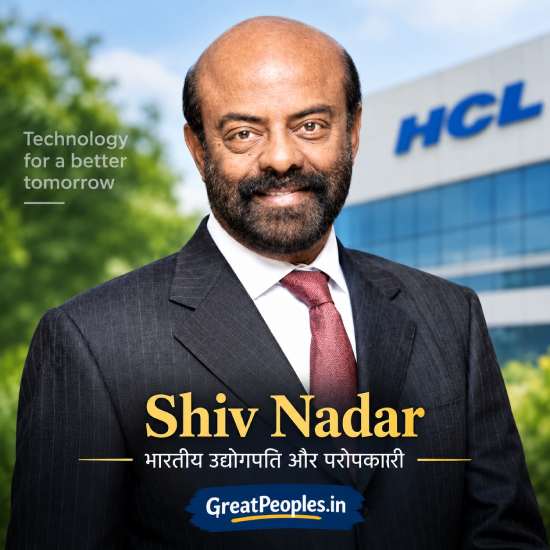
शिव नादर
| जन्म तिथि | 14 July 1945 |
| उम्र | 81 वर्ष (2026) |
| राशि | कर्क राशि |
| जन्म स्थान | भारत के तमिलनाडु राज्य के थूथुकुडी जिले में मूलाइपोझी गाँव |
| निवास स्थान | नई दिल्ली, भारत (कंपनी का मुख्यालय नोएडा में है) |
| पिता | शिवसुब्रमण्य नादर |
| माता | वामासुंदरी देवी |
| वजन | 81 किलोग्राम |
| जीवनसंगी | किरण नादर |
| बच्चे | एक पुत्री, रोशनी नादर मल्होत्रा (वर्तमान में HCL की अध्यक्ष) |
| शिक्षा | कुंभकोणम के टाउन हायर सेकेंडरी स्कूल |
| कॉलेज | PSG कॉलेज ऑफ टेक्नोलॉजी, कोयंबटूर |
| योग्यता | इलेक्ट्रिकल और इलेक्ट्रॉनिक्स इंजीनियरिंग में डिग्री |
| पेशा | HCL समूह के संस्थापक |
| रुचियाँ | शिव नादर को फिल्में देखने का शौक है, और उनके पास लगभग 4,000 फिल्मों का व्यक्तिगत संग्रह है |
| राष्ट्रीयता | भारतीय |
| धर्म | हिंदू |
| पुरस्कार | पद्म भूषण, 2008 |
| नेट वर्थ | अक्टूबर 2024 तक लगभग 42 अरब अमेरिकी डॉलर |
शिव नादर का जीवन परिचय (Shiv Nadar Biography in Hindi)——
भारतीय उद्योगपति, HCL समूह के संस्थापक और शिक्षाविद् एवं परोपकारी कार्यों के लिए प्रसिद्ध व्यक्तित्व
शिव नादर भारत के उन प्रमुख उद्योगपतियों में से एक हैं, जिन्होंने कंप्यूटर और सूचना प्रौद्योगिकी के क्षेत्र में भारतीय उद्यमिता को एक नई पहचान दिलाने में महत्वपूर्ण भूमिका निभाई। वे HCL समूह के संस्थापक हैं और भारत में कंप्यूटर उद्योग के शुरुआती अग्रदूतों में गिने जाते हैं। उन्होंने ऐसे समय में तकनीकी व्यवसाय की नींव रखी, जब भारत में कंप्यूटर तकनीक आज की तरह आम नहीं थी और इस क्षेत्र में कारोबार शुरू करना एक बड़ी चुनौती माना जाता था।
शिव नादर की कहानी केवल एक सफल कारोबारी की कहानी नहीं है। यह तकनीकी दूरदर्शिता, जोखिम उठाने की क्षमता, टीम के साथ काम करने, बदलते समय को समझने और शिक्षा के माध्यम से समाज में बदलाव लाने के प्रयासों की कहानी भी है। उन्होंने 1976 में HCL की स्थापना की और इसे कंप्यूटर हार्डवेयर से लेकर सॉफ्टवेयर, इंजीनियरिंग तथा वैश्विक सूचना प्रौद्योगिकी सेवाओं तक विकसित होते देखा।
व्यवसाय के साथ-साथ शिव नादर ने शिक्षा और सामाजिक विकास को भी अपने जीवन का महत्वपूर्ण उद्देश्य बनाया। वर्ष 1994 में उन्होंने शिव नादर फाउंडेशन की स्थापना की। इस संस्था के माध्यम से उन्होंने विद्यालयों, विश्वविद्यालयों, इंजीनियरिंग शिक्षा, ग्रामीण प्रतिभाओं के विकास और कला के क्षेत्र में दीर्घकालिक योगदान देने का प्रयास किया है। फाउंडेशन की आधिकारिक जानकारी के अनुसार, मार्च 2026 तक इसके माध्यम से शिक्षा और संस्थान निर्माण के लिए लगभग 1.85 अरब अमेरिकी डॉलर का निवेश किया जा चुका था।
शिव नादर कौन हैं?——
शिव नादर एक भारतीय उद्योगपति और परोपकारी हैं, जिन्हें मुख्य रूप से HCL समूह की स्थापना के लिए जाना जाता है। HCL का पूरा नाम हिंदुस्तान कंप्यूटर्स लिमिटेड (Hindustan Computers Limited) है। कंपनी की शुरुआत भारत में कंप्यूटर हार्डवेयर और तकनीकी उत्पादों के विकास के उद्देश्य से हुई थी। समय के साथ इसका कारोबार सॉफ्टवेयर सेवाओं, इंजीनियरिंग, अनुसंधान और वैश्विक प्रौद्योगिकी समाधानों तक फैल गया।
शिव नादर की व्यावसायिक यात्रा की एक खास बात यह है कि उन्होंने कंप्यूटर को केवल एक महँगे औद्योगिक उपकरण के रूप में नहीं देखा। वे समझते थे कि माइक्रोप्रोसेसर और कंप्यूटिंग तकनीक भविष्य में कारोबार, शिक्षा, संचार और आम जीवन को बदल सकती है। इसी सोच ने उन्हें अपने सहयोगियों के साथ एक तकनीकी कंपनी स्थापित करने के लिए प्रेरित किया।
HCL के शुरुआती वर्षों में भारतीय बाजार में कंप्यूटर निर्माण और तकनीकी उत्पादों के विकास की संभावनाएँ सीमित दिखाई देती थीं। इसके बावजूद शिव नादर और उनकी टीम ने स्वदेशी तकनीकी क्षमता विकसित करने पर जोर दिया। कंपनी ने आगे चलकर हार्डवेयर से सॉफ्टवेयर सेवाओं की ओर विस्तार किया और अंतरराष्ट्रीय ग्राहकों के साथ काम करना शुरू किया।
शिव नादर की दूसरी प्रमुख पहचान शिक्षा के क्षेत्र में उनके योगदान से जुड़ी है। उनका मानना रहा है कि गुणवत्तापूर्ण शिक्षा किसी व्यक्ति के जीवन के साथ-साथ पूरे समाज की दिशा बदल सकती है। इसी विचार को संस्थागत रूप देने के लिए उन्होंने शिव नादर फाउंडेशन की स्थापना की।
आज उनका नाम तीन प्रमुख क्षेत्रों के साथ जुड़ा हुआ है:
तकनीकी उद्यमिता: भारत में कंप्यूटर और सूचना प्रौद्योगिकी उद्योग के विकास में योगदान।
संस्थागत निर्माण: HCL जैसे बड़े तकनीकी समूह की स्थापना और विकास।
शिक्षा एवं परोपकार: विद्यालयों, विश्वविद्यालयों, छात्रवृत्ति और कला से जुड़ी पहलों को समर्थन।
HCLTech की आधिकारिक नेतृत्व जानकारी में उन्हें HCL समूह का संस्थापक, शिव नादर फाउंडेशन का संस्थापक तथा HCLTech का चेयरमैन एमेरिटस एवं बोर्ड का रणनीतिक सलाहकार बताया गया है।
शिव नादर का जन्म और प्रारंभिक जीवन——
शिव नादर का जन्म 14 जुलाई 1945 को हुआ था। उनका संबंध तमिलनाडु के एक ऐसे सामाजिक और सांस्कृतिक परिवेश से रहा, जहाँ शिक्षा, पारिवारिक संस्कार और मेहनत को जीवन में महत्वपूर्ण स्थान दिया जाता था। उनका बचपन स्वतंत्रता प्राप्ति के बाद के भारत में बीता। यह वह समय था जब देश औद्योगिक विकास, वैज्ञानिक अनुसंधान और आधुनिक तकनीक के क्षेत्र में अपनी क्षमताओं को विकसित करने की दिशा में आगे बढ़ रहा था।
भारत ने 1947 में स्वतंत्रता प्राप्त की थी। इसके बाद देश के सामने आर्थिक विकास, रोजगार, औद्योगिकीकरण और शिक्षा के विस्तार जैसी अनेक चुनौतियाँ थीं। उस समय कंप्यूटर तकनीक आम लोगों की पहुँच से बहुत दूर थी। आधुनिक डिजिटल उपकरणों का उपयोग मुख्यतः बड़े संस्थानों, वैज्ञानिक संगठनों और कुछ औद्योगिक प्रतिष्ठानों तक सीमित था।
ऐसे वातावरण में पले-बढ़े शिव नादर ने शिक्षा प्राप्त की और धीरे-धीरे विज्ञान तथा तकनीक के क्षेत्र में रुचि विकसित की। उनके जीवन के शुरुआती वर्षों के बारे में सार्वजनिक स्रोतों में बहुत अधिक व्यक्तिगत जानकारी उपलब्ध नहीं है। इसलिए उनके बचपन की ऐसी घटनाओं को तथ्य के रूप में प्रस्तुत करना उचित नहीं होगा, जिनकी विश्वसनीय पुष्टि उपलब्ध नहीं है।
हालाँकि, उनकी आगे की व्यावसायिक यात्रा से यह स्पष्ट होता है कि उन्होंने शिक्षा, तकनीकी ज्ञान और व्यावहारिक अनुभव को अपने जीवन में महत्वपूर्ण स्थान दिया।
शिव नादर का जीवन उस पीढ़ी का प्रतिनिधित्व करता है जिसने भारत में आधुनिक कंप्यूटर उद्योग को आकार लेते हुए देखा। उनके लिए तकनीकी उद्यमिता केवल व्यापार शुरू करने का माध्यम नहीं थी, बल्कि एक ऐसे क्षेत्र में काम करने का अवसर भी थी, जिसमें आने वाले दशकों में व्यापक परिवर्तन की संभावना थी।
बचपन के परिवेश का उनके व्यक्तित्व पर प्रभाव——
किसी भी व्यक्ति के व्यक्तित्व के निर्माण में उसका पारिवारिक वातावरण, शिक्षा, सामाजिक परिस्थितियाँ और आसपास उपलब्ध अवसर महत्वपूर्ण भूमिका निभाते हैं। शिव नादर के मामले में भी शिक्षा और ज्ञान का महत्व उनके बाद के जीवन में स्पष्ट रूप से दिखाई देता है।
उन्होंने अपनी सफलता के संदर्भ में शिक्षा और छात्रवृत्ति से मिले अवसरों को महत्वपूर्ण माना है। यही कारण है कि आगे चलकर उन्होंने शिक्षा के क्षेत्र में बड़े पैमाने पर निवेश किया।
उनके जीवन में शिक्षा का महत्व केवल व्यक्तिगत सफलता तक सीमित नहीं रहा। उन्होंने शिक्षा को सामाजिक परिवर्तन का एक साधन माना और ऐसे संस्थानों के निर्माण का समर्थन किया, जो लंबे समय तक विद्यार्थियों को अवसर प्रदान कर सकें।
शिव नादर की शिक्षा——
शिव नादर की शिक्षा उनके जीवन का एक महत्वपूर्ण हिस्सा रही। उन्होंने तमिलनाडु में स्कूली शिक्षा प्राप्त की और आगे चलकर इंजीनियरिंग की पढ़ाई की। तकनीकी शिक्षा ने उनके भविष्य के व्यावसायिक जीवन के लिए आधार तैयार किया।
उनकी शिक्षा से संबंधित विवरणों में तिरुचिरापल्ली के सेंट जोसेफ बॉयज हायर सेकेंडरी स्कूल और मदुरै के अमेरिकन कॉलेज का उल्लेख मिलता है। इसके बाद उन्होंने इलेक्ट्रिकल एवं इलेक्ट्रॉनिक्स इंजीनियरिंग के क्षेत्र में अध्ययन किया।
उनकी शिक्षा से जुड़ी एक महत्वपूर्ण बात यह है कि उन्होंने तकनीकी विषयों का ज्ञान प्राप्त करने के बाद सीधे उद्यमिता की दिशा में कदम नहीं बढ़ाया। उन्होंने पहले उद्योग में काम किया, व्यावसायिक प्रक्रियाओं को समझा और फिर अपने सहयोगियों के साथ स्वतंत्र व्यवसाय स्थापित किया।
तकनीकी शिक्षा का महत्व——
इंजीनियरिंग की शिक्षा ने शिव नादर को तकनीक के मूलभूत सिद्धांतों को समझने में सहायता की। उस दौर में इलेक्ट्रॉनिक्स और कंप्यूटर तकनीक तेजी से विकसित हो रही थी। माइक्रोप्रोसेसर के विकास ने कंप्यूटर उद्योग के लिए नए अवसर पैदा किए।
माइक्रोप्रोसेसर एक ऐसा इलेक्ट्रॉनिक घटक है, जो कंप्यूटर और अनेक डिजिटल उपकरणों में केंद्रीय प्रसंस्करण इकाई के रूप में कार्य करता है। इसके विकास ने कंप्यूटरों को अधिक छोटे, व्यावहारिक और विभिन्न कार्यों के लिए उपयोगी बनाने में महत्वपूर्ण भूमिका निभाई।
शिव नादर और उनके सहयोगियों ने इसी तकनीकी परिवर्तन में व्यावसायिक अवसर देखा। उनकी इंजीनियरिंग पृष्ठभूमि ने उन्हें तकनीकी उत्पादों और औद्योगिक आवश्यकताओं के बीच संबंध समझने में मदद की।
शिक्षा से मिली सीख——
शिव नादर की शिक्षा संबंधी सोच उनके परोपकारी कार्यों में भी दिखाई देती है। उन्होंने आगे चलकर ऐसे संस्थानों के निर्माण का समर्थन किया, जहाँ विद्यार्थियों को केवल परीक्षा पास करने तक सीमित शिक्षा न मिले, बल्कि उनमें शोध, रचनात्मकता, नेतृत्व और समस्या समाधान की क्षमता भी विकसित हो।
उनकी शैक्षिक पहलों का उद्देश्य विभिन्न सामाजिक और आर्थिक पृष्ठभूमियों से आने वाले विद्यार्थियों को गुणवत्तापूर्ण शिक्षा उपलब्ध कराना रहा है।
इस प्रकार उनकी अपनी शिक्षा ने न केवल उनके व्यावसायिक जीवन को दिशा दी, बल्कि उनके सामाजिक योगदान के विचारों को भी प्रभावित किया।
नौकरी से करियर की शुरुआत——
शिव नादर ने अपने करियर की शुरुआत नौकरी से की थी। वे दिल्ली क्लॉथ एंड जनरल मिल्स यानी DCM में मैनेजमेंट ट्रेनी के रूप में शामिल हुए। उस समय DCM भारत के प्रमुख औद्योगिक व्यावसायिक समूहों में गिना जाता था।
DCM में काम करने का अनुभव उनके लिए महत्वपूर्ण साबित हुआ। यहाँ उन्हें एक बड़े संगठन की कार्यप्रणाली, प्रबंधन, कारोबारी निर्णयों और उद्योग की व्यावहारिक आवश्यकताओं को समझने का अवसर मिला।
नौकरी के दौरान उनकी मुलाकात ऐसे कई लोगों से हुई, जो आगे चलकर HCL की स्थापना में उनके सहयोगी बने। इन सहयोगियों के साथ उन्होंने कंप्यूटर तकनीक के भविष्य पर विचार किया और एक स्वतंत्र तकनीकी कंपनी स्थापित करने की दिशा में काम शुरू किया।
नौकरी छोड़ने का निर्णय——
किसी स्थापित कंपनी में नौकरी करना और अपनी कंपनी शुरू करना दो अलग-अलग प्रकार के निर्णय होते हैं। नौकरी में व्यक्ति को एक निर्धारित संगठनात्मक ढाँचे के भीतर काम करना होता है, जबकि उद्यमिता में बाजार, पूँजी, उत्पाद, ग्राहक और कर्मचारियों से जुड़ी अनेक जिम्मेदारियाँ स्वयं उठानी पड़ती हैं।
शिव नादर और उनके सहयोगियों ने नौकरी छोड़कर अपना व्यवसाय शुरू करने का निर्णय लिया। यह निर्णय ऐसे समय में लिया गया, जब भारत में निजी कंप्यूटर उद्योग अभी शुरुआती अवस्था में था।
उनके सामने कई चुनौतियाँ थीं:
नए तकनीकी उत्पादों के लिए बाजार विकसित करना।
सीमित संसाधनों के साथ कंपनी शुरू करना।
तकनीकी प्रतिभाओं को एक साथ लाना।
ग्राहकों का विश्वास हासिल करना।
तेजी से बदलती कंप्यूटर तकनीक के अनुरूप काम करना।
इन परिस्थितियों के बावजूद उन्होंने अपने विचार को व्यावसायिक रूप देने का प्रयास किया।
HCL की स्थापना कैसे हुई?——
शिव नादर के जीवन की सबसे महत्वपूर्ण उपलब्धियों में HCL की स्थापना शामिल है। वर्ष 1976 में उन्होंने अपने सहयोगियों के साथ हिंदुस्तान कंप्यूटर्स लिमिटेड की शुरुआत की।
कंपनी की स्थापना का उद्देश्य भारत में कंप्यूटर तकनीक से जुड़े उत्पादों और समाधानों का विकास करना था। उस समय कंप्यूटर उद्योग में प्रवेश करना आसान नहीं था। तकनीकी संसाधनों की उपलब्धता, बाजार की सीमाएँ और आधुनिक इलेक्ट्रॉनिक उपकरणों के निर्माण की जटिलताएँ बड़ी चुनौतियाँ थीं।
HCL की शुरुआत दिल्ली में एक छोटे कार्यालय से हुई थी। शिव नादर फाउंडेशन की आधिकारिक जीवनी में इसके शुरुआती कार्यालय की तुलना एक छोटे स्टार्टअप से की गई है। यह विवरण उस दौर की सीमित परिस्थितियों और संस्थापकों की महत्वाकांक्षा को दर्शाता है।
HCL नाम का अर्थ——
HCL का पूरा नाम Hindustan Computers Limited था। हिंदी में इसे हिंदुस्तान कंप्यूटर्स लिमिटेड कहा जा सकता है।
कंपनी के नाम से ही उसके शुरुआती उद्देश्य का संकेत मिलता है। वह भारत में कंप्यूटर तकनीक और उससे जुड़े उत्पादों के विकास पर ध्यान केंद्रित करना चाहती थी।
बाद में HCL समूह का कारोबार कई क्षेत्रों में फैला। HCL Technologies, जिसे आज HCLTech के नाम से जाना जाता है, समूह की प्रमुख प्रौद्योगिकी सेवाओं से जुड़ी कंपनी बनी।
HCL की स्थापना के पीछे विचार——
शिव नादर और उनकी टीम का मानना था कि माइक्रोप्रोसेसर तकनीक भविष्य में कंप्यूटर उद्योग को बदल देगी। उस समय बड़े कंप्यूटरों की तुलना में छोटे कंप्यूटरों और माइक्रोप्रोसेसर आधारित प्रणालियों के विकास में नई संभावनाएँ दिखाई दे रही थीं।
कंपनी ने इसी बदलाव को ध्यान में रखते हुए तकनीकी उत्पादों के विकास की दिशा में काम किया।
यह निर्णय महत्वपूर्ण था, क्योंकि कंप्यूटर तकनीक में होने वाले बदलावों ने आने वाले दशकों में उद्योग, बैंकिंग, संचार, शिक्षा और व्यापार के काम करने के तरीकों को बदल दिया।
शुरुआती चुनौतियाँ——
HCL के शुरुआती दौर को समझने के लिए उस समय के भारतीय तकनीकी बाजार को ध्यान में रखना आवश्यक है।
आज कंप्यूटर, स्मार्टफोन और इंटरनेट सामान्य जीवन का हिस्सा हैं। लेकिन 1970 के दशक में कंप्यूटरों का उपयोग सीमित था। आधुनिक तकनीकी उपकरणों की लागत अधिक थी और उनका उपयोग मुख्य रूप से संस्थागत आवश्यकताओं के लिए किया जाता था।
किसी भारतीय कंपनी के लिए कंप्यूटर उत्पादों का निर्माण करना तकनीकी विशेषज्ञता, पूँजी और बाजार की समझ की माँग करता था।
शिव नादर ने अपने सहयोगियों के साथ इन चुनौतियों का सामना किया। कंपनी ने तकनीकी उत्पादों के विकास और नए बाजारों की संभावनाओं पर काम जारी रखा।
HCL के शुरुआती तकनीकी उत्पाद——
HCL के शुरुआती वर्षों में कंप्यूटर हार्डवेयर और स्वदेशी तकनीकी उत्पादों का विकास महत्वपूर्ण रहा। कंपनी ने भारत में कंप्यूटर निर्माण की क्षमताओं को विकसित करने पर ध्यान दिया।
उस समय कंप्यूटर उद्योग में तकनीकी बदलाव तेजी से हो रहे थे। माइक्रोप्रोसेसर आधारित प्रणालियों ने कंप्यूटरों के आकार, लागत और उपयोग की संभावनाओं को प्रभावित किया।
HCL ने इन तकनीकी अवसरों को ध्यान में रखते हुए उत्पादों के विकास में निवेश किया।
1978 का कंप्यूटर——
HCL के इतिहास में 1978 का वर्ष विशेष रूप से उल्लेखनीय है। कंपनी की आधिकारिक ऐतिहासिक सामग्री में माइक्रोप्रोसेसर आधारित कंप्यूटर के शुरुआती विकास का उल्लेख मिलता है।
यह उस समय के भारतीय तकनीकी उद्योग के लिए महत्वपूर्ण कदम था। देश में कंप्यूटर तकनीक को विकसित करने के प्रयासों ने आगे चलकर घरेलू तकनीकी उद्योग के विस्तार में योगदान दिया।
तकनीकी आत्मनिर्भरता की दिशा में प्रयास——
स्वदेशी कंप्यूटर उत्पादों के विकास का महत्व केवल किसी एक कंपनी की व्यावसायिक सफलता तक सीमित नहीं था। इससे भारतीय इंजीनियरों और तकनीकी विशेषज्ञों को उत्पाद निर्माण, डिजाइन और तकनीकी समस्याओं के समाधान में अनुभव प्राप्त करने का अवसर मिला।
तकनीकी उत्पादों का विकास एक ऐसी प्रक्रिया है, जिसमें हार्डवेयर, सॉफ्टवेयर, इलेक्ट्रॉनिक्स और औद्योगिक प्रबंधन के विभिन्न पहलुओं को एक साथ काम करना पड़ता है।
HCL ने इन क्षेत्रों में अपनी क्षमताओं को विकसित किया और आगे चलकर अपने कारोबार का विस्तार किया।
भारत में कंप्यूटर उद्योग के विकास में भूमिका——
शिव नादर को भारतीय कंप्यूटर उद्योग के शुरुआती अग्रदूतों में गिना जाता है। उनके नेतृत्व में HCL ने हार्डवेयर से शुरुआत की और बाद में सॉफ्टवेयर तथा तकनीकी सेवाओं की दिशा में विस्तार किया।
इस विकास ने भारतीय तकनीकी कंपनियों के लिए नए व्यावसायिक अवसरों के द्वार खोले।
HCL का विस्तार और बदलता कारोबारी मॉडल——
HCL की विकास यात्रा का एक महत्वपूर्ण पहलू उसका बदलता कारोबारी मॉडल है। शुरुआत में कंपनी का ध्यान कंप्यूटर हार्डवेयर और तकनीकी उत्पादों पर था। लेकिन समय के साथ सूचना प्रौद्योगिकी सेवाओं की माँग बढ़ने लगी।
कंपनी ने इस बदलाव के अनुरूप अपने कारोबार को विकसित किया।
तकनीकी क्षेत्र में किसी कंपनी की सफलता के लिए केवल एक उत्पाद बनाना पर्याप्त नहीं होता। उसे ग्राहकों की बदलती जरूरतों, तकनीकी प्रगति, प्रतिस्पर्धा और वैश्विक बाजार की परिस्थितियों के अनुसार स्वयं को विकसित करना पड़ता है।
HCL ने भी अपने कारोबारी मॉडल में बदलाव किए।
हार्डवेयर से सॉफ्टवेयर सेवाओं तक——
कंप्यूटर हार्डवेयर के विकास के बाद HCL ने सॉफ्टवेयर और सूचना प्रौद्योगिकी सेवाओं की दिशा में विस्तार किया।
सॉफ्टवेयर सेवाओं में विभिन्न प्रकार के कार्य शामिल होते हैं, जैसे:
कंप्यूटर प्रोग्राम और व्यावसायिक एप्लिकेशन विकसित करना।
कंपनियों के तकनीकी सिस्टम का रखरखाव।
डेटा प्रबंधन और डिजिटल प्रणालियों का संचालन।
इंजीनियरिंग और अनुसंधान से जुड़ी सेवाएँ।
तकनीकी परामर्श और डिजिटल परिवर्तन।
इन सेवाओं की माँग बढ़ने के साथ HCL ने अंतरराष्ट्रीय बाजारों में अपनी उपस्थिति विकसित की।
वैश्विक साझेदारियाँ——
शिव नादर ने कारोबार के विस्तार में साझेदारियों को महत्वपूर्ण माना। HCL ने विभिन्न अंतरराष्ट्रीय कंपनियों के साथ सहयोग किया, जिससे उसे नई तकनीकों, बाजारों और व्यावसायिक अवसरों तक पहुँच मिली।
HCL के इतिहास में Hewlett-Packard, Cisco और अन्य वैश्विक संगठनों के साथ साझेदारियों का उल्लेख मिलता है। इन संबंधों ने कंपनी के तकनीकी और व्यावसायिक विस्तार में भूमिका निभाई।
अंतरराष्ट्रीय बाजार में प्रवेश——
अंतरराष्ट्रीय बाजार में काम करने के लिए किसी कंपनी को विभिन्न देशों के ग्राहकों की आवश्यकताओं, तकनीकी मानकों और कारोबारी परिस्थितियों को समझना पड़ता है।
HCL ने समय के साथ अपने वैश्विक कारोबार का विस्तार किया। इससे भारतीय तकनीकी पेशेवरों को अंतरराष्ट्रीय परियोजनाओं में काम करने के अवसर भी मिले।
भारत में सॉफ्टवेयर सेवाओं के विकास के साथ तकनीकी कंपनियों ने विदेशी ग्राहकों के लिए काम करना शुरू किया। इस प्रक्रिया ने देश के आईटी उद्योग को वैश्विक अर्थव्यवस्था से जोड़ने में योगदान दिया।
HCLTech और आधुनिक सूचना प्रौद्योगिकी उद्योग——
HCLTech, HCL समूह की प्रमुख वैश्विक प्रौद्योगिकी सेवाओं से जुड़ी कंपनी है। इसका काम सॉफ्टवेयर, डिजिटल परिवर्तन, इंजीनियरिंग, क्लाउड, साइबर सुरक्षा और अन्य तकनीकी सेवाओं तक फैला हुआ है।
कंपनी की मौजूदा संरचना को समझने के लिए यह अंतर ध्यान में रखना जरूरी है कि HCL समूह और HCLTech एक ही नाम के दो अलग-अलग संदर्भ हैं। HCL समूह एक व्यापक कारोबारी समूह है, जबकि HCLTech एक विशिष्ट वैश्विक प्रौद्योगिकी कंपनी है।
शिव नादर ने HCL की स्थापना की और उसके विकास में केंद्रीय भूमिका निभाई। आगे चलकर कंपनी ने अलग-अलग व्यावसायिक क्षेत्रों में विस्तार किया।
तकनीकी सेवाओं की बदलती दुनिया——
सूचना प्रौद्योगिकी उद्योग में पिछले कुछ दशकों में व्यापक परिवर्तन हुए हैं।
पहले कंपनियों की तकनीकी जरूरतें मुख्य रूप से कंप्यूटर हार्डवेयर, स्थानीय नेटवर्क और बुनियादी सॉफ्टवेयर तक सीमित थीं। बाद में इंटरनेट, क्लाउड कंप्यूटिंग, मोबाइल तकनीक, डेटा विश्लेषण और कृत्रिम बुद्धिमत्ता ने इस क्षेत्र का विस्तार किया।
आज तकनीकी कंपनियाँ ग्राहकों को केवल सॉफ्टवेयर उपलब्ध नहीं करातीं, बल्कि उनके पूरे डिजिटल ढाँचे के निर्माण और संचालन में सहायता करती हैं।
HCLTech भी इसी व्यापक उद्योग का हिस्सा है।
अनुसंधान और इंजीनियरिंग——
शिव नादर की व्यावसायिक सोच में इंजीनियरिंग और अनुसंधान का महत्व रहा है। तकनीकी क्षेत्र में दीर्घकालिक प्रतिस्पर्धा बनाए रखने के लिए नए ज्ञान, प्रशिक्षित कर्मचारियों और उत्पाद विकास की क्षमता आवश्यक होती है।
HCLTech ने इंजीनियरिंग और अनुसंधान से संबंधित सेवाओं में अपनी पहचान विकसित की है।
इस क्षेत्र में काम करने वाली कंपनियाँ विभिन्न उद्योगों के लिए उत्पाद डिजाइन, परीक्षण, सॉफ्टवेयर विकास और तकनीकी प्रणालियों के निर्माण में सहयोग करती हैं।
कंपनी में शिव नादर की वर्तमान भूमिका——
समय के साथ शिव नादर ने कंपनी के दैनिक प्रबंधन से अलग होकर वरिष्ठ मार्गदर्शक की भूमिका अपनाई।
HCLTech की आधिकारिक नेतृत्व जानकारी के अनुसार, वे चेयरमैन एमेरिटस और बोर्ड के रणनीतिक सलाहकार हैं। यह भूमिका कंपनी के संस्थापक के रूप में उनके अनुभव और दीर्घकालिक दृष्टिकोण से जुड़ी है।
शिव नादर की नेतृत्व शैली——
शिव नादर की नेतृत्व यात्रा में कुछ प्रमुख विषय बार-बार सामने आते हैं—तकनीकी दूरदर्शिता, टीम निर्माण, साझेदारी, शिक्षा और संस्थागत विकास।
उनकी नेतृत्व शैली को समझने के लिए HCL की स्थापना और उसके विस्तार के विभिन्न चरणों को देखना उपयोगी है।
भविष्य की तकनीक को पहचानना——
1970 के दशक में कंप्यूटर उद्योग आज की तुलना में बहुत छोटा था। ऐसे समय में माइक्रोप्रोसेसर आधारित कंप्यूटिंग में अवसर देखना एक महत्वपूर्ण कारोबारी निर्णय था।
शिव नादर और उनके सहयोगियों ने कंप्यूटर तकनीक के भविष्य को ध्यान में रखकर कंपनी की स्थापना की।
इससे यह सीख मिलती है कि किसी नए उद्योग में काम करने के लिए वर्तमान बाजार को समझने के साथ-साथ भविष्य में होने वाले बदलावों पर भी ध्यान देना आवश्यक होता है।
टीम के साथ काम करना——
HCL की स्थापना किसी एक व्यक्ति के अकेले प्रयास का परिणाम नहीं थी। शिव नादर ने अपने सहयोगियों के साथ मिलकर कंपनी शुरू की।
किसी तकनीकी कंपनी को विकसित करने में इंजीनियरों, प्रबंधकों, कर्मचारियों, ग्राहकों और साझेदारों की भूमिका होती है।
इसलिए HCL की कहानी में टीम निर्माण और सामूहिक प्रयास को महत्वपूर्ण स्थान दिया जाना चाहिए।
साझेदारी का महत्व——
तकनीकी उद्योग में साझेदारियाँ नए बाजारों और तकनीकी क्षमताओं तक पहुँच प्रदान कर सकती हैं।
HCL ने विभिन्न वैश्विक कंपनियों के साथ सहयोग किया। इन संबंधों ने कंपनी को अंतरराष्ट्रीय तकनीकी बाजार में अपनी स्थिति विकसित करने में सहायता की।
दीर्घकालिक सोच——
शिव नादर का योगदान केवल कंपनी स्थापित करने तक सीमित नहीं रहा। उन्होंने ऐसे संस्थानों के निर्माण पर भी ध्यान दिया, जिनका प्रभाव कई पीढ़ियों तक बना रह सके।
उनकी शिक्षा संबंधी पहलों में भी दीर्घकालिक संस्थागत विकास पर जोर दिखाई देता है।
ज्ञान और शिक्षा को महत्व——
शिव नादर ने शिक्षा को व्यक्तिगत और सामाजिक विकास का महत्वपूर्ण साधन माना है।
उनकी परोपकारी गतिविधियाँ इस विचार को दर्शाती हैं कि गुणवत्तापूर्ण शिक्षा से व्यक्तियों की क्षमताओं का विकास हो सकता है और समाज में नए अवसर पैदा किए जा सकते हैं।
शिव नादर फाउंडेशन की स्थापना——
शिव नादर के जीवन में वर्ष 1994 एक महत्वपूर्ण पड़ाव है। इसी वर्ष उन्होंने शिव नादर फाउंडेशन की स्थापना की।
फाउंडेशन का उद्देश्य शिक्षा के माध्यम से सामाजिक और आर्थिक असमानताओं को कम करने में योगदान देना है। संस्था गुणवत्तापूर्ण शिक्षा, नेतृत्व विकास, शोध और कला से संबंधित विभिन्न पहलों का समर्थन करती है।
फाउंडेशन की आधिकारिक वेबसाइट के अनुसार, इसकी स्थापना एक अधिक समान अवसरों वाले और योग्यता-आधारित समाज के निर्माण के उद्देश्य से की गई थी। संस्था शिक्षा को सामाजिक परिवर्तन का प्रभावशाली माध्यम मानती है।
फाउंडेशन की स्थापना के पीछे विचार——
शिव नादर ने अपने जीवन में शिक्षा से मिलने वाले अवसरों को महत्वपूर्ण माना। उनके अनुसार, शिक्षा व्यक्ति को अपनी क्षमताओं को पहचानने और उनका उपयोग करने का अवसर देती है।
लेकिन समाज में सभी विद्यार्थियों को समान गुणवत्ता वाली शिक्षा उपलब्ध नहीं होती। आर्थिक स्थिति, ग्रामीण या शहरी परिवेश और शैक्षिक संसाधनों की उपलब्धता किसी विद्यार्थी के अवसरों को प्रभावित कर सकती है।
फाउंडेशन का उद्देश्य इन अंतरालों को कम करने में योगदान देना है।
केवल आर्थिक सहायता नहीं, संस्थान निर्माण——
शिव नादर फाउंडेशन की एक विशेषता यह है कि यह केवल दान देने तक सीमित नहीं है। इसकी कार्यप्रणाली में शैक्षणिक संस्थानों की स्थापना और उनका दीर्घकालिक विकास महत्वपूर्ण है।
इस दृष्टिकोण को फाउंडेशन ‘क्रिएटिव फिलैंथ्रॉपी’ यानी रचनात्मक परोपकार कहता है।
इस मॉडल के अंतर्गत शिक्षा और सामाजिक विकास के लिए ऐसे संस्थान बनाए जाते हैं, जो लंबे समय तक काम करते रहें और लगातार नए विद्यार्थियों को अवसर प्रदान करें।
शिक्षा के विभिन्न स्तरों पर काम——
फाउंडेशन की पहलों में स्कूल शिक्षा, उच्च शिक्षा, तकनीकी शिक्षा, ग्रामीण विद्यार्थियों का विकास और कला से जुड़ी गतिविधियाँ शामिल हैं।
इन पहलों का उद्देश्य अलग-अलग आयु और सामाजिक पृष्ठभूमि के लोगों तक शैक्षिक अवसर पहुँचाना है।
SSN कॉलेज ऑफ इंजीनियरिंग——
SSN कॉलेज ऑफ इंजीनियरिंग तमिलनाडु में स्थित एक प्रमुख शैक्षणिक संस्थान है। इसकी स्थापना फाउंडेशन की शुरुआती पहलों में शामिल थी।
संस्थान का उद्देश्य विद्यार्थियों को इंजीनियरिंग और तकनीकी शिक्षा प्रदान करना है।
तकनीकी शिक्षा में अच्छे संस्थानों की भूमिका महत्वपूर्ण होती है, क्योंकि वे विद्यार्थियों को सैद्धांतिक ज्ञान के साथ प्रयोगशाला, परियोजना और अनुसंधान के अवसर भी उपलब्ध कराते हैं।
SSN संस्थान की स्थापना ने शिव नादर की शिक्षा संबंधी सोच को व्यावहारिक रूप देने में भूमिका निभाई।
शिव नादर विश्वविद्यालय, दिल्ली-एनसीआर——
शिव नादर विश्वविद्यालय दिल्ली-एनसीआर उच्च शिक्षा और अनुसंधान पर केंद्रित एक बहुविषयक विश्वविद्यालय है।
विश्वविद्यालय में विभिन्न शैक्षणिक क्षेत्रों में अध्ययन और शोध के अवसर उपलब्ध कराए जाते हैं।
बहुविषयक शिक्षा का अर्थ है कि विद्यार्थियों को केवल एक विषय तक सीमित न रखकर विभिन्न विषयों के बीच संबंध समझने के अवसर दिए जाएँ।
उदाहरण के लिए, आधुनिक तकनीकी समस्याओं को हल करने के लिए इंजीनियरिंग के साथ गणित, सामाजिक विज्ञान, अर्थशास्त्र और प्रबंधन की समझ भी उपयोगी हो सकती है।
विश्वविद्यालय का उद्देश्य शिक्षा, शोध और नवाचार को एक साथ बढ़ावा देना है।
शिव नादर विश्वविद्यालय, चेन्नई——
चेन्नई में स्थित शिव नादर विश्वविद्यालय भी उच्च शिक्षा के क्षेत्र में फाउंडेशन की पहल का हिस्सा है।
यह संस्थान विभिन्न शैक्षणिक विषयों में अध्ययन के अवसर प्रदान करता है।
चेन्नई लंबे समय से इंजीनियरिंग, तकनीकी शिक्षा और औद्योगिक गतिविधियों का एक महत्वपूर्ण केंद्र रहा है। ऐसे शहर में उच्च शिक्षा संस्थान का विकास विद्यार्थियों को शैक्षणिक और व्यावसायिक अवसरों से जोड़ सकता है।
विद्याज्ञान स्कूल——
विद्याज्ञान शिव नादर फाउंडेशन की उन पहलों में शामिल है, जिनका उद्देश्य ग्रामीण क्षेत्रों के प्रतिभाशाली विद्यार्थियों को गुणवत्तापूर्ण शिक्षा के अवसर उपलब्ध कराना है।
ग्रामीण क्षेत्रों में कई विद्यार्थियों में प्रतिभा और सीखने की क्षमता होती है, लेकिन उन्हें अच्छे शैक्षणिक संसाधनों तक पहुँचने में कठिनाइयों का सामना करना पड़ सकता है।
विद्याज्ञान इसी अंतर को कम करने की दिशा में काम करता है।
इस पहल में योग्य विद्यार्थियों को बेहतर शैक्षिक वातावरण, शिक्षकों का मार्गदर्शन और आगे की पढ़ाई के अवसर उपलब्ध कराने पर ध्यान दिया जाता है।
इसका व्यापक उद्देश्य ऐसे विद्यार्थियों को विकसित करना है, जो भविष्य में अपने परिवार, समुदाय और देश के विकास में योगदान दे सकें।
शिव नादर स्कूल——
शिव नादर स्कूल विद्यालयी शिक्षा के क्षेत्र में फाउंडेशन की पहल है।
इसका उद्देश्य विद्यार्थियों में जिज्ञासा, रचनात्मकता, स्वतंत्र चिंतन और सीखने की क्षमता विकसित करना है।
विद्यालयी शिक्षा केवल पाठ्यपुस्तकों और परीक्षाओं तक सीमित नहीं होनी चाहिए। विद्यार्थियों को खेल, कला, विज्ञान, संवाद और व्यावहारिक गतिविधियों के माध्यम से भी सीखने का अवसर मिलना चाहिए।
शिव नादर स्कूल की शैक्षणिक सोच में विद्यार्थी-केंद्रित शिक्षा का महत्व है।
किरण नादर म्यूजियम ऑफ आर्ट——
किरण नादर म्यूजियम ऑफ आर्ट भारत में आधुनिक और समकालीन कला को बढ़ावा देने वाला एक महत्वपूर्ण संस्थान है।
इसका नाम शिव नादर की पत्नी किरण नादर के नाम पर है, जो कला संग्रह और कला संरक्षण के क्षेत्र में सक्रिय रही हैं।
कला संग्रहालयों की भूमिका केवल कलाकृतियों को सुरक्षित रखने तक सीमित नहीं होती। वे कलाकारों, विद्यार्थियों, शोधकर्ताओं और आम दर्शकों को कला से जुड़ने का अवसर भी देते हैं।
इस प्रकार शिव नादर परिवार की परोपकारी गतिविधियाँ शिक्षा के साथ-साथ कला और संस्कृति के क्षेत्र तक भी फैली हुई हैं।
शिक्षा से जुड़ी अन्य पहलें——
फाउंडेशन की अन्य पहलों में साक्षरता और शिक्षकों के विकास से संबंधित कार्यक्रम भी शामिल हैं।
इन पहलों का उद्देश्य शिक्षा की गुणवत्ता को बढ़ाना और अधिक लोगों तक सीखने के अवसर पहुँचाना है।
फाउंडेशन की आधिकारिक वेबसाइट पर SSN कॉलेज ऑफ इंजीनियरिंग, विद्याज्ञान, शिव नादर विश्वविद्यालय, शिव नादर स्कूल, किरण नादर म्यूजियम ऑफ आर्ट और शिक्षा से जुड़ी अन्य पहलों का उल्लेख किया गया है।
शिव नादर की परोपकार संबंधी सोच——
शिव नादर की परोपकार संबंधी सोच का केंद्र शिक्षा और संस्थागत विकास है। वे शिक्षा को ऐसा माध्यम मानते हैं, जो किसी व्यक्ति के जीवन में परिवर्तन लाने के साथ-साथ उसके परिवार और समुदाय को भी प्रभावित कर सकता है।
उनके दृष्टिकोण में परोपकार का अर्थ केवल तत्काल सहायता देना नहीं, बल्कि ऐसे अवसरों का निर्माण करना भी है, जिनसे लोग लंबे समय तक लाभान्वित हो सकें।
शिक्षा को सामाजिक परिवर्तन का माध्यम मानना——
शिक्षा किसी व्यक्ति को ज्ञान, कौशल और निर्णय लेने की क्षमता प्रदान करती है। इससे उसके रोजगार, आर्थिक स्थिति और सामाजिक भागीदारी के अवसर प्रभावित हो सकते हैं।
जब गुणवत्तापूर्ण शिक्षा उन विद्यार्थियों तक पहुँचती है, जिन्हें पहले सीमित अवसर मिले थे, तो इसका प्रभाव व्यक्तिगत उपलब्धियों से आगे बढ़ सकता है।
शिव नादर फाउंडेशन की शैक्षिक पहलों में इसी विचार को महत्व दिया गया है।
दीर्घकालिक निवेश——
फाउंडेशन के अनुसार, मार्च 2026 तक शिव नादर ने इसके माध्यम से लगभग 1.83 से 1.85 अरब अमेरिकी डॉलर की राशि शिक्षा और संस्थान निर्माण के लिए समर्पित की थी। अलग-अलग आधिकारिक पृष्ठों पर प्रकाशित आँकड़ों में मामूली अंतर दिखाई देता है।
यह राशि उनके परोपकारी कार्यों के बड़े पैमाने को दर्शाती है।
हालाँकि, परोपकार के प्रभाव का मूल्यांकन केवल खर्च की गई राशि से नहीं किया जा सकता। इसके लिए यह देखना भी आवश्यक है कि कितने विद्यार्थियों को शिक्षा मिली, उनकी शैक्षणिक प्रगति कैसी रही और उन्हें आगे कौन-कौन से अवसर प्राप्त हुए।
संस्थानों की निरंतरता——
शिव नादर फाउंडेशन का संस्थान-निर्माण मॉडल इस विचार पर आधारित है कि शिक्षा के लिए बनाए गए संस्थान लंबे समय तक काम करें।
इसका अर्थ है कि संस्थानों को केवल स्थापना के समय संसाधन उपलब्ध कराना पर्याप्त नहीं है। उन्हें योग्य शिक्षक, प्रशासन, शैक्षणिक कार्यक्रम, शोध सुविधाएँ और निरंतर वित्तीय सहायता भी चाहिए।
ऐसी व्यवस्था से संस्थान भविष्य में भी विद्यार्थियों को अवसर प्रदान कर सकते हैं।
शिव नादर की कुल संपत्ति और कमाई——
शिव नादर भारत के प्रमुख अरबपतियों में शामिल रहे हैं। उनकी संपत्ति का बड़ा हिस्सा HCL समूह से जुड़ी हिस्सेदारी और कारोबारी परिसंपत्तियों से संबंधित है।
उनकी कुल संपत्ति का सटीक मूल्य समय के साथ बदलता रहता है। शेयर बाजार में कंपनियों के मूल्य, निवेश, हिस्सेदारी और अन्य आर्थिक परिस्थितियाँ किसी भी उद्योगपति की अनुमानित संपत्ति को प्रभावित करती हैं।
इसलिए शिव नादर की संपत्ति के बारे में किसी एक संख्या को स्थायी या निश्चित मानना उचित नहीं है।
संपत्ति के प्रमुख स्रोत——
उनकी संपत्ति के प्रमुख स्रोतों को व्यापक रूप से इस प्रकार समझा जा सकता है:
HCL समूह से संबंधित हिस्सेदारी।
HCLTech में प्रत्यक्ष या पारिवारिक निवेश से जुड़ी आर्थिक हिस्सेदारी।
अन्य व्यावसायिक निवेश और परिसंपत्तियाँ।
समय के साथ शेयरों के मूल्य में होने वाले बदलाव।
कंपनी का कारोबार और व्यक्तिगत संपत्ति अलग हैं——
यहाँ एक महत्वपूर्ण अंतर समझना आवश्यक है। किसी कंपनी का कुल बाजार मूल्य और उसके संस्थापक की व्यक्तिगत संपत्ति एक ही चीज नहीं होती।
उदाहरण के लिए, यदि किसी कंपनी का बाजार मूल्य बढ़ता है, तो उसमें हिस्सेदारी रखने वाले निवेशकों की संपत्ति का अनुमान भी बढ़ सकता है। लेकिन कंपनी का पूरा बाजार मूल्य संस्थापक की निजी संपत्ति नहीं माना जा सकता।
इसी तरह, कंपनी की वार्षिक आय और व्यक्तिगत कमाई भी अलग-अलग अवधारणाएँ हैं।
क्या शिव नादर भारत के सबसे अमीर व्यक्ति हैं?——
भारत के सबसे अमीर व्यक्तियों की सूची समय के साथ बदलती रहती है। विभिन्न आर्थिक प्रकाशन अपनी अलग-अलग गणना पद्धतियों के आधार पर संपत्ति का अनुमान लगाते हैं।
किसी व्यक्ति की स्थिति शेयर बाजार, निवेश और अन्य परिसंपत्तियों के मूल्य के अनुसार ऊपर-नीचे हो सकती है।
इसलिए किसी विशेष तारीख और विश्वसनीय संपत्ति सूची के बिना शिव नादर को वर्तमान में भारत का सबसे अमीर व्यक्ति कहना उचित नहीं होगा।
संपत्ति का सामाजिक उपयोग——
शिव नादर के जीवन में संपत्ति का एक उल्लेखनीय पहलू उनका परोपकारी निवेश है। उन्होंने अपनी संपत्ति का बड़ा हिस्सा शिक्षा और संस्थान निर्माण से जुड़ी पहलों के लिए समर्पित किया है।
यह उनके व्यावसायिक जीवन और सामाजिक योगदान के बीच संबंध को दर्शाता है।
शिव नादर का पारिवारिक जीवन——

शिव नादर का पारिवारिक जीवन उनके सार्वजनिक व्यक्तित्व का एक महत्वपूर्ण हिस्सा है। उनकी पत्नी किरण नादर कला संग्रह और ब्रिज के क्षेत्र में जानी जाती हैं। उनकी बेटी रोशनी नादर मल्होत्रा HCL समूह के नेतृत्व में महत्वपूर्ण भूमिका निभाती हैं।
परिवार के सदस्यों ने अलग-अलग क्षेत्रों में अपनी पहचान बनाई है। जहाँ शिव नादर का प्रमुख योगदान तकनीकी उद्योग और शिक्षा के क्षेत्र में रहा है, वहीं किरण नादर ने कला और खेल तथा रोशनी नादर मल्होत्रा ने कॉर्पोरेट नेतृत्व और सामाजिक पहलों में काम किया है।
परिवार और व्यवसाय——
भारत में कई बड़े कारोबारी समूहों की तरह HCL समूह के विकास में भी परिवार की अगली पीढ़ी की भूमिका महत्वपूर्ण रही है।
हालाँकि, किसी कंपनी का विकास केवल पारिवारिक उत्तराधिकार से नहीं होता। इसके लिए पेशेवर प्रबंधन, तकनीकी विशेषज्ञता, कर्मचारियों और ग्राहकों के साथ संबंध तथा बदलती व्यावसायिक परिस्थितियों के अनुरूप निर्णय लेना आवश्यक होता है।
HCL समूह में नेतृत्व के विभिन्न स्तरों पर परिवार के सदस्यों और पेशेवर अधिकारियों की भूमिकाएँ अलग-अलग हैं।
शिव नादर की पत्नी किरण नादर——

किरण नादर भारतीय कला संग्रह, कला संरक्षण और परोपकार के क्षेत्र में प्रसिद्ध हैं। वे शिव नादर की पत्नी हैं और किरण नादर म्यूजियम ऑफ आर्ट से जुड़ी प्रमुख हस्ती हैं।
किरण नादर ने आधुनिक और समकालीन भारतीय कला को संरक्षित करने तथा लोगों तक पहुँचाने के लिए महत्वपूर्ण प्रयास किए हैं।
कला संग्रह में योगदान——
कला संग्रह का अर्थ केवल चित्रों और मूर्तियों को खरीदना नहीं है। इसमें कलाकृतियों का संरक्षण, कलाकारों के काम को पहचान देना, कला इतिहास को सुरक्षित रखना और नई पीढ़ी को कला से परिचित कराना भी शामिल है।
किरण नादर म्यूजियम ऑफ आर्ट इसी व्यापक उद्देश्य के साथ काम करता है।
ब्रिज खेल से संबंध——
किरण नादर अंतरराष्ट्रीय स्तर पर ब्रिज खेल से भी जुड़ी रही हैं। ब्रिज एक रणनीतिक कार्ड गेम है, जिसमें साझेदारों के बीच समन्वय, स्मरणशक्ति और विश्लेषणात्मक सोच महत्वपूर्ण होती है।
किरण नादर की पहचान कला और खेल दोनों क्षेत्रों में रही है।
पद्म श्री सम्मान——
किरण नादर को कला के क्षेत्र में उनके योगदान के लिए पद्म श्री से सम्मानित किया गया। यह भारत के प्रमुख नागरिक सम्मानों में से एक है।
उनका काम यह दर्शाता है कि परोपकार के माध्यम से कला और संस्कृति को भी सामाजिक जीवन में महत्वपूर्ण स्थान दिया जा सकता है।
शिव नादर की बेटी रोशनी नादर मल्होत्रा——
रोशनी नादर मल्होत्रा शिव नादर और किरण नादर की बेटी हैं। वे HCL समूह के नेतृत्व में महत्वपूर्ण भूमिका निभाती हैं।
उन्होंने उच्च शिक्षा प्राप्त की और आगे चलकर HCL के प्रबंधन तथा रणनीतिक नेतृत्व से जुड़ीं।
रोशनी नादर मल्होत्रा की भूमिका विशेष रूप से इसलिए महत्वपूर्ण है, क्योंकि उन्होंने एक बड़े तकनीकी समूह के नेतृत्व में जिम्मेदारी संभाली।
HCLTech में नेतृत्व——
रोशनी नादर मल्होत्रा HCLTech की चेयरपर्सन हैं। उनके नेतृत्व में कंपनी के रणनीतिक विकास, कारोबारी प्राथमिकताओं और दीर्घकालिक योजनाओं से संबंधित निर्णय लिए जाते हैं।
किसी वैश्विक तकनीकी कंपनी का नेतृत्व करना एक जटिल कार्य है। इसमें तकनीकी परिवर्तन, अंतरराष्ट्रीय प्रतिस्पर्धा, ग्राहक संबंध, प्रतिभा प्रबंधन और वित्तीय प्रदर्शन जैसे कई पहलू शामिल होते हैं।
शिक्षा और सामाजिक विकास——
रोशनी नादर मल्होत्रा शिव नादर फाउंडेशन से भी जुड़ी हैं। वे शिक्षा और सामाजिक विकास की पहलों में भूमिका निभाती हैं।
इसके अतिरिक्त, वे पर्यावरण संरक्षण से संबंधित गतिविधियों में भी सक्रिय रही हैं।
अगली पीढ़ी की भूमिका——
शिव नादर की व्यावसायिक यात्रा के बाद HCL समूह में अगली पीढ़ी का नेतृत्व भारतीय कारोबारी इतिहास का एक महत्वपूर्ण विषय है।
इस प्रक्रिया में संस्थापक की विरासत को बनाए रखने के साथ-साथ बदलते बाजार और नई तकनीकों के अनुरूप संगठन को विकसित करना भी आवश्यक है।
HCL समूह के नेतृत्व में रोशनी नादर मल्होत्रा की भूमिका इसी संदर्भ में देखी जा सकती है।
शिव नादर को मिले पुरस्कार और सम्मान——
शिव नादर को उद्योग, तकनीकी क्षेत्र और परोपकार में उनके योगदान के लिए विभिन्न सम्मान प्राप्त हुए हैं।
पद्म भूषण——
शिव नादर को वर्ष 2008 में भारत सरकार द्वारा पद्म भूषण से सम्मानित किया गया।
पद्म भूषण भारत के प्रमुख नागरिक सम्मानों में से एक है। यह विभिन्न क्षेत्रों में उल्लेखनीय योगदान देने वाले व्यक्तियों को प्रदान किया जाता है।
शिव नादर को यह सम्मान उद्योग और व्यापार के क्षेत्र में उनके योगदान के लिए दिया गया।
गोल्डन पीकॉक अवॉर्ड——
शिव नादर को 2014 में सोशल लीडरशिप के लिए गोल्डन पीकॉक अवॉर्ड से सम्मानित किए जाने का उल्लेख HCL समूह की आधिकारिक जानकारी में मिलता है।
यह सम्मान उनके सामाजिक योगदान और परोपकारी गतिविधियों से संबंधित था।
उद्योग और तकनीक में पहचान——
शिव नादर को भारतीय कंप्यूटर उद्योग के शुरुआती अग्रदूतों में गिना जाता है। HCL की स्थापना और उसके विकास ने उन्हें भारत के प्रमुख तकनीकी उद्यमियों में स्थान दिलाया।
उनकी पहचान केवल कंपनी के संस्थापक के रूप में नहीं, बल्कि शिक्षा और सामाजिक विकास के क्षेत्र में योगदान देने वाले परोपकारी के रूप में भी है।
शिव नादर का जीवन दर्शन——
शिव नादर के सार्वजनिक जीवन से कुछ प्रमुख विचार सामने आते हैं। इनमें शिक्षा का महत्व, तकनीकी नवाचार, टीम निर्माण और संस्थानों के दीर्घकालिक विकास पर जोर शामिल है।
शिक्षा जीवन बदल सकती है——
शिव नादर ने अपनी सफलता के संदर्भ में शिक्षा और छात्रवृत्ति से मिले अवसरों को महत्वपूर्ण माना है।
उनकी परोपकारी गतिविधियाँ इस विचार को दर्शाती हैं कि शिक्षा किसी व्यक्ति के जीवन की दिशा बदल सकती है।
अवसरों का विस्तार——
समाज में सभी लोगों को समान अवसर नहीं मिलते। आर्थिक और भौगोलिक परिस्थितियाँ विद्यार्थियों की शिक्षा को प्रभावित कर सकती हैं।
शिव नादर फाउंडेशन की विभिन्न पहलें ऐसे विद्यार्थियों तक गुणवत्तापूर्ण शिक्षा पहुँचाने का प्रयास करती हैं, जिन्हें अन्यथा सीमित अवसर मिल सकते हैं।
संस्थान बनाना——
शिव नादर की व्यावसायिक यात्रा और परोपकारी गतिविधियों में संस्थान निर्माण एक सामान्य विषय है।
HCL के माध्यम से उन्होंने एक तकनीकी व्यवसाय विकसित किया, जबकि फाउंडेशन के माध्यम से शैक्षणिक संस्थानों और कला से जुड़ी पहलों का समर्थन किया।
भविष्य के लिए तैयार रहना——
कंप्यूटर उद्योग में तकनीकी बदलाव तेजी से होते हैं। किसी कंपनी को लंबे समय तक विकसित बने रहने के लिए नई तकनीकों और बाजार की जरूरतों के अनुरूप स्वयं को बदलना पड़ता है।
HCL का हार्डवेयर से सॉफ्टवेयर और वैश्विक तकनीकी सेवाओं तक विस्तार इस प्रक्रिया का उदाहरण है।
सामाजिक जिम्मेदारी——
शिव नादर की परोपकारी गतिविधियाँ इस विचार को सामने रखती हैं कि बड़े व्यवसायों और संपत्ति के साथ सामाजिक जिम्मेदारी भी महत्वपूर्ण हो सकती है।
शिक्षा, शोध और कला में निवेश समाज के दीर्घकालिक विकास में योगदान दे सकता है।
शिव नादर के जीवन से मिलने वाली 15 महत्वपूर्ण सीख——
शिव नादर की जीवनी से उद्यमिता, शिक्षा और सामाजिक योगदान से जुड़ी कई सीख प्राप्त होती हैं।
भविष्य की संभावनाओं को पहचानें। किसी क्षेत्र के शुरुआती चरण में भी विकास के अवसर हो सकते हैं।
शिक्षा को महत्व दें। ज्ञान और कौशल व्यक्ति के जीवन में नए अवसर पैदा कर सकते हैं।
जोखिम लेने से पहले तैयारी करें। व्यवसाय शुरू करने के लिए विचार के साथ योजना और व्यावहारिक समझ भी आवश्यक है।
टीम बनाकर काम करें। बड़े संस्थानों का निर्माण सामूहिक प्रयास से होता है।
तकनीकी बदलावों पर ध्यान दें। नए आविष्कार पुराने कारोबारी तरीकों को बदल सकते हैं।
समय के साथ स्वयं को बदलें। किसी कंपनी का कारोबारी मॉडल स्थायी नहीं होता।
साझेदारियों का महत्व समझें। सहयोग से नए बाजारों और ज्ञान तक पहुँच मिल सकती है।
दीर्घकालिक लक्ष्य बनाएँ। स्थायी संस्थानों का निर्माण निरंतर प्रयास माँगता है।
प्रतिभा को अवसर दें। आर्थिक परिस्थितियाँ किसी विद्यार्थी की क्षमता का अंतिम निर्धारण नहीं करतीं।
सामाजिक जिम्मेदारी निभाएँ। व्यवसाय और समाज के बीच सकारात्मक संबंध विकसित किए जा सकते हैं।
शोध और नवाचार को प्रोत्साहित करें। तकनीकी क्षेत्र में आगे बढ़ने के लिए नए ज्ञान का निर्माण आवश्यक है।
गुणवत्तापूर्ण शिक्षा पर ध्यान दें। केवल विद्यार्थियों की संख्या बढ़ाना पर्याप्त नहीं, शिक्षा की गुणवत्ता भी महत्वपूर्ण है।
संस्थागत विकास को प्राथमिकता दें। ऐसे संस्थान बनाए जा सकते हैं, जो लंबे समय तक समाज को लाभ पहुँचाएँ।
सफलता को व्यापक दृष्टिकोण से देखें। आर्थिक उपलब्धियों के साथ सामाजिक योगदान भी महत्वपूर्ण है।
अपनी उपलब्धियों को दूसरों के अवसर बढ़ाने में उपयोग करें। ज्ञान, संसाधन और अनुभव को समाज के साथ साझा किया जा सकता है।
शिव नादर के बारे में 30 रोचक तथ्य——
शिव नादर का जन्म 14 जुलाई 1945 को हुआ था।
वे भारत के प्रमुख उद्योगपतियों में शामिल हैं।
वे HCL समूह के संस्थापक हैं।
HCL की स्थापना 1976 में हुई थी।
HCL का शुरुआती नाम हिंदुस्तान कंप्यूटर्स लिमिटेड था।
उन्होंने अपने करियर की शुरुआत DCM में मैनेजमेंट ट्रेनी के रूप में की।
HCL की स्थापना में उनके कई सहयोगियों ने भाग लिया।
कंपनी ने शुरुआत में कंप्यूटर हार्डवेयर पर ध्यान केंद्रित किया।
बाद में HCL ने सॉफ्टवेयर सेवाओं के क्षेत्र में विस्तार किया।
HCLTech आज एक वैश्विक प्रौद्योगिकी कंपनी है।
शिव नादर को भारतीय कंप्यूटर उद्योग के शुरुआती अग्रदूतों में गिना जाता है।
वे तकनीकी नवाचार को महत्व देते रहे हैं।
उन्होंने अंतरराष्ट्रीय साझेदारियों के माध्यम से कारोबार का विस्तार किया।
उन्होंने 1994 में शिव नादर फाउंडेशन की स्थापना की।
फाउंडेशन का प्रमुख कार्यक्षेत्र शिक्षा है।
फाउंडेशन गुणवत्तापूर्ण शिक्षा के अवसरों को बढ़ाने का प्रयास करता है।
विद्याज्ञान फाउंडेशन की प्रमुख पहलों में से एक है।
विद्याज्ञान ग्रामीण प्रतिभाशाली विद्यार्थियों को शिक्षा के अवसर प्रदान करता है।
शिव नादर विश्वविद्यालय उच्च शिक्षा और शोध पर केंद्रित है।
SSN कॉलेज ऑफ इंजीनियरिंग फाउंडेशन की शुरुआती शैक्षणिक पहलों में शामिल है।
शिव नादर स्कूल विद्यालयी शिक्षा के क्षेत्र में काम करता है।
किरण नादर म्यूजियम ऑफ आर्ट कला संरक्षण से जुड़ा है।
उनकी पत्नी किरण नादर कला संग्रह के क्षेत्र में प्रसिद्ध हैं।
किरण नादर ब्रिज खेल से भी जुड़ी रही हैं।
उनकी बेटी रोशनी नादर मल्होत्रा HCLTech की चेयरपर्सन हैं।
शिव नादर को 2008 में पद्म भूषण मिला।
उन्हें सामाजिक नेतृत्व के लिए गोल्डन पीकॉक अवॉर्ड भी मिला।
वे शिक्षा को सामाजिक परिवर्तन का माध्यम मानते हैं।
उनकी परोपकारी सोच में दीर्घकालिक संस्थान निर्माण महत्वपूर्ण है।
उनका जीवन तकनीकी उद्यमिता और शिक्षा आधारित परोपकार के मेल का उदाहरण है।
शिव नादर की जीवनी से जुड़े 25 महत्वपूर्ण प्रश्न और उत्तर——
प्रश्न 1. शिव नादर कौन हैं?
शिव नादर भारत के उद्योगपति, HCL समूह के संस्थापक और शिव नादर फाउंडेशन के संस्थापक हैं।
प्रश्न 2. शिव नादर का जन्म कब हुआ था?
उनका जन्म 14 जुलाई 1945 को हुआ था।
प्रश्न 3. शिव नादर किस कंपनी के संस्थापक हैं?
वे HCL समूह के संस्थापक हैं।
प्रश्न 4. HCL की स्थापना कब हुई?
HCL की स्थापना 1976 में हुई थी।
प्रश्न 5. HCL का पूरा नाम क्या है?
HCL का मूल पूरा नाम Hindustan Computers Limited है।
प्रश्न 6. शिव नादर ने अपने करियर की शुरुआत कहाँ से की?
उन्होंने DCM में मैनेजमेंट ट्रेनी के रूप में अपने करियर की शुरुआत की।
प्रश्न 7. शिव नादर फाउंडेशन की स्थापना कब हुई?
इसकी स्थापना 1994 में हुई थी।
प्रश्न 8. शिव नादर फाउंडेशन का मुख्य उद्देश्य क्या है?
इसका प्रमुख उद्देश्य शिक्षा के माध्यम से सामाजिक परिवर्तन और समान अवसरों को बढ़ावा देना है।
प्रश्न 9. विद्याज्ञान क्या है?
विद्याज्ञान शिव नादर फाउंडेशन की पहल है, जिसका उद्देश्य ग्रामीण क्षेत्रों के प्रतिभाशाली विद्यार्थियों को गुणवत्तापूर्ण शिक्षा के अवसर देना है।
प्रश्न 10. शिव नादर विश्वविद्यालय कहाँ स्थित है?
शिव नादर विश्वविद्यालय दिल्ली-एनसीआर में स्थित है। फाउंडेशन की उच्च शिक्षा संबंधी पहलों में चेन्नई का विश्वविद्यालय भी शामिल है।
प्रश्न 11. शिव नादर की पत्नी का नाम क्या है?
उनकी पत्नी का नाम किरण नादर है।
प्रश्न 12. किरण नादर किस क्षेत्र में प्रसिद्ध हैं?
वे कला संग्रह, कला संरक्षण और ब्रिज खेल के क्षेत्र में प्रसिद्ध हैं।
प्रश्न 13. शिव नादर की बेटी कौन हैं?
उनकी बेटी रोशनी नादर मल्होत्रा हैं।
प्रश्न 14. रोशनी नादर मल्होत्रा किस कंपनी की चेयरपर्सन हैं?
वे HCLTech की चेयरपर्सन हैं।
प्रश्न 15. शिव नादर को पद्म भूषण कब मिला?
उन्हें 2008 में पद्म भूषण से सम्मानित किया गया।
प्रश्न 16. शिव नादर की संपत्ति का प्रमुख स्रोत क्या है?
उनकी संपत्ति का प्रमुख स्रोत HCL समूह से जुड़ी हिस्सेदारी और निवेश हैं।
प्रश्न 17. क्या HCL और HCLTech एक ही हैं?
HCL समूह एक व्यापक कारोबारी समूह है, जबकि HCLTech उसकी प्रमुख वैश्विक प्रौद्योगिकी सेवाओं से जुड़ी कंपनी है।
प्रश्न 18. शिव नादर ने शिक्षा के क्षेत्र में क्या योगदान दिया?
उन्होंने विद्यालयों, विश्वविद्यालयों, इंजीनियरिंग संस्थानों और ग्रामीण विद्यार्थियों के लिए शिक्षा संबंधी पहलों को समर्थन दिया।
प्रश्न 19. किरण नादर म्यूजियम ऑफ आर्ट किस क्षेत्र से संबंधित है?
यह आधुनिक और समकालीन कला के संग्रह, संरक्षण और प्रदर्शन से संबंधित है।
प्रश्न 20. शिव नादर का वर्तमान पद क्या है?
वे HCLTech के चेयरमैन एमेरिटस एवं बोर्ड के रणनीतिक सलाहकार हैं।
प्रश्न 21. शिव नादर को भारतीय आईटी उद्योग का अग्रदूत क्यों माना जाता है?
क्योंकि उन्होंने 1970 के दशक में कंप्यूटर व्यवसाय की शुरुआत की और HCL को वैश्विक तकनीकी कंपनी के रूप में विकसित करने में भूमिका निभाई।
प्रश्न 22. HCL की शुरुआत किस क्षेत्र में हुई थी?
HCL की शुरुआत कंप्यूटर हार्डवेयर और तकनीकी उत्पादों के क्षेत्र में हुई थी।
प्रश्न 23. शिव नादर की परोपकार संबंधी सोच क्या है?
उनकी परोपकार संबंधी सोच शिक्षा, अवसरों के विस्तार और दीर्घकालिक संस्थान निर्माण पर केंद्रित है।
प्रश्न 24. शिव नादर फाउंडेशन ने किन क्षेत्रों में काम किया है?
इसने स्कूल शिक्षा, उच्च शिक्षा, तकनीकी शिक्षा, ग्रामीण प्रतिभा विकास, साक्षरता और कला के क्षेत्रों में काम किया है।
प्रश्न 25. शिव नादर के जीवन की सबसे प्रमुख विशेषता क्या है?
उनके जीवन की प्रमुख विशेषता तकनीकी उद्यमिता और शिक्षा आधारित परोपकार का संयोजन है।
शिव नादर की उपलब्धियों का समग्र मूल्यांकन——
शिव नादर के जीवन को समझने के लिए उनकी उपलब्धियों को तीन व्यापक क्षेत्रों में देखा जा सकता है।
पहला क्षेत्र तकनीकी उद्यमिता है। उन्होंने ऐसे समय में HCL की स्थापना की, जब भारत में कंप्यूटर उद्योग सीमित था। कंपनी ने हार्डवेयर से शुरुआत की और बाद में सॉफ्टवेयर तथा वैश्विक तकनीकी सेवाओं में विस्तार किया।
दूसरा क्षेत्र संस्थान निर्माण है। HCL का विकास एक छोटे उद्यम से अंतरराष्ट्रीय तकनीकी संगठन तक पहुँचना इस बात का उदाहरण है कि किसी व्यवसाय को लंबे समय तक विकसित करने के लिए तकनीकी ज्ञान, प्रबंधन, प्रतिभा और बाजार की समझ की आवश्यकता होती है।
तीसरा क्षेत्र शिक्षा और परोपकार है। शिव नादर फाउंडेशन के माध्यम से उन्होंने ऐसे संस्थानों और कार्यक्रमों को समर्थन दिया, जिनका उद्देश्य विद्यार्थियों को गुणवत्तापूर्ण शिक्षा और विकास के अवसर प्रदान करना है।
इन तीनों क्षेत्रों को साथ रखकर देखने पर उनकी सार्वजनिक भूमिका अधिक स्पष्ट होती है। उन्होंने केवल एक कंपनी स्थापित नहीं की, बल्कि तकनीकी उद्योग और शिक्षा के क्षेत्र में दीर्घकालिक संस्थागत योगदान देने का प्रयास भी किया।
शिव नादर से जुड़े कुछ महत्वपूर्ण तथ्य और सावधानियाँ——
पहली बात: HCL समूह, HCLTech और अन्य HCL कंपनियों को एक ही कानूनी या व्यावसायिक इकाई मानना सही नहीं है। इनके कार्यक्षेत्र और संरचना अलग-अलग हो सकते हैं।
दूसरी बात: शिव नादर की व्यक्तिगत संपत्ति और HCLTech का बाजार मूल्य अलग-अलग चीजें हैं। संपत्ति के किसी भी अनुमान के साथ तारीख और स्रोत का उल्लेख होना चाहिए।
तीसरी बात: फाउंडेशन द्वारा किए गए निवेश, विद्यार्थियों की संख्या और संस्थानों की संख्या समय के साथ बदल सकती है। इसलिए ऐसे आँकड़ों को प्रकाशित करते समय संबंधित वर्ष का उल्लेख करना उपयोगी है।
चौथी बात: शिव नादर की सफलता को केवल व्यक्तिगत उपलब्धि के रूप में देखना HCL की सामूहिक यात्रा को अधूरा प्रस्तुत करेगा। कंपनी के विकास में उनके सहयोगियों, कर्मचारियों, प्रबंधकों और तकनीकी विशेषज्ञों का भी योगदान रहा है।
पाँचवीं बात: उनके परोपकारी कार्यों का आकलन करते समय केवल दान की राशि नहीं, बल्कि शिक्षा की गुणवत्ता, विद्यार्थियों के अवसर और संस्थानों के दीर्घकालिक प्रभाव को भी ध्यान में रखना चाहिए।
निष्कर्ष: शिव नादर का जीवन परिचय——
शिव नादर का जीवन आधुनिक भारत में तकनीकी उद्यमिता और शिक्षा आधारित परोपकार की एक महत्वपूर्ण कहानी है। उन्होंने 1976 में HCL की स्थापना करके भारतीय कंप्यूटर उद्योग के विकास में योगदान दिया। उस समय कंप्यूटर तकनीक अपने शुरुआती दौर में थी, लेकिन उन्होंने और उनके सहयोगियों ने इस क्षेत्र की भविष्य की संभावनाओं को पहचाना।
HCL ने कंप्यूटर हार्डवेयर से शुरुआत की और समय के साथ सॉफ्टवेयर, इंजीनियरिंग तथा वैश्विक सूचना प्रौद्योगिकी सेवाओं के क्षेत्र में विस्तार किया। इस विकास यात्रा ने भारत की तकनीकी क्षमताओं और वैश्विक आईटी उद्योग में भारतीय कंपनियों की भूमिका को मजबूत करने में योगदान दिया।
शिव नादर के जीवन का दूसरा महत्वपूर्ण पहलू शिक्षा और परोपकार है। वर्ष 1994 में स्थापित शिव नादर फाउंडेशन के माध्यम से उन्होंने गुणवत्तापूर्ण शिक्षा, ग्रामीण प्रतिभाओं के विकास, उच्च शिक्षा, अनुसंधान और कला से जुड़ी पहलों को समर्थन दिया।
उनकी कहानी यह भी बताती है कि किसी व्यक्ति की उपलब्धियों का प्रभाव केवल उसके व्यक्तिगत जीवन तक सीमित नहीं रहता। जब ज्ञान, अनुभव और संसाधनों का उपयोग संस्थान बनाने तथा दूसरों के लिए अवसर पैदा करने में किया जाता है, तो उसका प्रभाव लंबे समय तक बना रह सकता है।
शिव नादर की विरासत को HCL की कारोबारी उपलब्धियों और शिक्षा के क्षेत्र में उनके योगदान—दोनों के संदर्भ में समझा जाना चाहिए। वे उन भारतीय उद्यमियों में शामिल हैं जिन्होंने तकनीकी व्यवसाय के साथ-साथ सामाजिक विकास को भी अपने सार्वजनिक जीवन का महत्वपूर्ण हिस्सा बनाया।
Shiv Nadar Biography——
From a Small Village to a Global Technology Empire
India's technology sector has several names that have established the country on the global map. Among these, the name Shiv Nadar stands out prominently. Born in a small Tamil village, Shiv Nadar laid the foundation of India's information technology revolution through his vision, tireless hard work, and indomitable courage. He not only built a global IT giant like HCL (Hindustan Computers Limited) but also became one of India's greatest philanthropists, making unprecedented contributions to the field of education.
Shiv Nadar's story is the story of a man who had not properly learned to speak English until the age of 22, yet led one of the world's largest technology companies. It is the story of an engineer who started in 1976 from a small garage in Delhi with an investment of ₹1,87,000, and today that same company has revenue of over $12 billion with more than 225,000 employees working in 60 countries.
This biography presents every aspect of Shiv Nadar's life in depth — his early life, education, career beginnings, founding of HCL, global expansion, family life, philanthropic activities, and honors and awards. It is an inspiring journey that demonstrates how any obstacle can be overcome with determination and clear vision.
Early Life and Family Background
Birth and Family Background
Shiv Nadar was born on 14 July 1945 in the village of Moolaipozhi in the Madras Presidency (now located in Thoothukudi district of Tamil Nadu) into a Tamil Hindu family. His father was Sivasubramanya Nadar and his mother was Vamasundari Devi. His mother, Vamasundari Devi, was the sister of S.P. Adithanar, founder of the Dina Thanthi newspaper.
It is worth noting that some sources have minor variations regarding Shiv Nadar's birthplace. Some reports state his birthplace as Tiruchendur or Tiruchirappalli district. However, the most reliable and widely cited information is that he was born in Moolaipozhi village in Thoothukudi district of Tamil Nadu.
His father, Sivasubramanya Nadar, was a district judge by profession. According to some sources, his father also ran a small textile business in Chennai. Due to his father's job, Shiv Nadar's childhood was spent in many different cities, which gave him the opportunity to see and understand various cultures and environments.
Shiv Nadar's family's economic condition was modest, but special emphasis was placed on education in the family. His parents always inspired him to obtain a good education. This is why Shiv Nadar was bright in his studies from the beginning, and his inclination was toward mathematics and electronics.
Early Education
Shiv Nadar's early education was in Tamil medium. Interestingly, he had not even started speaking English until the age of 22. This fact reflects his extraordinary personality and determination — the language barrier never became an obstacle in his path to success.
He began his school education at Town Higher Secondary School in Kumbakonam. In June 1955, he was admitted to the sixth grade and continued his studies at Town High School until June 1957. After this, he also studied at Elango Corporation Higher Secondary School in Madurai.
For further education, he enrolled at St. Joseph Boys Higher Secondary School in Trichy and completed his high school education there. During his school education itself, his deep interest in mathematics and science had developed.
Higher Education
After completing school education, Shiv Nadar obtained a Pre-University degree from American College in Madurai. After this, he earned a degree in Electrical and Electronics Engineering from PSG College of Technology in Coimbatore. This institution was one of India's most prestigious technical institutions at that time.
During his engineering studies, Shiv Nadar understood the world of computers and electronics closely. At that time, computer technology in India was very underdeveloped, but Shiv Nadar had recognized the immense possibilities in this field in the future. This same foresight proved decisive in shaping the direction of his career ahead.
Career Beginnings
First Job
Shiv Nadar began his career in 1967 at Cooper Engineering Limited, a company of the Walchand Group in Pune. This was his first job, and he started working there as a management trainee.
During his job itself, Shiv Nadar had realized that the future of technology in India was very bright. But until then, the computer and IT sector in the country had not developed that much. He saw that there were enormous possibilities in computers and electronics in India, but there were very few companies working in this field.
Founding of Microcomp
During his job itself, Shiv Nadar decided to start his own business along with some of his colleagues. In 1967 itself, he founded a company called Microcomp along with seven associates. This company focused on selling telegigital calculators in the Indian market.
The idea behind founding Microcomp was to meet the growing demand for electronic products in India. At that time, foreign calculators dominated the Indian market, and prices were very high. Shiv Nadar saw that if calculators were made within the country, they could be made available at lower prices.
However, Microcomp did not achieve the expected success, and later Shiv Nadar sold it to Telegigital Calculators. But this experience taught him a lot — how a business is run, how a market is understood, and how customers' needs are met.
Background of HCL's Founding
In the mid-1970s, Shiv Nadar was working in Delhi. At that time, he came into contact with some young engineers working at Delhi Cloth Mills (DCM). All these young people were dissatisfied with their jobs and wanted to do something bigger.
Shiv Nadar decided to start a company along with these young people that would work in the field of computers and electronics in India. He believed that a computer revolution was coming in India, and if the right step were taken at the right time, great success could be achieved.
Interestingly, the plan to open HCL was conceived in the canteen of Delhi Cloth Mills. During lunchtime, Shiv Nadar and his colleagues would sit there and discuss their future plans.
Founding of HCL and Early Struggles
Starting from a Garage
In 1976, Shiv Nadar, along with some of his engineer friends, laid the foundation of a company in a small garage in Delhi, which was named Hindustan Computers Limited (HCL). Along with Shiv Nadar, Ajay Chowdhury, Arjun Malhotra, Subhash Arora, Yogesh Vaidya, S. Raman, Mahendra Pratap, and D.S. Puri were involved in founding this company.
At the time of HCL's founding, the total investment was ₹1,87,000. Shiv Nadar raised this money by selling his previous company, Microcomp. All the founders together had raised about ₹20 lakh.
In the early days, HCL's office was in a garage, and 'Televista' calculators and microprocessors were made there. The company's main focus was on making computer hardware and electronic devices.
Early Challenges
HCL's beginning was not easy at all. Shiv Nadar and his colleagues had to face many challenges:
Financial Difficulties: The company initially had very limited capital. Getting loans from banks was difficult because at that time the computer sector was considered risky. Shiv Nadar and his colleagues had to manage by taking loans from their personal savings and friends and relatives.
Technical Limitations: In the 1970s, computer technology in India was very underdeveloped. Computer parts and technical information had to be imported from abroad, which was an expensive and time-consuming process.
Market Competition: At that time, foreign companies like IBM dominated the Indian market. These companies had better technology and more resources. As an Indian company, it was very difficult for HCL to win customers' trust.
Lack of Skilled Employees: At that time, the number of computer engineers in India was very low. Finding the right employees and training them was a big challenge.
Despite all these challenges, Shiv Nadar believed that the purpose of technology is to make common people's lives easier. This same thinking gradually moved HCL forward.
First Big Success
In the early 1980s, HCL achieved its first big success. In 1980, the company opened its first international branch, 'Far East Computers,' in Singapore. The purpose of this branch was to sell IT hardware. In the very first year, this branch earned revenue of ₹10 lakh.
This success was very important for HCL because it proved that an Indian company could compete in the international market. After this, the company began establishing its presence in other countries as well.
India's First Computer
In 1982, an important turning point came in HCL's history. At that time, IBM stopped supplying computers to HCL. This was a major crisis for HCL because the company was dependent on IBM's computers.
But Shiv Nadar and his team did not give up. They decided to build their own computer. After hard work and dedication, HCL built India's first indigenous computer. This was a historic achievement for the Indian computer industry.
This achievement gave HCL a distinct identity in the Indian market. Now the company was not just a company selling foreign computers but had become a company that made computers itself. This increased both the company's credibility and customers' trust.
HCL's Global Expansion
From Hardware to Software
In the 1980s and 1990s, HCL expanded into software and IT services along with computer hardware. The company gradually took steps internationally and established its branches in America, Europe, and Asia.
In 1991, HCL entered the market in a new form — HCL Technologies. This company focused on IT services and software solutions. This step transformed HCL from a hardware company into a complete IT enterprise.
In 1992, HCL was listed on the National Stock Exchange. This was a major milestone for the company because it gave the company an opportunity to raise funds from the capital market and also increased the company's credibility.
Expansion in the International Market
HCL gradually strengthened its hold in the international market. The company opened its offices in America, Europe, Asia, and other regions. Today, HCL Technologies operates in about 60 countries around the world.
A major reason for the company's success was that it changed its strategy from time to time. Initially, the company focused on hardware, but as the market changed, the company stepped into areas like software services, cloud computing, cybersecurity, and digital transformation.
HCL Today
Today, HCL Technologies is one of the world's leading IT companies. The company's revenue is $12.8 billion (approximately ₹1.07 lakh crore). The company has more than 225,000 employees working worldwide.
Today, HCL is among the world's leading companies in advanced services like cloud computing, cybersecurity, digital transformation, and enterprise software. The company's headquarters is in Noida, Uttar Pradesh.
The contribution of employees is very significant in HCL's success. The company provides better facilities and incentives to its employees. The company's policy in this regard is widely appreciated.
Leadership Transition and Legacy
Roshni Nadar Takes Charge
In July 2020, Shiv Nadar made a historic decision. He resigned from the position of Chairman of HCL Technologies and handed over the reins of the company to his daughter, Roshni Nadar Malhotra. Roshni Nadar Malhotra became the first woman Chairperson of any listed Indian IT company.
This decision reflects Shiv Nadar's foresight and family values. He always involved his daughter in the company's affairs and prepared her for leadership. Roshni Nadar has received education from America and gained experience by working in various departments of the company.
In July 2021, Shiv Nadar also resigned from the position of Managing Director of HCL Technologies. C. Vijayakumar was given this responsibility in his place. However, Shiv Nadar still guides the company as Chairman Emeritus and strategic advisor.
HCL's Legacy
Shiv Nadar led HCL for more than four decades until 2020. During this time, he took the company from a small garage to a global IT giant. His greatest achievement is that he laid the foundation of the computer and IT industry in India and established the country on the global technology map.
Shiv Nadar believed that the purpose of technology is to make common people's lives easier. With this same thinking, he moved HCL forward. He always encouraged innovation and inspired employees to bring new ideas.
HCL's success story is one of the most inspiring stories of Indian entrepreneurship. It demonstrates that with the right vision, determination, and hard work, great success can be achieved even with limited resources.
Family Life
Marriage and Family
Shiv Nadar married Kiran Nadar. Kiran Nadar is a renowned art collector and philanthropist. She founded the Kiran Nadar Museum of Art, which is one of India's leading art museums.
Shiv Nadar and Kiran Nadar have one daughter — Roshni Nadar Malhotra. Roshni Nadar Malhotra was born in 1980 and received her education from Northwestern University in America. Currently, she is the Chairperson of HCL Technologies.
Family Values
Shiv Nadar's family life has been very simple and disciplined. He has always kept his family separate from business and given priority to family relationships. His wife, Kiran Nadar, has played an important role in his philanthropic work.
Shiv Nadar has been very active in preparing his daughter Roshni for the company's leadership. He gave her the opportunity to work in various departments of the company so that she could understand the intricacies of business. It is the result of his foresight that Roshni Nadar is successfully leading HCL today.
Love for Films
Shiv Nadar has a great love for films. He has a collection of about 4,000 films. This is a different and interesting aspect of his personality. Amid the hustle and bustle of business, he relieves stress and entertains himself by watching films.
Philanthropic Activities
Shiv Nadar Foundation
Shiv Nadar is not just a successful businessman but also one of India's greatest philanthropists. He founded the Shiv Nadar Foundation in 1994. This foundation works in the field of education and provides quality education to talented children from rural areas.
Shiv Nadar has donated $1.1 billion to his foundation. This is the largest donation given by any individual in India. The foundation directly benefits 36,000 children.
VidyaGyan Schools
The most important project of the Shiv Nadar Foundation is VidyaGyan Schools. These are residential schools located in rural areas of Uttar Pradesh where free education is provided to talented children from poor families.
In VidyaGyan schools, children are provided not only free education but also food, accommodation, and other facilities. The purpose of these schools is to provide opportunities to talented children from rural India that they cannot get due to economic reasons.
The foundation also provides scholarships to 200 students in 50 districts of Uttar Pradesh. This scholarship is given to children who are economically weak but bright in studies.
SSN College of Engineering
Shiv Nadar founded SSN College of Engineering in Chennai in 1996. This college was built in memory of his father, Sivasubramanya Nadar. Shiv Nadar wanted Indian students to participate in research projects with foreign universities as well.
Shiv Nadar also donated HCL shares worth ₹10 lakh to this college. He actively participates in the college's activities and encourages students. In 2006, he announced that in addition to promoting research, the college would ensure that students benefit from partnerships with foreign universities.
Shiv Nadar University
Shiv Nadar took another important step in the field of education — the establishment of Shiv Nadar University. This university is located in Greater Noida, Uttar Pradesh, and provides high-quality education.
The purpose of Shiv Nadar University is to promote interdisciplinary education and research. The university offers courses in various fields like engineering, management, humanities, and natural sciences.
Other Philanthropic Activities
Shiv Nadar has also undertaken philanthropic activities in fields other than education. He has also contributed to the fields of healthcare, art, and culture.
His wife, Kiran Nadar, founded the Kiran Nadar Museum of Art, which is an important museum of Indian and international art. This museum is located in Delhi and has a rich collection of modern and contemporary art.
Over the past few years, Shiv Nadar has sold 2.5% of HCL's equity for ₹585 crore and invested the entire amount in philanthropic projects. His main focus is on education because he believes that education is the most powerful means of transforming society.
One of the Biggest Donors
Shiv Nadar is one of India's biggest donors. In 2022-2023, he donated ₹2,042 crore. In 2024, he donated ₹2,153 crore, which was far more than any donation made by any other individual in India.
According to the EdelGive Hurun India Philanthropy List 2023, Shiv Nadar donated ₹2,042 crore for social service and education. In the Hurun India Philanthropy List 2022, he earned the title of the country's biggest donor, leaving behind Azim Premji.
Shiv Nadar believes that those who receive a lot from society have a duty to give back to society. He has followed this principle in his life and dedicated a large part of his wealth to philanthropic causes.
Honors and Awards
Padma Bhushan
In 2008, Shiv Nadar was awarded the Padma Bhushan by the Government of India. This honor was given to him for his significant contribution to the IT industry. The Padma Bhushan is one of India's most prestigious civilian honors.
This honor symbolizes the contribution Shiv Nadar made to the development of the computer and information technology industry in India. He not only built a successful business but also played an important role in establishing India on the global IT map.
Doctorate Degree
Madras University honored Shiv Nadar with a doctorate degree. This honor was given to him for his contribution to the fields of education and technology.
Place in Forbes List
Shiv Nadar has consistently been included in Forbes' list of the world's richest people. As of October 2024, his estimated wealth was $42 billion. He is one of India's richest people and is considered the richest person in Delhi.
According to Forbes' 2024 list, Shiv Nadar is India's third richest person. A large part of his wealth comes from his stake in HCL. Shiv Nadar's family owns a 61% stake in HCL.
Other Honors
Shiv Nadar has received many other honors and awards as well. He is counted among India's greatest philanthropists, and various institutions have recognized his contribution.
In 2016, Forbes included him in the list of the world's 100 richest tech tycoons. He is one of the few Indian billionaires to have found a place on this list.
Personality and Life Philosophy
Work Style
Shiv Nadar's work style is an important part of his personality. He always encourages innovation and inspires employees to bring new ideas. He believes that teamwork is essential for success.
Shiv Nadar's leadership philosophy is that he does not give leadership opportunities but keeps an eye on those who can take command. This shows that he believes in recognizing and developing his employees' potential.
Inspiring Thoughts
Shiv Nadar's thoughts inspire the youth. He believes that "dream to set goals; if you don't even dream, you will have no goal in life, and without a goal, success cannot be achieved."
Another famous thought of his is — "Start working as early as possible." He advises the youth to set their goals early and work hard to achieve them.
Shiv Nadar believes that determination, hard work, and effort in the right direction are necessary for success. His life itself is proof of this — that if a person has a clear vision and strong intent, he can overcome any obstacle.
Simplicity and Discipline
Shiv Nadar is known for his simplicity and discipline. Despite his vast wealth, he lives a simple life. He believes that wealth should be used for the good of society, not for personal luxury.
Shiv Nadar likes to spend time with his family. He enjoys watching films and has a collection of more than 4,000 films. This shows that even amid the busyness of business, he has kept his hobbies and interests alive.
Contribution to the Indian IT Industry
Computer Revolution in India
Shiv Nadar is called the father of the IT industry in India. He stepped into the field of computers and technology at a time when people did not know much about it.
HCL played an important role in bringing computers to every home and office in India. The company made computers available at affordable prices so that common people could also benefit from this technology.
Shiv Nadar's foresight helped make India self-reliant in the field of information technology. He proved that Indian companies can compete globally and build world-class products.
Employment Generation
HCL has provided employment to millions of people in India. The company currently has more than 225,000 employees. Most of these are Indians to whom HCL has provided employment and career opportunities.
Shiv Nadar believed that popularizing computer technology in India and opening new employment opportunities for the country's youth was his goal. HCL has played an important role in achieving this goal.
HCL gives opportunities to freshers and prepares them for jobs. This policy of the company has helped thousands of youth start their careers.
Technological Innovation
Shiv Nadar has always encouraged technological innovation. HCL has adopted new technologies from time to time and adapted them for the Indian market.
The company has made significant investments in areas like cloud computing, cybersecurity, digital transformation, and artificial intelligence. This shows that Shiv Nadar's foresight still guides the company today.
Conclusion: An Inspiring Legacy
Shiv Nadar's life story is one of the most inspiring stories of Indian entrepreneurship. A boy from an ordinary family born in a small Tamil village built a global technology empire through his hard work, dedication, and foresight.
Shiv Nadar proved that neither innate talent nor wealth is necessary for success. What is necessary is a clear goal, determination, and continuous effort. He could not speak English properly until the age of 22, yet he led one of the world's largest companies.
Shiv Nadar's greatest legacy is his philanthropic work. He donated a large part of his wealth to the field of education and helped change the lives of millions of children. He believes that education is the most powerful means of transforming society, and he has proven this belief through his actions.
Even today, at the age of 80, Shiv Nadar is active and guides the company as Chairman Emeritus. His daughter, Roshni Nadar Malhotra, is leading the company and carrying forward her father's legacy.
Shiv Nadar's life is proof that if a person has the courage to dream and the determination to fulfill them, he can reach any height. His story will continue to inspire future generations and remain an example of Indian entrepreneurship.
Key Achievements at a Glance:
| Field | Achievement |
|---|---|
| Business | Founding of HCL (1976), building a global IT giant company |
| Employment | 225,000+ employees in 60 countries |
| Revenue | $12.8 billion (approximately ₹1.07 lakh crore) |
| Philanthropy | Donated $1.1 billion to Shiv Nadar Foundation |
| Education | Founding of SSN College of Engineering, Shiv Nadar University, VidyaGyan Schools |
| Honors | Padma Bhushan (2008) |
| Wealth | $42 billion (October 2024) |
Shiv Nadar's story teaches that true success is that which makes others' lives better. He not only built a successful business but also fulfilled his duties toward society with complete dedication. This is why he is one of India's most respected and inspiring individuals.
Shiv Nadar Biography — Personal Information Table
| Item | Details |
|---|---|
| Weight | 81 kg (another source states 90 kg) |
| Height | 175 cm (5 feet 9 inches) (some sources state 173 cm/5 feet 7 inches) |
| Nickname | Magus ("magician" in Persian) |
| Zodiac Sign | Sun sign: Cancer (some astrological sources state Gemini) |
| Residence | New Delhi, India (company headquarters in Noida) |
| Birthplace | Moolaipozhi village, Thoothukudi district, Tamil Nadu, India |
| Parents | Father: Sivasubramanya Nadar; Mother: Vamasundari Devi |
| Siblings | No public information available |
| Age | Born 14 July 1945, currently 81 years old |
| Marital Status | Married, wife Kiran Nadar |
| Children | One daughter, Roshni Nadar Malhotra (currently Chairperson of HCL) |
| Education | Degree in Electrical and Electronics Engineering |
| School | Town Higher Secondary School, Kumbakonam |
| College/University | PSG College of Technology, Coimbatore |
| Lifestyle | Wife involved in art collection, founded Kiran Nadar Museum of Art; couple has donated extensively to education |
| Net Worth | Approximately $42 billion as of October 2024 |
According to available information, no clear information was found in search results about Shiv Nadar's siblings.
Religion: Shiv Nadar follows Hinduism, and he was born into a Tamil Hindu family.
Hobbies: Shiv Nadar has a hobby of watching films, and he has a personal collection of about 4,000 films. He also likes watching cricket, and he was also interested in playing cards (bridge), but in recent years his attention to this game has decreased.
Language: Shiv Nadar's native language is Tamil, and he received his education mainly through Tamil medium. He could hardly speak English until the age of 22, and at that time his Hindi was also very poor. Apart from this, he has described the knowledge of Hindi learned in school as very useful for his career.
Shiv Nadar Biography (Detailed English Version)
Who is Shiv Nadar?
Shiv Nadar is an Indian industrialist and philanthropist, primarily known for founding the HCL Group. The full name of HCL is Hindustan Computers Limited. The company began with the objective of developing computer hardware and technical products in India. Over time, its business expanded to software services, engineering, research, and global technology solutions.
A special feature of Shiv Nadar's business journey is that he did not see computers merely as expensive industrial equipment. He understood that microprocessor and computing technology could change business, education, communication, and everyday life in the future. This same thinking inspired him to establish a technology company along with his colleagues.
In HCL's early years, the possibilities for computer manufacturing and technical product development in the Indian market seemed limited. Despite this, Shiv Nadar and his team emphasized developing indigenous technical capabilities. The company later expanded from hardware to software services and began working with international clients.
Shiv Nadar's second major identity is associated with his contribution to the field of education. He has believed that quality education can change the direction of not only an individual's life but also of society as a whole. To give institutional form to this idea, he founded the Shiv Nadar Foundation.
Today, his name is associated with three major areas:
Technical Entrepreneurship: Contribution to the development of the computer and information technology industry in India.
Institutional Building: Founding and development of a large technology group like HCL.
Education and Philanthropy: Support for initiatives related to schools, universities, scholarships, and art.
According to HCLTech's official leadership information, he is described as the Founder of the HCL Group, Founder of the Shiv Nadar Foundation, and Chairman Emeritus and strategic advisor to the Board of HCLTech.
Shiv Nadar's Birth and Early Life
Shiv Nadar was born on 14 July 1945. He belonged to a social and cultural environment in Tamil Nadu where education, family values, and hard work were given an important place in life. His childhood was spent in post-independence India. This was a time when the country was moving forward in developing its capabilities in industrial development, scientific research, and modern technology.
India had gained independence in 1947. After this, the country faced many challenges such as economic development, employment, industrialization, and expansion of education. At that time, computer technology was far beyond the reach of common people. The use of modern digital devices was mainly limited to large institutions, scientific organizations, and some industrial establishments.
Growing up in such an environment, Shiv Nadar obtained education and gradually developed an interest in the fields of science and technology. Not much personal information is available in public sources about his early years. Therefore, it would not be appropriate to present such incidents from his childhood as facts whose reliable confirmation is not available.
However, from his later business journey, it is clear that he gave important place to education, technical knowledge, and practical experience in his life.
Shiv Nadar's life represents that generation which saw the modern computer industry take shape in India. For him, technical entrepreneurship was not just a means of starting a business but also an opportunity to work in a field in which broad changes were possible in the coming decades.
Impact of Childhood Environment on His Personality
In the formation of any person's personality, their family environment, education, social circumstances, and available opportunities play an important role. In Shiv Nadar's case too, the importance of education and knowledge is clearly visible in his later life.
He has considered the opportunities received from education and scholarships important in the context of his success. This is why he later invested on a large scale in the field of education.
The importance of education in his life did not remain limited to personal success. He considered education a means of social change and supported the creation of institutions that could provide opportunities to students for a long time.
Shiv Nadar's Education
Shiv Nadar's education was an important part of his life. He received school education in Tamil Nadu and later studied engineering. Technical education prepared the foundation for his future professional life.
In details related to his education, mention is found of St. Joseph Boys Higher Secondary School in Tiruchirappalli and American College in Madurai. After this, he studied in the field of Electrical and Electronics Engineering.
An important thing related to his education is that after obtaining knowledge of technical subjects, he did not directly move in the direction of entrepreneurship. He first worked in the industry, understood business processes, and then established an independent business along with his colleagues.
Importance of Technical Education
Engineering education helped Shiv Nadar understand the fundamental principles of technology. At that time, electronics and computer technology were developing rapidly. The development of the microprocessor created new opportunities for the computer industry.
A microprocessor is an electronic component that functions as the central processing unit in computers and many digital devices. Its development played an important role in making computers smaller, more practical, and useful for various tasks.
Shiv Nadar and his colleagues saw business opportunities in this same technological change. His engineering background helped him understand the relationship between technical products and industrial needs.
Lessons from Education
Shiv Nadar's thinking about education is also visible in his philanthropic work. He later supported the creation of institutions where students would not receive education limited to passing examinations but would also develop research, creativity, leadership, and problem-solving abilities.
The objective of his educational initiatives has been to provide quality education to students coming from various social and economic backgrounds.
Thus, his own education not only gave direction to his professional life but also influenced the ideas of his social contribution.
Beginning of Career from a Job
Shiv Nadar started his career with a job. He joined Delhi Cloth and General Mills, or DCM, as a management trainee. At that time, DCM was counted among India's major industrial business groups.
The experience of working at DCM proved important for him. Here he got the opportunity to understand the working of a large organization, management, business decisions, and the practical needs of the industry.
During his job, he met many people who later became his colleagues in founding HCL. Along with these colleagues, he thought about the future of computer technology and began working in the direction of establishing an independent technology company.
Decision to Leave the Job
Working in an established company and starting one's own company are two different types of decisions. In a job, a person has to work within a defined organizational structure, while in entrepreneurship, many responsibilities related to the market, capital, product, customers, and employees have to be borne by oneself.
Shiv Nadar and his colleagues decided to leave their jobs and start their own business. This decision was taken at a time when the private computer industry in India was still in its early stages.
He faced many challenges:
Developing a market for new technical products.
Starting a company with limited resources.
Bringing technical talent together.
Winning customers' trust.
Working in accordance with rapidly changing computer technology.
Despite these circumstances, he tried to give practical shape to his idea.
How Was HCL Founded?
One of the most important achievements of Shiv Nadar's life is the founding of HCL. In 1976, he started Hindustan Computers Limited along with his colleagues.
The purpose of founding the company was to develop products and solutions related to computer technology in India. At that time, entering the computer industry was not easy. The availability of technical resources, market limitations, and the complexities of manufacturing modern electronic devices were major challenges.
HCL's beginning took place from a small office in Delhi. In the official biography of the Shiv Nadar Foundation, the early office is compared to a small startup. This description reflects the limited circumstances of that time and the ambition of the founders.
Meaning of the Name HCL
The full name of HCL was Hindustan Computers Limited. In Hindi, it can be called Hindustan Computers Limited.
The company's name itself indicates its early objective. It wanted to focus on the development of computer technology and related products in India.
Later, the HCL Group's business spread across many sectors. HCL Technologies, known today as HCLTech, became the group's major company related to technology services.
The Idea Behind HCL's Founding
Shiv Nadar and his team believed that microprocessor technology would change the computer industry in the future. At that time, new possibilities were visible in the development of smaller computers and microprocessor-based systems compared to large computers.
The company worked in the direction of developing technical products keeping this change in mind.
This decision was important because the changes taking place in computer technology changed the ways of working in industry, banking, communication, education, and trade in the coming decades.
Early Challenges
To understand HCL's early period, it is necessary to keep in mind the Indian technical market of that time.
Today, computers, smartphones, and the internet are part of everyday life. But in the 1970s, the use of computers was limited. The cost of modern technical devices was high, and their use was mainly for institutional needs.
For an Indian company, manufacturing computer products required technical expertise, capital, and an understanding of the market.
Shiv Nadar faced these challenges along with his colleagues. The company continued to work on the development of technical products and the possibilities of new markets.
HCL's Early Technical Products
In HCL's early years, the development of computer hardware and indigenous technical products was important. The company focused on developing computer manufacturing capabilities in India.
At that time, technological changes in the computer industry were happening rapidly. Microprocessor-based systems affected the size, cost, and usage possibilities of computers.
HCL invested in product development keeping these technological opportunities in mind.
The Computer of 1978
In HCL's history, the year 1978 is particularly notable. In the company's official historical material, mention is found of the early development of a microprocessor-based computer.
This was an important step for the Indian technical industry of that time. Efforts to develop computer technology in the country later contributed to the expansion of the domestic technical industry.
Efforts Toward Technical Self-Reliance
The importance of developing indigenous computer products was not limited to the business success of any one company. It gave Indian engineers and technical experts the opportunity to gain experience in product manufacturing, design, and solving technical problems.
The development of technical products is a process in which various aspects of hardware, software, electronics, and industrial management have to work together.
HCL developed its capabilities in these areas and later expanded its business.
Role in the Development of the Computer Industry in India
Shiv Nadar is counted among the early pioneers of the Indian computer industry. Under his leadership, HCL started with hardware and later expanded in the direction of software and technical services.
This development opened new business opportunities for Indian technology companies.
HCL's Expansion and Changing Business Model
An important aspect of HCL's development journey is its changing business model. Initially, the company's focus was on computer hardware and technical products. But over time, the demand for information technology services began to increase.
The company developed its business in accordance with this change.
For the success of a company in the technology sector, creating just one product is not enough. It has to develop itself according to customers' changing needs, technological progress, competition, and global market conditions.
HCL also made changes in its business model.
From Hardware to Software Services
After the development of computer hardware, HCL expanded in the direction of software and information technology services.
Software services include various types of work, such as:
Developing computer programs and business applications.
Maintenance of companies' technical systems.
Data management and operation of digital systems.
Services related to engineering and research.
Technical consulting and digital transformation.
With the increasing demand for these services, HCL developed its presence in international markets.
Global Partnerships
Shiv Nadar considered partnerships important in business expansion. HCL collaborated with various international companies, which gave it access to new technologies, markets, and business opportunities.
In HCL's history, mention is found of partnerships with Hewlett-Packard, Cisco, and other global organizations. These relationships played a role in the company's technical and business expansion.
Entry into the International Market
To work in the international market, a company has to understand the needs of customers in different countries, technical standards, and business conditions.
HCL expanded its global business over time. This also gave Indian technical professionals the opportunity to work on international projects.
With the development of software services in India, technology companies began working for foreign clients. This process contributed to connecting the country's IT industry with the global economy.
HCLTech and the Modern Information Technology Industry
HCLTech is the HCL Group's major company related to global technology services. Its work extends to software, digital transformation, engineering, cloud, cybersecurity, and other technical services.
To understand the company's current structure, it is important to keep in mind the difference that the HCL Group and HCLTech are two different references with the same name. The HCL Group is a broader business group, while HCLTech is a specific global technology company.
Shiv Nadar founded HCL and played a central role in its development. Later, the company expanded into different business areas.
The Changing World of Technology Services
Broad changes have taken place in the information technology industry over the past few decades.
Earlier, companies' technical needs were mainly limited to computer hardware, local networks, and basic software. Later, the internet, cloud computing, mobile technology, data analytics, and artificial intelligence expanded this sector.
Today, technology companies not only provide software to clients but also assist in the construction and operation of their entire digital infrastructure.
HCLTech is also part of this broader industry.
Research and Engineering
Engineering and research have been important in Shiv Nadar's business thinking. To maintain long-term competition in the technology sector, new knowledge, trained employees, and product development capability are necessary.
HCLTech has developed its identity in services related to engineering and research.
Companies working in this field assist in product design, testing, software development, and the creation of technical systems for various industries.
Shiv Nadar's Current Role in the Company
Over time, Shiv Nadar stepped away from the company's day-to-day management and adopted the role of a senior guide.
According to HCLTech's official leadership information, he is Chairman Emeritus and strategic advisor to the Board. This role is related to his experience and long-term vision as the company's founder.
Shiv Nadar's Leadership Style
In Shiv Nadar's leadership journey, some major themes appear repeatedly — technical foresight, team building, partnerships, education, and institutional development.
To understand his leadership style, it is useful to look at the various stages of HCL's founding and its expansion.
Recognizing Future Technology
In the 1970s, the computer industry was much smaller than today. Seeing opportunities in microprocessor-based computing at such a time was an important business decision.
Shiv Nadar and his colleagues founded the company keeping in mind the future of computer technology.
This teaches the lesson that to work in a new industry, along with understanding the current market, it is also necessary to pay attention to the changes that will happen in the future.
Working with a Team
HCL's founding was not the result of a single person's lone effort. Shiv Nadar started the company along with his colleagues.
In developing a technology company, engineers, managers, employees, customers, and partners all have a role.
Therefore, in HCL's story, team building and collective effort should be given an important place.
Importance of Partnership
In the technology industry, partnerships can provide access to new markets and technical capabilities.
HCL collaborated with various global companies. These relationships helped the company develop its position in the international technology market.
Long-Term Thinking
Shiv Nadar's contribution was not limited to just founding a company. He also focused on building institutions whose impact could last for generations.
In his educational initiatives too, emphasis on long-term institutional development is visible.
Importance of Knowledge and Education
Shiv Nadar has considered education an important means of personal and social development.
His philanthropic activities reflect this idea that quality education can develop individuals' capabilities and create new opportunities in society.
Founding of the Shiv Nadar Foundation
The year 1994 is an important milestone in Shiv Nadar's life. In this same year, he founded the Shiv Nadar Foundation.
The foundation's objective is to contribute to reducing social and economic inequalities through education. The organization supports various initiatives related to quality education, leadership development, research, and art.
According to the foundation's official website, it was established with the objective of building a society with more equal opportunities and based on merit. The organization considers education a powerful means of social change.
The Idea Behind the Foundation's Founding
Shiv Nadar considered the opportunities received from education important in his life. According to him, education gives a person the opportunity to recognize and use their capabilities.
But in society, not all students have access to education of equal quality. Economic status, rural or urban environment, and the availability of educational resources can affect a student's opportunities.
The foundation's objective is to contribute to reducing these gaps.
Not Just Financial Assistance, Institution Building
A special feature of the Shiv Nadar Foundation is that it is not limited to just giving donations. In its working method, the establishment of educational institutions and their long-term development are important.
The foundation calls this approach 'Creative Philanthropy.'
Under this model, institutions are created for education and social development that continue to work for a long time and provide opportunities to new students continuously.
Work at Various Levels of Education
The foundation's initiatives include school education, higher education, technical education, development of rural students, and activities related to art.
The objective of these initiatives is to reach educational opportunities to people of different ages and social backgrounds.
Major Institutions of the Shiv Nadar Foundation
The Shiv Nadar Foundation has developed many institutions and initiatives in the fields of education and culture. These include higher education, school education, development of rural talent, and preservation of art.
SSN College of Engineering
SSN College of Engineering is a leading educational institution located in Tamil Nadu. Its establishment was among the foundation's early initiatives.
The institution's objective is to provide engineering and technical education to students.
The role of good institutions in technical education is important because they provide students with opportunities for laboratories, projects, and research along with theoretical knowledge.
The establishment of the SSN institution played a role in giving practical shape to Shiv Nadar's educational thinking.
Shiv Nadar University, Delhi-NCR
Shiv Nadar University Delhi-NCR is a multidisciplinary university focused on higher education and research.
The university provides opportunities for study and research in various academic fields.
Multidisciplinary education means that students are not kept limited to just one subject but are given the opportunity to understand the relationships between various subjects.
For example, to solve modern technical problems, an understanding of mathematics, social sciences, economics, and management along with engineering can also be useful.
The university's objective is to promote education, research, and innovation together.
Shiv Nadar University, Chennai
Shiv Nadar University located in Chennai is also part of the foundation's initiative in the field of higher education.
This institution provides opportunities for study in various academic subjects.
Chennai has long been an important center of engineering, technical education, and industrial activities. The development of a higher education institution in such a city can connect students with academic and professional opportunities.
VidyaGyan Schools
VidyaGyan is among the initiatives of the Shiv Nadar Foundation whose objective is to provide opportunities for quality education to talented students from rural areas.
Many students in rural areas have talent and learning ability, but they may face difficulties in accessing good educational resources.
VidyaGyan works in the direction of reducing this gap.
In this initiative, emphasis is placed on providing qualified students with a better educational environment, guidance from teachers, and opportunities for further education.
Its broader objective is to develop such students who can contribute to the development of their family, community, and country in the future.
Shiv Nadar School
Shiv Nadar School is the foundation's initiative in the field of school education.
Its objective is to develop curiosity, creativity, independent thinking, and learning ability in students.
School education should not be limited to just textbooks and examinations. Students should also get the opportunity to learn through sports, art, science, dialogue, and practical activities.
The importance of student-centered education is in the academic thinking of Shiv Nadar School.
Kiran Nadar Museum of Art
The Kiran Nadar Museum of Art is an important institution promoting modern and contemporary art in India.
It is named after Shiv Nadar's wife, Kiran Nadar, who has been active in the field of art collection and art preservation.
The role of art museums is not limited to just preserving artworks. They also give artists, students, researchers, and general audiences the opportunity to engage with art.
Thus, the philanthropic activities of Shiv Nadar's family extend to the fields of art and culture along with education.
Other Education-Related Initiatives
The foundation's other initiatives include programs related to literacy and teacher development.
The objective of these initiatives is to increase the quality of education and reach learning opportunities to more people.
On the foundation's official website, mention is made of SSN College of Engineering, VidyaGyan, Shiv Nadar University, Shiv Nadar School, Kiran Nadar Museum of Art, and other education-related initiatives.
Shiv Nadar's Philanthropic Thinking
The center of Shiv Nadar's philanthropic thinking is education and institutional development. He considers education a means that can bring change in a person's life as well as affect their family and community.
In his approach, philanthropy does not mean just giving immediate assistance but also creating opportunities from which people can benefit for a long time.
Considering Education a Means of Social Change
Education provides a person with knowledge, skills, and the ability to make decisions. This can affect their employment, economic status, and social participation opportunities.
When quality education reaches students who previously had limited opportunities, its impact can go beyond individual achievements.
This same idea has been given importance in the educational initiatives of the Shiv Nadar Foundation.
Long-Term Investment
According to the foundation, by March 2026, Shiv Nadar had dedicated approximately $1.83 to $1.85 billion through it for education and institution building. Minor differences are visible in the figures published on different official pages.
This amount reflects the large scale of his philanthropic work.
However, the impact of philanthropy cannot be evaluated merely by the amount spent. For this, it is also necessary to see how many students received education, how their academic progress was, and what opportunities they received ahead.
Continuity of Institutions
The Shiv Nadar Foundation's institution-building model is based on the idea that institutions created for education should work for a long time.
This means that providing resources to institutions only at the time of establishment is not enough. They also need qualified teachers, administration, academic programs, research facilities, and continuous financial support.
With such a system, institutions can provide opportunities to students in the future as well.
Shiv Nadar's Total Wealth and Earnings
Shiv Nadar has been among India's major billionaires. A large part of his wealth is related to his stake in the HCL Group and business assets.
The exact value of his total wealth keeps changing over time. The value of companies in the stock market, investments, stakes, and other economic conditions affect the estimated wealth of any industrialist.
Therefore, it would not be appropriate to consider any single number as permanent or fixed regarding Shiv Nadar's wealth.
Major Sources of Wealth
His major sources of wealth can be broadly understood as follows:
Stake related to the HCL Group.
Economic stake related to direct or family investment in HCLTech.
Other business investments and assets.
Changes in the value of shares over time.
Company's Business and Personal Wealth Are Different
Here it is necessary to understand an important difference. The total market value of a company and the personal wealth of its founder are not the same thing.
For example, if a company's market value increases, the estimated wealth of investors holding a stake in it may also increase. But the company's entire market value cannot be considered the founder's personal wealth.
Similarly, the company's annual income and personal earnings are also different concepts.
Is Shiv Nadar India's Richest Person?
The list of India's richest people keeps changing over time. Various economic publications estimate wealth based on their different calculation methods.
A person's position can go up or down according to the value of stocks, investments, and other assets.
Therefore, without a specific date and a reliable wealth list, it would not be appropriate to call Shiv Nadar currently India's richest person.
Social Use of Wealth
A notable aspect of Shiv Nadar's life is his philanthropic investment. He has dedicated a large part of his wealth to initiatives related to education and institution building.
This reflects the relationship between his professional life and social contribution.
Shiv Nadar's Family Life
Shiv Nadar's family life is an important part of his public personality. His wife, Kiran Nadar, is known in the fields of art collection and bridge. His daughter, Roshni Nadar Malhotra, plays an important role in the leadership of the HCL Group.
Family members have established their identities in different fields. While Shiv Nadar's major contribution has been in the technology industry and education, Kiran Nadar has worked in art and sports, and Roshni Nadar Malhotra has worked in corporate leadership and social initiatives.
Family and Business
Like many large business groups in India, the role of the next generation of the family has also been important in the development of the HCL Group.
However, the development of a company does not happen merely through family succession. For this, professional management, technical expertise, relationships with employees and customers, and making decisions in accordance with changing business circumstances are necessary.
In the HCL Group, the roles of family members and professional officers at various levels of leadership are different.
Shiv Nadar's Wife, Kiran Nadar
Kiran Nadar is renowned in the fields of Indian art collection, art preservation, and philanthropy. She is Shiv Nadar's wife and a leading figure associated with the Kiran Nadar Museum of Art.
Kiran Nadar has made important efforts to preserve and bring modern and contemporary Indian art to people.
Contribution to Art Collection
Art collection does not mean just buying paintings and sculptures. It also includes preserving artworks, giving recognition to artists' work, preserving art history, and introducing new generations to art.
The Kiran Nadar Museum of Art works with this broader objective.
Connection with the Sport of Bridge
Kiran Nadar has also been associated with the sport of bridge at the international level. Bridge is a strategic card game in which coordination between partners, memory, and analytical thinking are important.
Kiran Nadar's identity has been in both the fields of art and sports.
Padma Shri Honor
Kiran Nadar was honored with the Padma Shri for her contribution to the field of art. This is one of India's major civilian honors.
Her work shows that through philanthropy, art and culture can also be given an important place in social life.
Shiv Nadar's Daughter, Roshni Nadar Malhotra
Roshni Nadar Malhotra is the daughter of Shiv Nadar and Kiran Nadar. She plays an important role in the leadership of the HCL Group.
She obtained higher education and later became associated with HCL's management and strategic leadership.
Roshni Nadar Malhotra's role is particularly important because she took on responsibility in the leadership of a large technology group.
Leadership in HCLTech
Roshni Nadar Malhotra is the Chairperson of HCLTech. Under her leadership, decisions related to the company's strategic development, business priorities, and long-term plans are made.
Leading a global technology company is a complex task. It includes many aspects such as technological change, international competition, customer relationships, talent management, and financial performance.
Education and Social Development
Roshni Nadar Malhotra is also associated with the Shiv Nadar Foundation. She plays a role in initiatives for education and social development.
In addition, she has also been active in activities related to environmental conservation.
Role of the Next Generation
After Shiv Nadar's business journey, the leadership of the next generation in the HCL Group is an important subject in Indian business history.
In this process, along with maintaining the founder's legacy, it is also necessary to develop the organization in accordance with changing markets and new technologies.
Roshni Nadar Malhotra's role in the leadership of the HCL Group can be seen in this context.
Awards and Honors Received by Shiv Nadar
Shiv Nadar has received various honors for his contribution to industry, the technology sector, and philanthropy.
Padma Bhushan
Shiv Nadar was honored with the Padma Bhushan by the Government of India in 2008.
The Padma Bhushan is one of India's major civilian honors. It is awarded to individuals who make remarkable contributions in various fields.
Shiv Nadar was given this honor for his contribution to the field of industry and trade.
Golden Peacock Award
Mention is found in the HCL Group's official information that Shiv Nadar was honored with the Golden Peacock Award for Social Leadership in 2014.
This honor was related to his social contribution and philanthropic activities.
Recognition in Industry and Technology
Shiv Nadar is counted among the early pioneers of the Indian computer industry. HCL's founding and its development gave him a place among India's major technology entrepreneurs.
His identity is not only as the founder of a company but also as a philanthropist contributing to the fields of education and social development.
Shiv Nadar's Life Philosophy
Some major thoughts emerge from Shiv Nadar's public life. These include emphasis on the importance of education, technological innovation, team building, and long-term development of institutions.
Education Can Change Lives
Shiv Nadar has considered the opportunities received from education and scholarships important in the context of his success.
His philanthropic activities reflect this idea that education can change the direction of a person's life.
Expansion of Opportunities
Not everyone in society gets equal opportunities. Economic and geographical circumstances can affect students' education.
Various initiatives of the Shiv Nadar Foundation attempt to reach quality education to students who might otherwise receive limited opportunities.
Building Institutions
In Shiv Nadar's business journey and philanthropic activities, institution building is a common theme.
Through HCL, he developed a technology business, while through the foundation, he supported educational institutions and art-related initiatives.
Being Prepared for the Future
Technological changes in the computer industry happen rapidly. To remain developed for a long time, a company has to change itself according to new technologies and market needs.
HCL's expansion from hardware to software and global technology services is an example of this process.
Social Responsibility
Shiv Nadar's philanthropic activities put forward the idea that along with large businesses and wealth, social responsibility can also be important.
Investment in education, research, and art can contribute to society's long-term development.
15 Important Lessons from Shiv Nadar's Life
Many lessons related to entrepreneurship, education, and social contribution are obtained from Shiv Nadar's biography.
Recognize future possibilities. There can be opportunities for development even in the early stages of a field.
Give importance to education. Knowledge and skills can create new opportunities in a person's life.
Prepare before taking risks. Along with an idea, planning and practical understanding are also necessary for starting a business.
Work by building a team. The creation of large institutions happens through collective effort.
Pay attention to technological changes. New inventions can change old business methods.
Change yourself over time. A company's business model is not permanent.
Understand the importance of partnerships. Collaboration can provide access to new markets and knowledge.
Set long-term goals. Building lasting institutions requires continuous effort.
Give opportunities to talent. Economic circumstances do not determine a student's ultimate potential.
Fulfill social responsibility. Positive relationships between business and society can be developed.
Encourage research and innovation. The creation of new knowledge is necessary for progress in the technology sector.
Focus on quality education. Merely increasing the number of students is not enough; the quality of education is also important.
Give priority to institutional development. Such institutions can be created that benefit society for a long time.
Look at success from a broad perspective. Along with economic achievements, social contribution is also important.
Use your achievements to increase others' opportunities. Knowledge, resources, and experience can be shared with society.
30 Interesting Facts About Shiv Nadar
Shiv Nadar was born on 14 July 1945.
He is among India's major industrialists.
He is the founder of the HCL Group.
HCL was founded in 1976.
HCL's early name was Hindustan Computers Limited.
He started his career as a management trainee at DCM.
Several of his colleagues participated in HCL's founding.
The company initially focused on computer hardware.
Later, HCL expanded into the field of software services.
HCLTech is today a global technology company.
Shiv Nadar is counted among the early pioneers of the Indian computer industry.
He has continued to give importance to technological innovation.
He expanded the business through international partnerships.
He founded the Shiv Nadar Foundation in 1994.
The foundation's major field of work is education.
The foundation attempts to increase opportunities for quality education.
VidyaGyan is one of the foundation's major initiatives.
VidyaGyan provides educational opportunities to talented rural students.
Shiv Nadar University is focused on higher education and research.
SSN College of Engineering is among the foundation's early educational initiatives.
Shiv Nadar School works in the field of school education.
The Kiran Nadar Museum of Art is associated with art preservation.
His wife, Kiran Nadar, is renowned in the field of art collection.
Kiran Nadar has also been associated with the sport of bridge.
His daughter, Roshni Nadar Malhotra, is the Chairperson of HCLTech.
Shiv Nadar received the Padma Bhushan in 2008.
He also received the Golden Peacock Award for social leadership.
He considers education a means of social change.
Long-term institution building is important in his philanthropic thinking.
His life is an example of a combination of technical entrepreneurship and education-based philanthropy.
25 Important Questions and Answers Related to Shiv Nadar's Biography
Question 1. Who is Shiv Nadar?
Shiv Nadar is an Indian industrialist, founder of the HCL Group, and founder of the Shiv Nadar Foundation.
Question 2. When was Shiv Nadar born?
He was born on 14 July 1945.
Question 3. Of which company is Shiv Nadar the founder?
He is the founder of the HCL Group.
Question 4. When was HCL founded?
HCL was founded in 1976.
Question 5. What is HCL's full name?
HCL's original full name is Hindustan Computers Limited.
Question 6. Where did Shiv Nadar start his career?
He started his career as a management trainee at DCM.
Question 7. When was the Shiv Nadar Foundation founded?
It was founded in 1994.
Question 8. What is the main objective of the Shiv Nadar Foundation?
Its main objective is to promote social change and equal opportunities through education.
Question 9. What is VidyaGyan?
VidyaGyan is an initiative of the Shiv Nadar Foundation whose objective is to provide quality education opportunities to talented students from rural areas.
Question 10. Where is Shiv Nadar University located?
Shiv Nadar University is located in Delhi-NCR. The foundation's higher education initiatives also include a university in Chennai.
Question 11. What is the name of Shiv Nadar's wife?
His wife's name is Kiran Nadar.
Question 12. In which field is Kiran Nadar famous?
She is famous in the fields of art collection, art preservation, and the sport of bridge.
Question 13. Who is Shiv Nadar's daughter?
His daughter is Roshni Nadar Malhotra.
Question 14. Of which company is Roshni Nadar Malhotra the Chairperson?
She is the Chairperson of HCLTech.
Question 15. When did Shiv Nadar receive the Padma Bhushan?
He was honored with the Padma Bhushan in 2008.
Question 16. What is the major source of Shiv Nadar's wealth?
The major source of his wealth is his stake and investments related to the HCL Group.
Question 17. Are HCL and HCLTech the same?
The HCL Group is a broader business group, while HCLTech is its major company related to global technology services.
Question 18. What contribution did Shiv Nadar make to the field of education?
He supported schools, universities, engineering institutions, and education-related initiatives for rural students.
Question 19. Which field is the Kiran Nadar Museum of Art related to?
It is related to the collection, preservation, and display of modern and contemporary art.
Question 20. What is Shiv Nadar's current position?
He is Chairman Emeritus and strategic advisor to the Board of HCLTech.
Question 21. Why is Shiv Nadar considered a pioneer of the Indian IT industry?
Because he started a computer business in the 1970s and played a role in developing HCL as a global technology company.
Question 22. In which sector did HCL begin?
HCL began in the sector of computer hardware and technical products.
Question 23. What is Shiv Nadar's philanthropic thinking?
His philanthropic thinking is centered on education, expansion of opportunities, and long-term institution building.
Question 24. In which fields has the Shiv Nadar Foundation worked?
It has worked in the fields of school education, higher education, technical education, rural talent development, literacy, and art.
Question 25. What is the most prominent feature of Shiv Nadar's life?
The most prominent feature of his life is the combination of technical entrepreneurship and education-based philanthropy.
Overall Assessment of Shiv Nadar's Achievements
To understand Shiv Nadar's life, his achievements can be seen in three broad areas.
The first area is technical entrepreneurship. He founded HCL at a time when the computer industry in India was limited. The company started with hardware and later expanded into software and global technology services.
The second area is institution building. HCL's development from a small enterprise to an international technology organization is an example of the fact that to develop a business over the long term, technical knowledge, management, talent, and market understanding are necessary.
The third area is education and philanthropy. Through the Shiv Nadar Foundation, he supported such institutions and programs whose objective is to provide students with quality education and development opportunities.
Looking at these three areas together, his public role becomes clearer. He not only founded a company but also attempted to make long-term institutional contributions in the fields of the technology industry and education.
Some Important Facts and Cautions Related to Shiv Nadar
While writing Shiv Nadar's biography, it is necessary to keep some things clear.
First point: It is not correct to consider the HCL Group, HCLTech, and other HCL companies as one legal or business entity. Their areas of work and structure may be different.
Second point: Shiv Nadar's personal wealth and HCLTech's market value are different things. Any estimate of wealth should mention the date and source.
Third point: The investment made by the foundation, the number of students, and the number of institutions may change over time. Therefore, while publishing such figures, it is useful to mention the relevant year.
Fourth point: Looking at Shiv Nadar's success only as a personal achievement would present HCL's collective journey incompletely. His colleagues, employees, managers, and technical experts also contributed to the company's development.
Fifth point: While assessing his philanthropic work, not only the amount of donation but also the quality of education, students' opportunities, and the long-term impact of institutions should be kept in mind.
Conclusion: Shiv Nadar's Life Biography
Shiv Nadar's life is an important story of technical entrepreneurship and education-based philanthropy in modern India. He contributed to the development of the Indian computer industry by founding HCL in 1976. At that time, computer technology was in its early stages, but he and his colleagues recognized the future possibilities of this field.
HCL started with computer hardware and over time expanded into the fields of software, engineering, and global information technology services. This development journey contributed to strengthening India's technical capabilities and the role of Indian companies in the global IT industry.
The second important aspect of Shiv Nadar's life is education and philanthropy. Through the Shiv Nadar Foundation, established in 1994, he supported initiatives related to quality education, development of rural talent, higher education, research, and art.
His story also tells that the impact of a person's achievements does not remain limited to their personal life alone. When knowledge, experience, and resources are used to build institutions and create opportunities for others, their impact can last for a long time.
Shiv Nadar's legacy should be understood in the context of both HCL's business achievements and his contribution to the field of education. He is among those Indian entrepreneurs who made social development an important part of their public life along with technical business.