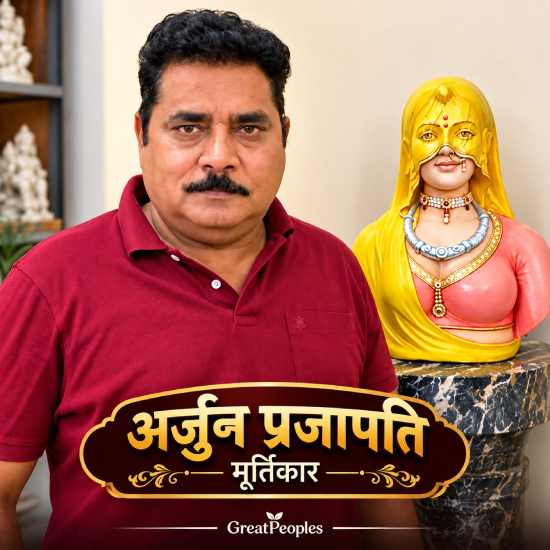
अर्जुन प्रजापति
('क्लोनिंग के महारथी', 'मूर्तिकला का जादूगर')
| जन्म तिथि | 09 April 1957 |
| उम्र | 63 वर्ष |
| जन्म स्थान | जयपुर, राजस्थान, भारत |
| निवास स्थान | 1877, दर्जियों का चौराहा, खजानेवालों का रास्ता, जयपुर |
| पिता | बालचंदजी |
| माता | कमला देवी |
| जीवनसंगी | कमला देवी |
| बच्चे | पुत्र: सुनील प्रजापति, राजेन्द्र अर्जुन प्रजापति |
| शिक्षा | मूर्तिकला और एनाटॉमिकल ड्रॉइंग में उच्च शिक्षा |
| पेशा | मूर्तिकार, कलाकार |
| राष्ट्रीयता | भारतीय |
| धर्म | हिन्दू |
| पुरस्कार | पद्मश्री (2010), शिल्प गुरु (2016) |
| मृत्यु | 12 नवंबर, 2020 (कोरोना वायरस संक्रमण) |
अर्जुन प्रजापति जीवनी ——
राजस्थान की माटी से जीवन फूंकने वाले अनूठे मूर्तिकार
एक असाधारण कलाकार का साधारण जन्म——
भारत की सांस्कृतिक विरासत में मूर्तिकला का एक विशिष्ट स्थान है। सिंधु घाटी सभ्यता के धड़ाधड़ पत्थरों से लेकर आधुनिक समकालीन मूर्तियों तक, भारतीय मूर्तिकारों ने अपनी छेनी और हथौड़ी से पत्थरों और मिट्टी में जीवन फूंकने का काम किया है। राजस्थान, जो अपनी कला, संस्कृति और वीरता के लिए विश्वभर में प्रसिद्ध है, ने कई ऐसे कलाकारों को जन्म दिया है जिन्होंने अपनी कला के दम पर देश-विदेश में नाम कमाया है। ऐसे ही एक असाधारण कलाकार हैं अर्जुन प्रजापति, जिन्हें 'क्लोनिंग के महारथी' के नाम से जाना जाता है। उन्हें 'माटी के जादूगर' कहा जाता था क्योंकि वे मिट्टी के एक ढेले को जीवंत मानव आकृति में बदलने की अद्भुत क्षमता रखते थे।
अर्जुन प्रजापति का जीवन एक प्रेरणादायक कहानी है——
एक ऐसे व्यक्ति की कहानी जिसने औपचारिक शिक्षा को बीच में छोड़कर अपने जुनून और गुरुओं के मार्गदर्शन के बल पर मूर्तिकला के क्षेत्र में अंतरराष्ट्रीय ख्याति प्राप्त की। उन्होंने न केवल पारंपरिक राजस्थानी मूर्तिकला को नई ऊंचाइयों तक पहुंचाया, बल्कि 'बणी-ठणी' जैसी पारंपरिक कला को नया रूप देकर उसे पुनर्जीवित किया। उनकी सबसे बड़ी विशेषता यह थी कि वे मात्र बीस मिनट में सामने बैठे व्यक्ति का हूबहू 'क्लोन' (प्रतिमा) तैयार कर सकते थे। यही कारण है कि अमेरिका के पूर्व राष्ट्रपति बिल क्लिंटन ने उन्हें 'मैजिशियन ऑफ स्कल्पचर आर्ट' (मूर्तिकला का जादूगर) की उपाधि दी थी।
यह जीवनी अर्जुन प्रजापति के जीवन, उनकी कला-साधना, उनकी उपलब्धियों और उनकी विरासत को विस्तार से प्रस्तुत करने का एक विनम्र प्रयास है। यह उन सभी के लिए प्रेरणा का स्रोत है जो कला के क्षेत्र में अपनी पहचान बनाना चाहते हैं और यह विश्वास रखते हैं कि प्रतिभा और समर्पण के बल पर कोई भी ऊंचाई हासिल की जा सकती है।
जन्म तिथि और स्थान——
अर्जुन प्रजापति का जन्म 9 अप्रैल, 1957 को राजस्थान की राजधानी जयपुर में हुआ था। उनका जन्म एक साधारण कुम्हार परिवार में हुआ था। उनके पिता का नाम बालचंदजी था। जयपुर, जिसे 'गुलाबी नगरी' के नाम से जाना जाता है, अपनी समृद्ध कला और संस्कृति के लिए विश्वभर में प्रसिद्ध है। यह वही शहर है जहां हवा महल, जंतर मंतर, आमेर किला और नाहरगढ़ किला जैसे ऐतिहासिक स्थल हैं। लेकिन जयपुर की पहचान सिर्फ अपने स्मारकों से नहीं है, बल्कि यहां के कलाकारों, कारीगरों और शिल्पकारों से भी है। अर्जुन प्रजापति का जन्म इसी कला-प्रेमी शहर में हुआ था।
हिंदी विकिपीडिया के अनुसार, अर्जुन प्रजापति (Arjun Prajapati) (1957 – 2020) राजस्थान के एक भारतीय कलाकार थे जो अपनी मिट्टी के बर्तनों की कला के लिए जाने जाते थे। अंग्रेजी विकिपीडिया में उन्हें "Indian artist from Jaipur, Rajasthan, known for his pottery and sculptures" के रूप में वर्णित किया गया है।
पारिवारिक पृष्ठभूमि और प्रारंभिक जीवन——
अर्जुन प्रजापति का जन्म एक कुम्हार (प्रजापति) परिवार में हुआ था। सकोया फाउंडेशन की प्रोफाइल के अनुसार, "Arjun Prajapati was born in a Kumbhaar (Potter's) family and as a young boy he was inclined towards Art and Craft"। यह कहना अतिशयोक्ति नहीं होगी कि मिट्टी से उनका नाता जन्मजात था। कुम्हार परिवार में जन्म लेने के कारण उन्हें बचपन से ही मिट्टी, चाक और मूर्तिकला का माहौल मिला। उनके परिवार के लोग पारंपरिक रूप से मिट्टी के बर्तन बनाने का काम करते थे, लेकिन अर्जुन का मन बर्तन बनाने से आगे की ओर था। वे मिट्टी से छोटी-छोटी मूर्तियां बनाना पसंद करते थे।
अर्जुन प्रजापति का बचपन जयपुर के परंपरागत मूर्ति मोहल्ले में बीता, जो 'खजाने वालों के रास्ते' में स्थित है। यह वह इलाका है जहां पीढ़ियों से मूर्तिकार और शिल्पकार रहते आए हैं। इसी माहौल ने अर्जुन के भीतर कलाकार को जन्म दिया। ज़ी न्यूज़ की रिपोर्ट के अनुसार, "9 अप्रैल, 1957 को बालचन्दजी के घर जन्मे अर्जुन का 1972 में मूर्ति कला के प्रति प्रेम जागा"। यानी जब वे लगभग 15 वर्ष के थे, तब उन्हें मूर्तिकला के प्रति गहरा लगाव महसूस हुआ।
पढ़ाई और औपचारिक शिक्षा——
अर्जुन प्रजापति की औपचारिक शिक्षा के बारे में सीमित जानकारी उपलब्ध है। सकोया फाउंडेशन के अनुसार, "He did his higher education in the field of sculpture and anatomical drawing"। इससे पता चलता है कि उन्होंने मूर्तिकला और शारीरिक रचना (एनाटॉमिकल ड्रॉइंग) की उच्च शिक्षा प्राप्त की थी। एनाटॉमिकल ड्रॉइंग का ज्ञान उनके लिए अत्यंत महत्वपूर्ण साबित हुआ क्योंकि इससे उन्हें मानव शरीर की संरचना, मांसपेशियों, हड्डियों और अंगों की सही समझ मिली। यही कारण है कि उनकी बनाई हुई मूर्तियों में जीवंतता झलकती थी।
हालांकि, एक अन्य स्रोत से पता चलता है कि अर्जुन प्रजापति ने पढ़ाई बीच में ही छोड़ दी थी और मूर्ति कला की साधना में जुनून की तरह जुट गए थे। वैश्विक हिंदी परिवार की एक ब्लॉग पोस्ट के अनुसार, "पाँच भाइयों में सबसे छोटे रहे अर्जुन तब पढ़ाई बीच में छोड़कर मूर्ति कला की साधना में जुनून की तरह जुट गए थे"। इसका मतलब है कि उन्होंने पारंपरिक शिक्षा को छोड़कर अपने जुनून का पीछा किया, जो उनके लिए सही साबित हुआ।
पारिवारिक जीवन——
अर्जुन प्रजापति का विवाह कमला देवी से हुआ था। उनके पुत्र का नाम सुनील प्रजापति है और पोते का नाम कृष्ण है। उदयपुर टाइम्स की एक रिपोर्ट के अनुसार, "To give finishing touches to the idol, Arjun Prajapati was in Udaipur with his wife Kamla, son Sunil and grandson Krishna since a long time"। इससे पता चलता है कि उनका परिवार उनके काम में सहयोगी था और वे अपने परिवार के साथ मिलकर काम करते थे। उनके पुत्र मुकेश प्रजापति भी मूर्तिकार हैं और उन्होंने अपने पिता की विरासत को आगे बढ़ाया है। ज़ी न्यूज़ की 2021 की एक रिपोर्ट के अनुसार, "देश-दुनिया के मशहूर मूर्तिकार पद्मश्री मरहूम अर्जुन प्रजापति के पुत्र मूर्तिकार मुकेश प्रजापति ने क्ले मॉडल में बाल श्रीकृष्ण के नख-शिख अलंकृत अलहदे स्वरूप को साकार किया है"।
कला-शिक्षा और गुरु-शिष्य परंपरा——
गुरुओं का मार्गदर्शन——
अर्जुन प्रजापति की कला-यात्रा में उनके गुरुओं का अत्यंत महत्वपूर्ण योगदान रहा। उन्होंने स्वयं स्वीकार किया था कि उनकी सफलता के पीछे उनके गुरुजनों का आशीर्वाद और मार्गदर्शन है। 'द बेटर इंडिया' से बात करते हुए उन्होंने कहा था, "इस मुकाम तक पहुँचने के लिए मैं अपने गुरुजनों का आभारी हूँ, जिनसे मुझे लगातार सीखने को मिला। छेनी-हथौड़ी से पत्थर पर पहली चोट से लेकर आज तक की गौरवमय यात्रा के लिए मैं अपने गुरुजनों स्वर्गीय महेन्द्रदासजी, स्वर्गीय द्वारका प्रसादजी शर्मा और आन्नदीलालजी वर्मा के योगदान को कभी नहीं भुला सकता"।
इस कथन से स्पष्ट है कि अर्जुन प्रजापति ने तीन प्रमुख गुरुओं से शिक्षा प्राप्त की:
- स्वर्गीय महेन्द्रदासजी - जिन्होंने उन्हें मूर्तिकला की बारीकियां सिखाईं
- स्वर्गीय द्वारका प्रसादजी शर्मा - जो अपने समय के प्रसिद्ध मूर्तिकार थे
- आन्नदीलालजी वर्मा - जिनसे उन्होंने कला के गूढ़ रहस्य सीखे
सकोया फाउंडेशन की प्रोफाइल में भी इस बात का उल्लेख है: "He was always influenced by great artists of their times like Dass Babu, Dwarka Prasad Sharma and Anandilal Verma"। इन गुरुओं ने अर्जुन प्रजापति को न केवल तकनीकी कौशल सिखाया, बल्कि कला के प्रति समर्पण और निष्ठा का महत्व भी समझाया।
स्व-शिक्षा और निरंतर अभ्यास——
औपचारिक शिक्षा के अलावा, अर्जुन प्रजापति ने स्वयं भी निरंतर अभ्यास और प्रयोग के माध्यम से अपनी कला को निखारा। डीएनए इंडिया की एक रिपोर्ट के अनुसार, "Prajapati said he mastered his art through continuous dedication and hard work"। उन्होंने कभी भी सीखने की प्रक्रिया को बंद नहीं किया। वे नई-नई तकनीकों और सामग्रियों के साथ प्रयोग करते रहते थे।
अर्जुन प्रजापति ने मार्बल, टेराकोटा, ब्रॉन्ज, प्लास्टर ऑफ पेरिस और फाइबर ग्लास जैसी विभिन्न सामग्रियों में महारत हासिल की। उन्होंने स्वयं को 'ऑल राउंडर' कहना पसंद किया क्योंकि वे विभिन्न माध्यमों में मूर्तियां बना सकते थे। 'द बेटर इंडिया' के अनुसार, "मैं खुद को 'ऑल राउंडर' कहना ज्यादा पसंद करता हूँ। मैं मार्बल, टेराकोटा, ब्रॉन्ज, प्लास्टर ऑफ पेरिस और फाइबर ग्लास में भी मूर्तियाँ बनाता हूँ"।
गुरु-शिष्य परंपरा का निर्वाह——
अर्जुन प्रजापति न केवल एक कुशल कलाकार थे, बल्कि एक समर्पित शिक्षक भी थे। उन्होंने अपने जीवनकाल में 10,000 से अधिक शिष्यों को मूर्तिकला की शिक्षा दी। 'द बेटर इंडिया' की रिपोर्ट के अनुसार, "अब तक वे इस कला में 10,000 से अधिक शिष्यों को तैयार कर चुके हैं"। उन्होंने जयपुर में 'आर्ट ट्रेनिंग सेंटर' की स्थापना की, जहां वे इच्छुक कलाकारों को मूर्तिकला की बारीकियां सिखाते थे।
सकोया फाउंडेशन की प्रोफाइल के अनुसार, "As a true devotee to its art form Arjun Prajapati has established a 'Sculpture Art Training Centre' in order to train and nourish the aspiring artists and continues to give his best in his creation"। यह उनकी गुरु-शिष्य परंपरा के प्रति निष्ठा को दर्शाता है। उन्होंने अपने गुरुओं से जो सीखा, उसे आगे बढ़ाने का काम किया।
कला-यात्रा की शुरुआत और संघर्ष——
प्रारंभिक कला-साधना (1972-1980)——
1972 में जब अर्जुन प्रजापति को मूर्तिकला के प्रति प्रेम जागा, तब वे मात्र 15 वर्ष के थे। उन्होंने अपने गुरुओं के सान्निध्य में मूर्तिकला की बारीकियां सीखनी शुरू कीं। प्रारंभिक दिनों में उन्होंने छोटी-छोटी मूर्तियां बनाईं और धीरे-धीरे बड़े कामों की ओर बढ़े।
अर्जुन प्रजापति का बचपन जयपुर के परम्परागत मूर्ति मोहल्ले में बीता, जहां उन्हें पारंपरिक राजस्थानी मूर्तिकला का माहौल मिला। इस माहौल ने उनके भीतर कलाकार को आकार दिया। उन्होंने 'बणी-ठणी' जैसी पारंपरिक कला को नया रूप देना शुरू किया, जो आगे चलकर उनकी पहचान बनी।
'अर्जुन आर्ट्स' की स्थापना——
अर्जुन प्रजापति ने जयपुर में 'अर्जुन आर्ट्स' नाम से एक गैलरी की स्थापना की। यह गैलरी मूर्तिकला और पत्थर की कलाकृतियों के लिए प्रसिद्ध हुई। डीएनए इंडिया की रिपोर्ट के अनुसार, "The sculptor runs Arjun Arts, a gallery here well known for artistic stoneworks, marble sculptures, sand stone and clay"।
'अर्जुन आर्ट्स' की स्थापना का उद्देश्य लुप्त होती लोक मूर्तिकला परंपरा को पुनर्जीवित करना और कला को एक नया आधुनिक रूप देना था। लिंक्डइन पर 'अर्जुन आर्ट्स' की प्रोफाइल के अनुसार, "Founder of Arjun Arts Sh. Arjun Prajapati started the gallery with a sole objective of reviving the waning folk art of sculpture and giving a new and modern look to the art as a whole"।
'माटी मानस' संग्रहालय की स्थापना——
अर्जुन प्रजापति ने 2008 में 'माटी मानस' नाम से एक मूर्ति शिल्प संग्रहालय की स्थापना की। यह राजस्थान का पहला मूर्ति शिल्प संग्रहालय है। ज़ी न्यूज़ की रिपोर्ट के अनुसार, "उनके द्वारा बनवाया गया 'माटी मानस' राजस्थान का पहला मूर्ति शिल्प संग्रहालय है"।
'माटी मानस' संग्रहालय में अर्जुन प्रजापति की 1000 से अधिक कलाकृतियां प्रदर्शित हैं। इनमें विभिन्न प्रकार की मूर्तियां, जैसे देवी-देवताओं की प्रतिमाएं, ऐतिहासिक हस्तियों के क्लोन, और पारंपरिक राजस्थानी कला के नमूने शामिल हैं। इस संग्रहालय का उद्देश्य आम जनता को मूर्तिकला की समृद्ध विरासत से परिचित कराना था।
कला-शैली और विशेषताएं——
विविध सामग्रियों में महारत——
अर्जुन प्रजापति को मार्बल, टेराकोटा, ब्रॉन्ज, प्लास्टर ऑफ पेरिस और फाइबर ग्लास जैसी विभिन्न सामग्रियों में मूर्तियां बनाने में महारत हासिल थी। उन्होंने हर सामग्री की अपनी विशेषताओं को समझा और उसी के अनुसार अपनी तकनीक विकसित की। मार्बल में उनकी मूर्तियां विशेष रूप से प्रसिद्ध थीं क्योंकि मार्बल की चमक और सफेदी मूर्तियों को एक अलग ही आकर्षण प्रदान करती थी।
वनइंडिया की रिपोर्ट के अनुसार, "अर्जुन प्रजापति को मार्बल, टेराकोटा, ब्रॉन्ज, प्लास्टर ऑफ पेरिस और फाइबर ग्लास से मूर्तियां बनाने में महारथ हासिल थी"। यह उनकी बहुमुखी प्रतिभा को दर्शाता है।
'बणी-ठणी' का पुनर्जीवन——
राजस्थान की पारंपरिक मूर्तिकला 'बणी-ठणी' को अर्जुन प्रजापति ने नया रूप प्रदान किया। यह कला उनकी पहचान बन गई और 'अर्जुन की बणी-ठणी' के नाम से प्रसिद्ध हुई। 'बणी-ठणी' मूल रूप से राजस्थानी चित्रकला की एक शैली है जिसमें एक सुंदर महिला का चित्रण किया जाता है, जिसका चेहरा घूंघट से ढका होता है।
'द बेटर इंडिया' के अनुसार, "उन्होंने परंपरागत कला 'बणी-ठणी' को नया रूप प्रदान किया, जो देखने वालों के दिलों को भा गई। यह कला 'अर्जुन की बणी-ठणी' कहलाई। उन्होंने इस मूर्ति कला के ज़रिए नारी के आकर्षक चेहरे, वक्षों और सुडौल शरीर में जिस सजीवता के साथ जान फूँकने की कारीगरी दिखलाई, वह कला समीक्षकों की नजर में इनकी कला साधना का उल्लेखनीय पहलू है"।
'अर्जुन की बणी-ठणी' एक दो फुट ऊंची टेराकोटा मूर्ति है जिसमें एक सुंदर महिला को घूंघट में दर्शाया गया है। यह मूर्ति अपनी बारीक नक्काशी और भावनात्मक गहराई के लिए विश्वभर में प्रसिद्ध है। ग्रोकिपीडिया के अनुसार, "Among his most celebrated creations is Arjun Ki Bani Thani, a two-foot-tall terracotta sculpture depicting a gracefully veiled woman inspired by Rajasthan's aesthetic of ornate beauty, which gained international acclaim"।
'क्लोनिंग के महारथी'——
अर्जुन प्रजापति की सबसे अनोखी विशेषता यह थी कि वे मात्र 20 मिनट में सामने बैठे व्यक्ति का हूबहू 'क्लोन' (प्रतिमा) तैयार कर सकते थे। इसी कारण उन्हें 'क्लोनिंग के महारथी' के नाम से जाना जाता था। वनइंडिया की रिपोर्ट के अनुसार, "अर्जुन भारत के पहले ऐसे मूर्तिकार हैं जो मात्र 20 मिनट में किसी को भी सामने बैठाकर उसका क्लोन तैयार कर देते थे। इसके चलते उन्हें 'क्लोनिंग के महारथी' के खिताब से नवाजा गया"।
यह कला उन्होंने अमेरिका में 'स्पॉट स्कल्पचरिंग' के दौरान दिखाई थी, जहां उन्होंने 20 मिनट में अमेरिकी राष्ट्रपति बिल क्लिंटन का क्लोन बनाया था। ज़ी न्यूज़ की रिपोर्ट के अनुसार, "अर्जुन ने अमेरिकी राष्ट्रपति बिल क्लिंटन का क्लोन मात्र 20 मिनट में बनाकर दिखाया तो उन्होंने बदले में 20 मिनट तक माटी से सने अर्जुन के हाथों को अपने हाथों में थामे रखा था। उन्होंने पूछा कि अर्जुन इन उंगलियों में आखिर क्या खास है"।
'मैजिशियन ऑफ स्कल्पचर आर्ट'——
बिल क्लिंटन की मूर्ति बनाने के बाद अर्जुन प्रजापति को अंतरराष्ट्रीय ख्याति मिली। सकोया फाउंडेशन के अनुसार, "In fact once in America, during 'spot sculpturing' with clay in just 20 minutes the US President was so much impressed that he designated him as 'Magician of Sculpture Art'"। बिल क्लिंटन ने उन्हें 'मैजिशियन ऑफ स्कल्पचर आर्ट' (मूर्तिकला का जादूगर) की उपाधि दी।
यह घटना अर्जुन प्रजापति के करियर का एक महत्वपूर्ण मोड़ साबित हुई। इसके बाद उन्हें देश-विदेश में कई प्रतिष्ठित हस्तियों की मूर्तियां बनाने का मौका मिला।
प्रमुख कलाकृतियां और परियोजनाएं——
ऐतिहासिक और राजनीतिक हस्तियों की मूर्तियां——
अर्जुन प्रजापति ने कई ऐतिहासिक और राजनीतिक हस्तियों की मूर्तियां बनाईं। इनमें पूर्व प्रधानमंत्री इंदिरा गांधी, पूर्व अमेरिकी राष्ट्रपति बिल क्लिंटन, ब्रिटेन के प्रिंस चार्ल्स, मॉरीशस के सर नवीन चंद्र रामगुलाम, पूर्व राष्ट्रपति भैरों सिंह शेखावत, क्रिकेटर सचिन तेंदुलकर, अभिनेत्री मनीषा कोइराला, उद्घोषक पद्मश्री जसदेव सिंह, और पंडित विश्वमोहन भट्ट शामिल हैं।
वनइंडिया की रिपोर्ट के अनुसार, "अर्जुन खेल, कला जगत और सिनेमा से जुड़ी हजारों हस्तियों सहित ब्रिटेन के प्रिंस चार्ल्स, मॉरिशस के सर नवीन चन्द्र रामगुलाम, अभिनेत्री मनीषा कोइराला, उद्घोषक पद्मश्री जसदेव सिंह, पूर्व अमेरिकी राष्ट्रपति बिल क्लिंटन, पद्मश्री पण्डित विश्वमोहन भट्ट आदि के क्लोन बनाए"।
मायावती की मूर्तियां——
अर्जुन प्रजापति ने उत्तर प्रदेश की पूर्व मुख्यमंत्री मायावती की सात मूर्तियां बनाईं। बीबीसी न्यूज़ की रिपोर्ट के अनुसार, "Mr Prajapati has made seven statues of his favourite subject, Ms Mayawati"। उन्होंने मायावती की मूर्तियों को बनाने में जो कौशल दिखाया, वह उनकी कला का एक और उदाहरण है।
अर्जुन प्रजापति ने कहा था कि जीवित व्यक्ति की मूर्ति बनाना एक चुनौतीपूर्ण काम है क्योंकि व्यक्ति लगातार बदलता रहता है। बीबीसी की रिपोर्ट में उनके हवाले से कहा गया है, "It's a challenge to sculpt a living being because a person is constantly changing"।
महात्मा गांधी की प्रतिमा——
अर्जुन प्रजापति ने महात्मा गांधी की एक प्रतिमा भी बनाई, जिसे अमेरिका के डलास शहर में हिल्टन अनाटोल होटल में स्थापित किया गया। डलास मॉर्निंग न्यूज़ की एक रिपोर्ट के अनुसार, "Hilton Anatole now home to Mahatma Gandhi statue"। यह प्रतिमा 2015 में स्थापित की गई थी और यह अर्जुन प्रजापति की अंतरराष्ट्रीय ख्याति का प्रमाण है।
ऐश्वर्या राय की 25 मूर्तियां——
अर्जुन प्रजापति ने बॉलीवुड अभिनेत्री ऐश्वर्या राय की 25 मूर्तियां बनाईं। उन्होंने बताया था कि उन्हें सपने में एक दिव्य स्त्री ने दर्शन दिए और एक सुंदर महिला की मूर्तियां बनाने की सलाह दी। डीएनए इंडिया की रिपोर्ट के अनुसार, "A divine lady appeared in my dreams and suggested me to make sculptures of a beautiful woman. She told me that it would give me recognition across the country"।
इसके बाद उन्होंने ऐश्वर्या राय को चुना क्योंकि वे उन्हें दुनिया की सबसे खूबसूरत महिलाओं में से एक मानते थे। उन्होंने कहा था, "Each week I conceived a new pose of Aishwarya in my dreams and I worked on each of them. I would soon complete 25 different poses of the actress"। ये मूर्तियां उन्होंने बेचने के लिए नहीं बनाई थीं, बल्कि अपनी रचनात्मक इच्छा को पूरा करने के लिए बनाई थीं।
स्वतंत्रता सेनानियों की श्रृंखला——
अर्जुन प्रजापति ने स्वतंत्रता सेनानियों की मूर्तियों की एक श्रृंखला भी बनाई। उदयपुर टाइम्स की रिपोर्ट के अनुसार, "Presently Arjun Prajapati, who has been over occupied in making a series of freedom fighters' idols in Kukas studio"। उन्होंने महाराणा मेवाड़ चैरिटेबल फाउंडेशन के ट्रस्टी लक्ष्यराज सिंह मेवाड़ की भी एक जीवन-आकार की मूर्ति बनाई थी।
'भारत निर्माता' श्रृंखला——
अर्जुन प्रजापति की कलाकृतियों की 'भारत निर्माता' श्रृंखला जवाहर कला केंद्र, जयपुर की अलंकार आर्ट गैलरी में प्रदर्शित की गई थी। पत्रिका की रिपोर्ट के अनुसार, "जवाहर कला केंद्र की अलंकार आर्ट गैलरी में पद्मश्री से सम्मानित मूर्तिकार अर्जुन प्रजापति की कलाकृतियों की प्रदर्शनी 'भारत निर्माता श्रृंखला' शुरू हुई"। इस श्रृंखला में उन्होंने भारत के निर्माण में योगदान देने वाली महान हस्तियों की मूर्तियां बनाईं।
कला-दर्शन और विशेषताएं——
परंपरा और आधुनिकता का संगम——
अर्जुन प्रजापति की कला में परंपरा और आधुनिकता का अद्भुत संगम देखने को मिलता है। वे पारंपरिक राजस्थानी मूर्तिकला को संरक्षित करने के पक्षधर थे, लेकिन साथ ही आधुनिक और अत्याधुनिक कला में हाथ आजमाने से भी नहीं हिचकिचाते थे। 'द बेटर इंडिया' के अनुसार, "मैं पारम्परिक कला का पक्षधर हूँ, वैसे आधुनिक और अत्याधुनिक कला में हाथ आजमाने से भी मुझे गुरेज नहीं है"।
ग्रोकिपीडिया के अनुसार, "His work often drew from Rajasthani heritage, blending traditional techniques with modern appeal to create pieces that connected viewers to stories of cultural and spiritual significance"। यही कारण है कि उनकी मूर्तियां न केवल परंपरागत सौंदर्य को समेटे हुए थीं, बल्कि आधुनिक दृष्टिकोण से भी प्रासंगिक थीं।
जीवंतता और यथार्थवाद——
अर्जुन प्रजापति की मूर्तियों की सबसे बड़ी विशेषता उनमें जीवंतता का संचार था। उनकी बनाई हुई मूर्तियों को देखकर ऐसा लगता था जैसे वे सांस ले रही हों। उन्होंने मानव शरीर की बारीकियों को इतनी सटीकता से समझा था कि उनकी मूर्तियों में हर मांसपेशी, हर हड्डी और हर भाव स्पष्ट रूप से दिखाई देता था।
यही कारण है कि उन्हें 'माटी का जादूगर' कहा जाता था। उनकी कला के बारे में लोग कहते थे कि वे मिट्टी में जान फूंक देते हैं। उदयपुर टाइम्स की रिपोर्ट के अनुसार, "He is famous as a man who can put life into clay"।
तकनीकी नवाचार——
अर्जुन प्रजापति ने अपनी कला में कई तकनीकी नवाचार भी किए। उन्होंने मार्बल, टेराकोटा, ब्रॉन्ज और अन्य सामग्रियों के साथ प्रयोग किए और नई तकनीकों को विकसित किया। उनकी 'स्पॉट स्कल्पचरिंग' तकनीक विशेष रूप से उल्लेखनीय थी, जिसमें वे मात्र 20 मिनट में किसी व्यक्ति का क्लोन तैयार कर लेते थे।
उन्होंने अपनी कला को देश-विदेश में प्रदर्शित करने के लिए कई कार्यशालाएं, प्रदर्शनियां और सेमिनार आयोजित किए। सकोया फाउंडेशन के अनुसार, "Arjun Prajapati has organized workshops, demonstration, seminars all over in India and foreign countries"।
पुरस्कार और सम्मान——
पद्मश्री पुरस्कार (2010)
अर्जुन प्रजापति को 2010 में भारत के चौथे सबसे बड़े नागरिक सम्मान 'पद्मश्री' से सम्मानित किया गया। यह सम्मान उन्हें मूर्ति कला के क्षेत्र में उल्लेखनीय योगदान के लिए दिया गया। 7 अप्रैल, 2010 को तत्कालीन राष्ट्रपति प्रतिभा पाटील ने उन्हें यह सम्मान प्रदान किया।
'द बेटर इंडिया' के अनुसार, "7 अप्रैल, 2010 को तत्कालीन राष्ट्रपति प्रतिभा पाटील ने मूर्ति कला के क्षेत्र में उल्लेखनीय योगदान के लिए अर्जुन प्रजापति को देश के चौथे नागरिक अलंकरण सम्मान 'पद्मश्री' से सम्मानित किया"। यह उनके करियर का सबसे बड़ा सम्मान था।
शिल्प गुरु पुरस्कार (2016)——
2016 में अर्जुन प्रजापति को 'शिल्प गुरु' पुरस्कार से सम्मानित किया गया। यह पुरस्कार उन्हें टेराकोटा कला में उत्कृष्टता के लिए दिया गया। ग्रोकिपीडिया के अनुसार, "Prajapati received the National Award from the Ministry of Textiles in 2004, the prestigious Padma Shri award in 2010 from the Government of India for his excellence in terracotta art, and the Shilp Guru award in 2016"।
राष्ट्रीय पुरस्कार (2004)——
2004 में अर्जुन प्रजापति को वस्त्र मंत्रालय से राष्ट्रीय पुरस्कार भी प्राप्त हुआ था। यह पुरस्कार उन्हें उनकी कला के लिए दिया गया था।
अन्य सम्मान——
अर्जुन प्रजापति को राष्ट्रीय और अंतरराष्ट्रीय संगठनों से कई अन्य पुरस्कार और सम्मान भी प्राप्त हुए। डीएनए इंडिया की रिपोर्ट के अनुसार, "Recipient of a number of awards and accolades from national and international organisations"। उन्हें 'क्लोनिंग के महारथी' और 'मैजिशियन ऑफ स्कल्पचर आर्ट' जैसी उपाधियों से भी नवाजा गया।
'अर्जुन कला अवार्ड' की स्थापना——
अर्जुन प्रजापति के निधन के बाद, उनकी स्मृति में 'अर्जुन कला अवार्ड' की स्थापना की गई। 2022 में 'माटी मानस अर्जुन कला संग्रहालय' की ओर से पहली बार यह पुरस्कार छह हस्तियों को प्रदान किया गया। ज़ी न्यूज़ की रिपोर्ट के अनुसार, "कार्यक्रम के दौरान अर्जुन प्रजापति के जरिए स्थापित माटी मानस अर्जुन कला संग्रहालय की ओर से उनकी याद में 'अर्जुन कला अवार्ड' इस समारोह में पहली बार छह हस्तियों को दिया गया है"।
अंतरराष्ट्रीय ख्याति और विदेशी यात्राएं——
अमेरिका यात्रा और बिल क्लिंटन का क्लोन——
अर्जुन प्रजापति की अंतरराष्ट्रीय ख्याति का सबसे बड़ा प्रमाण उनकी अमेरिका यात्रा थी, जहां उन्होंने 'स्पॉट स्कल्पचरिंग' का प्रदर्शन किया। इस दौरान उन्होंने मात्र 20 मिनट में तत्कालीन अमेरिकी राष्ट्रपति बिल क्लिंटन का क्लोन बनाया। यह घटना उनके जीवन की सबसे यादगार घटनाओं में से एक थी।
ज़ी न्यूज़ की रिपोर्ट के अनुसार, "अर्जुन ने अमेरिकी राष्ट्रपति बिल क्लिंटन का क्लोन मात्र 20 मिनट में बनाकर दिखाया तो उन्होंने बदले में 20 मिनट तक माटी से सने अर्जुन के हाथों को अपने हाथों में थामे रखा था"। बिल क्लिंटन इतने प्रभावित हुए कि उन्होंने अर्जुन प्रजापति को 'मैजिशियन ऑफ स्कल्पचर आर्ट' कहा।
अन्य देशों की यात्राएं——
अर्जुन प्रजापति ने भारत के अलावा कई अन्य देशों की यात्राएं कीं, जहां उन्होंने अपनी कला का प्रदर्शन किया। उन्होंने मॉरीशस, ब्रिटेन और अन्य देशों में भी अपनी कला के जौहर दिखाए। मॉरीशस के सर नवीन चंद्र रामगुलाम का क्लोन बनाना उनके करियर की एक और महत्वपूर्ण उपलब्धि थी।
अंतरराष्ट्रीय प्रदर्शनियां——
अर्जुन प्रजापति की कलाकृतियों को देश-विदेश में कई प्रदर्शनियों में स्थान मिला। ग्रोकिपीडिया के अनुसार, "Prajapati's sculptures, including replications in durable Makrana marble, emphasized quality materials like bronze and fiber while serving over 120 exhibitions and custom commissions worldwide"। उन्होंने 120 से अधिक प्रदर्शनियों में अपनी कला का प्रदर्शन किया।
व्यक्तित्व और जीवन-दर्शन——
विनम्रता और सरलता——
अर्जुन प्रजापति को अपनी कला में महारत हासिल थी, लेकिन उनका व्यक्तित्व अत्यंत विनम्र और सरल था। 'द बेटर इंडिया' की रिपोर्ट के अनुसार, "वे आज देश-दुनिया के लोकप्रिय मूर्तिकारों में शुमार किए जाते हैं, पर विनम्रता में उनका कोई सानी नहीं"। वे अपनी सफलता का श्रेय अपने गुरुओं और अपने परिवार को देते थे।
कला के प्रति समर्पण——
अर्जुन प्रजापति का पूरा जीवन कला के प्रति समर्पित था। वे दिन-रात मूर्तिकला में लीन रहते थे। उन्होंने अपनी कला को ही अपनी साधना बनाया और जीवनपर्यंत इस साधना में जुटे रहे। उनके शिष्यों और सहयोगियों के अनुसार, वे कभी भी अपने काम से थकते नहीं थे और हमेशा नए-नए प्रयोग करते रहते थे।
परिवार और सहयोगी——
अर्जुन प्रजापति का परिवार उनके काम में पूरा सहयोग करता था। उनकी पत्नी कमला, पुत्र सुनील और पोते कृष्ण उनके साथ काम करते थे। उनके पुत्र मुकेश प्रजापति भी एक कुशल मूर्तिकार हैं और उन्होंने अपने पिता की विरासत को आगे बढ़ाया है।
प्रेरणा के स्रोत——
अर्जुन प्रजापति के लिए उनके गुरु, परिवार और स्वयं उनकी कला ही प्रेरणा के स्रोत थे। वे मानते थे कि कला ईश्वर का वरदान है और इसे समर्पण भाव से करना चाहिए। उन्होंने अपने जीवन में जो सीखा, उसे दूसरों को सिखाने में भी कोई कसर नहीं छोड़ी।
कोविड-19 और निधन——
कोरोना संक्रमण——
2020 में जब पूरी दुनिया कोविड-19 महामारी से जूझ रही थी, तब अर्जुन प्रजापति भी इस वायरस की चपेट में आ गए। उन्हें कोरोना संक्रमण की पुष्टि हुई और उन्हें जयपुर के अस्पताल में भर्ती कराया गया। हालांकि, उनकी स्थिति लगातार बिगड़ती गई।
निधन (12 नवंबर, 2020)——
12 नवंबर, 2020 को अर्जुन प्रजापति का जयपुर में कोरोना संक्रमण के कारण निधन हो गया। वे 63 वर्ष के थे। अंग्रेजी विकिपीडिया के अनुसार, "He died on 12 November 2020, in Jaipur, Rajasthan due to Coronavirus"। उनके निधन की खबर ने पूरे कला जगत को शोक में डुबो दिया।
शोक संदेश——
अर्जुन प्रजापति के निधन पर राजस्थान के मुख्यमंत्री अशोक गहलोत, राज्यपाल कलराज मिश्र, चिकित्सा मंत्री डॉ. रघु शर्मा और कई अन्य गणमान्य व्यक्तियों ने शोक व्यक्त किया। मुख्यमंत्री अशोक गहलोत ने ट्वीट कर कहा, "सुप्रसिद्ध मूर्तिकार, पद्मश्री सहित अनेक पुरस्कारों से सम्मानित श्री अर्जुन प्रजापति के असामयिक निधन का समाचार अत्यंत दुखद है। जयपुर, राजस्थान के श्री प्रजापति ने मूर्तिकला को नए आयाम दिये एवं प्रदेश का मान देश-दुनिया में बढ़ाया"।
चिकित्सा एवं स्वास्थ्य मंत्री डॉ. रघु शर्मा ने कहा कि अर्जुन प्रजापति ने मूर्ति कला के क्षेत्र में एक विशिष्ट पहचान बनाई थी। ईटीवी भारत की रिपोर्ट के अनुसार, "अर्जुन प्रजापति ने मूर्ति कला के क्षेत्र में एक विशिष्ट पहचान बनाई थी। उनकी कला ने देश-विदेश में राजस्थान को गौरवान्वित किया"।
विरासत और प्रभाव——
'क्ले मास्टर ऑफ राजस्थान'——
अर्जुन प्रजापति को 'क्ले मास्टर ऑफ राजस्थान' के रूप में याद किया जाता है। उन्होंने टेराकोटा और पत्थर की मूर्तिकला में जो महारत हासिल की, वह उन्हें एक विशिष्ट पहचान देती है। ग्रोकिपीडिया के अनुसार, "He passed away on 12 November 2020 in Jaipur at the age of 64 due to complications from COVID-19, leaving a legacy as the 'Clay Maestro of Rajasthan'"।
'माटी मानस' संग्रहालय की विरासत——
अर्जुन प्रजापति द्वारा स्थापित 'माटी मानस' संग्रहालय आज भी उनकी विरासत को जीवित रखे हुए है। यह संग्रहालय राजस्थान का पहला मूर्ति शिल्प संग्रहालय है और इसमें उनकी 1000 से अधिक कलाकृतियां प्रदर्शित हैं। यह संग्रहालय आने वाली पीढ़ियों के लिए प्रेरणा का स्रोत बना हुआ है।
शिष्यों की परंपरा——
अर्जुन प्रजापति ने 10,000 से अधिक शिष्यों को मूर्तिकला की शिक्षा दी। उनके ये शिष्य आज देश-विदेश में मूर्तिकला के क्षेत्र में अपनी पहचान बना रहे हैं। उनकी शिक्षा और मार्गदर्शन ने कई पीढ़ियों के कलाकारों को प्रेरित किया है।
पारिवारिक विरासत——
अर्जुन प्रजापति की विरासत को उनके पुत्र मुकेश प्रजापति आगे बढ़ा रहे हैं। मुकेश ने भी मूर्तिकला के क्षेत्र में अपनी पहचान बनाई है और अपने पिता की तरह ही कला के प्रति समर्पित हैं। उन्होंने बाल श्रीकृष्ण की मूर्ति बनाकर अपनी कला का प्रदर्शन किया है।
'अर्जुन कला अवार्ड'——
अर्जुन प्रजापति की स्मृति में 'अर्जुन कला अवार्ड' की स्थापना की गई है। यह पुरस्कार उन कलाकारों को दिया जाता है जो मूर्तिकला के क्षेत्र में उत्कृष्ट योगदान दे रहे हैं। 2022 में पहली बार यह पुरस्कार छह हस्तियों को प्रदान किया गया।
अर्जुन प्रजापति की कला का विश्लेषण——
तकनीकी पक्ष——
अर्जुन प्रजापति की कला की सबसे बड़ी विशेषता उनकी तकनीकी महारत थी। उन्होंने मार्बल, टेराकोटा, ब्रॉन्ज, प्लास्टर ऑफ पेरिस और फाइबर ग्लास जैसी विभिन्न सामग्रियों में काम किया। हर सामग्री की अपनी अलग विशेषताएं होती हैं और उन्होंने हर सामग्री के साथ न्याय किया।
मार्बल में उनकी मूर्तियां विशेष रूप से उल्लेखनीय हैं क्योंकि मार्बल की कठोरता और चमक को संभालना आसान नहीं है। लेकिन अर्जुन प्रजापति ने मार्बल में ऐसी मूर्तियां बनाईं जो जीवंत प्रतीत होती थीं। उन्होंने मकराना मार्बल का उपयोग किया, जो राजस्थान का प्रसिद्ध संगमरमर है।
सौंदर्यात्मक पक्ष——
अर्जुन प्रजापति की मूर्तियों में सौंदर्य का अद्भुत संचार है। उनकी 'बणी-ठणी' मूर्ति इसका सबसे अच्छा उदाहरण है। इस मूर्ति में एक सुंदर महिला को घूंघट में दर्शाया गया है, जिसकी आंखों में एक रहस्यमयी भाव है। मूर्ति की बारीक नक्काशी और भावपूर्ण अभिव्यक्ति दर्शकों को मंत्रमुग्ध कर देती है।
उनकी मूर्तियों में नारी सौंदर्य का चित्रण विशेष रूप से उल्लेखनीय है। उन्होंने नारी के आकर्षक चेहरे, वक्षों और सुडौल शरीर में जीवंतता का संचार किया। यही कारण है कि उनकी मूर्तियों को कला समीक्षकों की सराहना मिली।
भावनात्मक पक्ष——
अर्जुन प्रजापति की मूर्तियों में भावनाओं की गहराई देखने को मिलती है। उन्होंने जिन हस्तियों की मूर्तियां बनाईं, उनके व्यक्तित्व की विशेषताओं को उन मूर्तियों में उतारा। चाहे बिल क्लिंटन हों, महात्मा गांधी हों, या मायावती हों, उन्होंने हर मूर्ति में उस व्यक्ति के व्यक्तित्व को प्रतिबिंबित किया।
सांस्कृतिक पक्ष——
अर्जुन प्रजापति की कला में राजस्थानी संस्कृति की गहरी छाप है। उन्होंने राजस्थानी लोक कला, पारंपरिक वेशभूषा, आभूषण और सौंदर्यशास्त्र को अपनी मूर्तियों में उतारा। उनकी 'बणी-ठणी' मूर्ति राजस्थानी नारी सौंदर्य का प्रतीक है।
जीवन और कला से जुड़े 50 रोचक तथ्य——
- अर्जुन प्रजापति का जन्म 9 अप्रैल, 1957 को जयपुर, राजस्थान में हुआ था।
- उनका जन्म एक पारंपरिक कुम्हार (प्रजापति) परिवार में हुआ था।
- उनके पिता का नाम बालचंदजी था।
- मूर्तिकला के प्रति उनका प्रेम 1972 में, मात्र 15 वर्ष की आयु में जागा।
- उनका बचपन जयपुर के पारंपरिक मूर्ति मोहल्ले 'खजाने वालों के रास्ते' में बीता।
- उन्होंने औपचारिक शिक्षा बीच में ही छोड़ दी और मूर्ति कला की साधना में जुट गए।
- उनके गुरुओं में स्वर्गीय महेन्द्रदासजी, स्वर्गीय द्वारका प्रसादजी शर्मा और आन्नदीलालजी वर्मा शामिल थे।
- वे स्वयं को 'ऑल राउंडर' कहना पसंद करते थे क्योंकि वे मार्बल, टेराकोटा, ब्रॉन्ज, प्लास्टर ऑफ पेरिस और फाइबर ग्लास—सभी में मूर्तियां बनाते थे।
- उन्हें 'क्लोनिंग के महारथी' के नाम से जाना जाता था।
- वे भारत के पहले ऐसे मूर्तिकार थे जो मात्र 20 मिनट में सामने बैठे व्यक्ति का हूबहू 'क्लोन' (प्रतिमा) तैयार कर देते थे।
- अमेरिका में 'स्पॉट स्कल्पचरिंग' के दौरान उन्होंने 20 मिनट में तत्कालीन अमेरिकी राष्ट्रपति बिल क्लिंटन का क्लोन बनाया।
- बिल क्लिंटन इतने प्रभावित हुए कि उन्होंने 20 मिनट तक माटी से सने अर्जुन के हाथ अपने हाथों में थामे रखे।
- बिल क्लिंटन ने उन्हें 'मैजिशियन ऑफ स्कल्पचर आर्ट' (मूर्तिकला का जादूगर) की उपाधि दी थी।
- उन्होंने परंपरागत राजस्थानी कला 'बणी-ठणी' को नया रूप प्रदान किया, जो 'अर्जुन की बणी-ठणी' के नाम से प्रसिद्ध हुई।
- 'अर्जुन की बणी-ठणी' एक दो फुट ऊंची टेराकोटा मूर्ति है जिसमें एक सुंदर महिला को घूंघट में दर्शाया गया है।
- उन्होंने 2008 में 'माटी मानस' नाम से मूर्ति शिल्प संग्रहालय की स्थापना की।
- 'माटी मानस' राजस्थान का पहला मूर्ति शिल्प संग्रहालय है।
- इस संग्रहालय में उनकी 1000 से अधिक कलाकृतियां प्रदर्शित हैं।
- उन्होंने जयपुर में 'अर्जुन आर्ट्स' नाम से एक गैलरी की भी स्थापना की।
- 'अर्जुन आर्ट्स' की स्थापना का उद्देश्य लुप्त होती लोक मूर्तिकला परंपरा को पुनर्जीवित करना था।
- उन्हें 2010 में भारत के चौथे सबसे बड़े नागरिक सम्मान 'पद्मश्री' से सम्मानित किया गया।
- 7 अप्रैल, 2010 को तत्कालीन राष्ट्रपति प्रतिभा पाटील ने उन्हें पद्मश्री प्रदान किया।
- उन्हें 2016 में 'शिल्प गुरु' पुरस्कार से भी सम्मानित किया गया।
- 2004 में उन्हें वस्त्र मंत्रालय से राष्ट्रीय पुरस्कार भी प्राप्त हुआ था。
- उन्होंने 10,000 से अधिक शिष्यों को मूर्तिकला की शिक्षा दी।
- उन्होंने 'स्कल्पचर आर्ट ट्रेनिंग सेंटर' की स्थापना की।
- उन्होंने पूर्व प्रधानमंत्री इंदिरा गांधी की मूर्ति बनाई।
- उन्होंने ब्रिटेन के प्रिंस चार्ल्स का क्लोन भी बनाया।
- मॉरीशस के सर नवीन चंद्र रामगुलाम का क्लोन बनाना उनकी एक और बड़ी उपलब्धि थी।
- उन्होंने पूर्व राष्ट्रपति भैरों सिंह शेखावत की भी मूर्ति बनाई।
- उन्होंने क्रिकेटर सचिन तेंदुलकर की मूर्ति भी बनाई।
- उन्होंने अभिनेत्री मनीषा कोइराला की मूर्ति बनाई।
- उन्होंने उद्घोषक पद्मश्री जसदेव सिंह की मूर्ति बनाई।
- उन्होंने पंडित विश्वमोहन भट्ट की मूर्ति बनाई।
- उन्होंने बॉलीवुड अभिनेत्री ऐश्वर्या राय की 25 मूर्तियां बनाईं।
- ऐश्वर्या राय की मूर्तियां बनाने की प्रेरणा उन्हें सपने में मिली थी।
- उन्होंने ऐश्वर्या की मूर्तियों को बेचने के लिए नहीं, बल्कि अपनी रचनात्मक इच्छा पूरी करने के लिए बनाया था।
- उन्होंने उत्तर प्रदेश की पूर्व मुख्यमंत्री मायावती की सात मूर्तियां बनाईं।
- उन्होंने महात्मा गांधी की एक प्रतिमा बनाई, जो अमेरिका के डलास शहर में स्थापित की गई।
- उन्होंने स्वतंत्रता सेनानियों की मूर्तियों की एक श्रृंखला भी बनाई।
- उनकी कलाकृतियों की 'भारत निर्माता' श्रृंखला जवाहर कला केंद्र, जयपुर में प्रदर्शित की गई थी।
- उन्होंने 120 से अधिक प्रदर्शनियों में अपनी कला का प्रदर्शन किया।
- उनकी कला में परंपरा और आधुनिकता का अद्भुत संगम देखने को मिलता है।
- उनकी मूर्तियों में जीवंतता और यथार्थवाद स्पष्ट रूप से झलकता था, जिसके कारण उन्हें 'माटी का जादूगर' कहा जाता था।
- उनके पुत्र मुकेश प्रजापति भी एक कुशल मूर्तिकार हैं और उन्होंने अपने पिता की विरासत को आगे बढ़ाया है।
- उनकी पत्नी का नाम कमला देवी और पुत्र का नाम सुनील प्रजापति है।
- उनके पोते का नाम कृष्ण है, जो उनके साथ काम में सहयोग करता था।
- 12 नवंबर, 2020 को कोरोना संक्रमण के कारण उनका निधन हो गया।
- उनके निधन पर राजस्थान के मुख्यमंत्री अशोक गहलोत ने ट्वीट कर शोक व्यक्त किया था।
- उनकी स्मृति में 'अर्जुन कला अवार्ड' की स्थापना की गई है, जो 2022 से प्रतिभाशाली कलाकारों को प्रदान किया जा रहा है।
अर्जुन प्रजापति प्रश्न (FAQ)——
कला और करियर (Art and Career)——
1. अर्जुन प्रजापति कौन थे?
वे राजस्थान के जयपुर से एक प्रसिद्ध भारतीय कलाकार थे, जो अपनी मिट्टी के बर्तनों और मूर्तियों की कला के लिए जाने जाते थे।
2. उन्हें 'क्लोनिंग के महारथी' क्यों कहा जाता था?
क्योंकि वे भारत के पहले ऐसे मूर्तिकार थे जो मात्र 20 मिनट में सामने बैठे व्यक्ति का हूबहू 'क्लोन' (प्रतिमा) तैयार कर देते थे।
3. उनकी सबसे प्रसिद्ध कलाकृति कौन सी थी?
उनकी सबसे प्रसिद्ध कलाकृति 'अर्जुन की बणी-ठणी' थी, जो एक दो फुट ऊंची टेराकोटा मूर्ति है और इसमें एक सुंदर महिला को घूंघट में दर्शाया गया है।
4. उन्होंने किन सामग्रियों में मूर्तियां बनाईं?
वे एक 'ऑल राउंडर' थे और उन्होंने मार्बल, टेराकोटा, ब्रॉन्ज, प्लास्टर ऑफ पेरिस और फाइबर ग्लास जैसी विभिन्न सामग्रियों में महारत हासिल की थी।
5. उन्होंने बिल क्लिंटन का क्लोन कैसे बनाया?
अमेरिका में 'स्पॉट स्कल्पचरिंग' के दौरान उन्होंने 20 मिनट में तत्कालीन राष्ट्रपति बिल क्लिंटन का क्लोन बनाया, जिससे वे इतने प्रभावित हुए कि उन्होंने 20 मिनट तक उनके माटी से सने हाथ थामे रखे।
6. 'बणी-ठणी' कला में उन्होंने क्या नया किया?
उन्होंने परंपरागत 'बणी-ठणी' कला को नया रूप प्रदान किया, जिसे 'अर्जुन की बणी-ठणी' के नाम से जाना गया। उन्होंने नारी के चेहरे और शरीर में जिस सजीवता के साथ जान फूंकी, वह कला समीक्षकों द्वारा सराही गई।
7. उनके गुरु कौन थे?
उन्होंने स्वर्गीय महेन्द्रदासजी, स्वर्गीय द्वारका प्रसादजी शर्मा और आन्नदीलालजी वर्मा से मूर्तिकला की बारीकियां सीखीं।
8. उन्होंने कितने शिष्यों को प्रशिक्षित किया?
उन्होंने 10,000 से अधिक शिष्यों को मूर्तिकला की शिक्षा दी और 'स्कल्पचर आर्ट ट्रेनिंग सेंटर' की स्थापना की।
9. उनकी कला में परंपरा और आधुनिकता का कैसे संगम था?
वे पारंपरिक कला के पक्षधर थे, लेकिन आधुनिक और अत्याधुनिक कला में हाथ आजमाने से भी नहीं हिचकिचाते थे। उनकी कला में राजस्थानी विरासत और आधुनिक आकर्षण का अद्भुत संगम देखने को मिलता है।
10. उन्होंने कितनी प्रदर्शनियों में भाग लिया?
उनकी कलाकृतियों को देश-विदेश में 120 से अधिक प्रदर्शनियों में स्थान मिला।
11. उन्हें 'माटी का जादूगर' क्यों कहा जाता था?
क्योंकि उनकी मूर्तियों में जीवंतता और यथार्थवाद स्पष्ट रूप से झलकता था, ऐसा लगता था जैसे वे सांस ले रही हों।
12. उन्होंने मायावती की कितनी मूर्तियां बनाईं?
उन्होंने उत्तर प्रदेश की पूर्व मुख्यमंत्री मायावती की सात मूर्तियां बनाईं।
13. उन्होंने महात्मा गांधी की प्रतिमा कहां स्थापित की?
उन्होंने महात्मा गांधी की एक प्रतिमा बनाई, जिसे अमेरिका के डलास शहर में हिल्टन अनाटोल होटल में स्थापित किया गया।
14. उन्होंने ऐश्वर्या राय की मूर्तियां क्यों बनाईं?
उन्हें सपने में एक दिव्य स्त्री ने दर्शन दिए और एक सुंदर महिला की मूर्तियां बनाने की सलाह दी। उन्होंने ऐश्वर्या राय को चुना और उनकी 25 मूर्तियां बनाईं।
15. उनका 'अर्जुन आर्ट्स' क्या है?
यह जयपुर में स्थित एक गैलरी है, जिसकी स्थापना उन्होंने लुप्त होती लोक मूर्तिकला परंपरा को पुनर्जीवित करने के उद्देश्य से की थी।
16. उन्होंने स्वतंत्रता सेनानियों की कौन सी श्रृंखला बनाई?
उन्होंने स्वतंत्रता सेनानियों की मूर्तियों की एक श्रृंखला बनाई, जिसे 'भारत निर्माता' श्रृंखला कहा जाता है। यह जवाहर कला केंद्र, जयपुर में प्रदर्शित की गई थी।
17. उनकी कला का मुख्य केंद्र क्या था?
उनकी कला का मुख्य केंद्र राजस्थानी विरासत, संस्कृति और सौंदर्यशास्त्र था, जिसे उन्होंने आधुनिक तरीकों से प्रस्तुत किया।
18. उन्होंने किस तकनीक का आविष्कार किया?
उन्होंने 'स्पॉट स्कल्पचरिंग' तकनीक विकसित की, जिसमें वे मात्र 20 मिनट में किसी व्यक्ति का क्लोन तैयार कर लेते थे।
19. उनकी कला में नारी सौंदर्य का चित्रण कैसा था?
उन्होंने नारी के आकर्षक चेहरे, वक्षों और सुडौल शरीर में जीवंतता का संचार किया। उनकी मूर्तियों में नारी सौंदर्य अपनी संपूर्णता में उभरकर सामने आता था।
20. उन्होंने किन ऐतिहासिक हस्तियों की मूर्तियां बनाईं?
उन्होंने पूर्व प्रधानमंत्री इंदिरा गांधी, ब्रिटेन के प्रिंस चार्ल्स, मॉरीशस के सर नवीन चंद्र रामगुलाम, पूर्व राष्ट्रपति भैरों सिंह शेखावत, क्रिकेटर सचिन तेंदुलकर, अभिनेत्री मनीषा कोइराला और उद्घोषक पद्मश्री जसदेव सिंह जैसी कई हस्तियों की मूर्तियां बनाईं।
पुरस्कार और सम्मान (Awards and Recognition)——
21. अर्जुन प्रजापति को कौन-कौन से पुरस्कार मिले?
उन्हें 2010 में पद्मश्री, 2016 में शिल्प गुरु पुरस्कार और 2004 में वस्त्र मंत्रालय से राष्ट्रीय पुरस्कार प्राप्त हुआ।
22. उन्हें पद्मश्री कब और क्यों मिला?
उन्हें 2010 में मूर्ति कला के क्षेत्र में उल्लेखनीय योगदान के लिए देश के चौथे नागरिक अलंकरण सम्मान 'पद्मश्री' से सम्मानित किया गया। 7 अप्रैल, 2010 को तत्कालीन राष्ट्रपति प्रतिभा पाटील ने उन्हें यह सम्मान प्रदान किया।
23. उन्हें 'मैजिशियन ऑफ स्कल्पचर आर्ट' की उपाधि किसने दी?
अमेरिका के पूर्व राष्ट्रपति बिल क्लिंटन ने उन्हें यह उपाधि दी थी।
24. 'शिल्प गुरु' पुरस्कार कब मिला?
उन्हें 2016 में टेराकोटा कला में उत्कृष्टता के लिए 'शिल्प गुरु' पुरस्कार से सम्मानित किया गया।
25. उन्हें राष्ट्रीय पुरस्कार कब मिला?
2004 में उन्हें वस्त्र मंत्रालय से राष्ट्रीय पुरस्कार प्राप्त हुआ।
26. 'अर्जुन कला अवार्ड' क्या है?
यह उनकी स्मृति में स्थापित एक पुरस्कार है, जो 'माटी मानस अर्जुन कला संग्रहालय' की ओर से कला के क्षेत्र में योगदान देने वाली हस्तियों को प्रदान किया जाता है।
27. 'अर्जुन कला अवार्ड' पहली बार कब दिया गया?
2022 में जयपुर के बिडला ऑडिटोरियम में आयोजित एक समारोह में पहली बार यह पुरस्कार छह हस्तियों को प्रदान किया गया।
28. उन्हें किन-किन क्षेत्रों में सम्मान मिला?
उन्हें राष्ट्रीय और अंतरराष्ट्रीय संगठनों से कला, शिल्प और मूर्तिकला के क्षेत्र में कई पुरस्कार और सम्मान प्राप्त हुए。
29. उनके निधन पर किन्होंने शोक व्यक्त किया?
राजस्थान के मुख्यमंत्री अशोक गहलोत, राज्यपाल कलराज मिश्र, चिकित्सा मंत्री डॉ. रघु शर्मा और कई अन्य गणमान्य व्यक्तियों ने शोक व्यक्त किया। मुख्यमंत्री ने ट्वीट कर कहा कि उन्होंने मूर्तिकला को नए आयाम दिए।
30. उनकी स्मृति में कौन सा संग्रहालय स्थापित है?
उन्होंने 2008 में 'माटी मानस' नाम से मूर्ति शिल्प संग्रहालय की स्थापना की, जो राजस्थान का पहला मूर्ति शिल्प संग्रहालय है।
व्यक्तिगत जीवन (Personal Life)——
31. अर्जुन प्रजापति का जन्म कब और कहाँ हुआ था?
उनका जन्म 9 अप्रैल, 1957 को राजस्थान की राजधानी जयपुर में हुआ था।
32. उनके पिता का नाम क्या था?
उनके पिता का नाम बालचंदजी था।
33. उनका परिवार किस पेशे से जुड़ा था?
उनका जन्म एक पारंपरिक कुम्हार (प्रजापति) परिवार में हुआ था।
34. मूर्तिकला के प्रति उनका प्रेम कब जागा?
1972 में, जब वे मात्र 15 वर्ष के थे, तब उन्हें मूर्ति कला के प्रति गहरा लगाव महसूस हुआ।
35. उनका बचपन कहाँ बीता?
उनका बचपन जयपुर के परंपरागत मूर्ति मोहल्ले 'खजाने वालों के रास्ते' में बीता।
36. उनकी पत्नी का नाम क्या था?
उनकी पत्नी का नाम कमला देवी था।
37. उनके पुत्र का नाम क्या है?
उनके पुत्र का नाम सुनील प्रजापति और मुकेश प्रजापति है। मुकेश भी एक कुशल मूर्तिकार हैं।
38. उनके पोते का नाम क्या है?
उनके पोते का नाम कृष्ण है, जो उनके साथ काम में सहयोग करता था।
39. उन्होंने औपचारिक शिक्षा कहाँ से प्राप्त की?
उन्होंने मूर्तिकला और एनाटॉमिकल ड्रॉइंग की उच्च शिक्षा प्राप्त की, लेकिन पढ़ाई बीच में छोड़कर मूर्ति कला की साधना में जुट गए।
40. उनका व्यक्तित्व कैसा था?
वे अत्यंत विनम्र और सरल स्वभाव के थे। वे अपनी सफलता का श्रेय अपने गुरुओं और परिवार को देते थे।
41. उन्होंने अपना पूरा जीवन किसके लिए समर्पित किया?
उन्होंने अपना पूरा जीवन कला के प्रति समर्पित कर दिया और दिन-रात मूर्तिकला में लीन रहते थे।
42. उनका निधन कब और कैसे हुआ?
12 नवंबर, 2020 को कोरोना संक्रमण के कारण जयपुर में उनका निधन हो गया।
43. उनके निधन के समय उनकी आयु कितनी थी?
उनके निधन के समय उनकी आयु 63 वर्ष थी।
44. उनकी मृत्यु के समय वे किस परियोजना पर काम कर रहे थे?
वे उस समय स्वतंत्रता सेनानियों की मूर्तियों की एक श्रृंखला पर काम कर रहे थे।
विरासत और प्रभाव (Legacy and Impact)——
45. उन्हें 'क्ले मास्टर ऑफ राजस्थान' क्यों कहा जाता है?
उन्होंने टेराकोटा और पत्थर की मूर्तिकला में जो महारत हासिल की, वह उन्हें एक विशिष्ट पहचान देती है। उन्हें 'क्ले मास्टर ऑफ राजस्थान' के रूप में याद किया जाता है।
46. उनकी विरासत को आगे कौन बढ़ा रहा है?
उनकी विरासत को उनके पुत्र मुकेश प्रजापति और उनके शिष्य आगे बढ़ा रहे हैं।
47. 'माटी मानस' संग्रहालय में क्या प्रदर्शित है?
इस संग्रहालय में उनकी 1000 से अधिक कलाकृतियां प्रदर्शित हैं, जिनमें देवी-देवताओं की प्रतिमाएं, ऐतिहासिक हस्तियों के क्लोन और पारंपरिक राजस्थानी कला के नमूने शामिल हैं।
48. उन्होंने कला शिक्षा में क्या योगदान दिया?
उन्होंने 'स्कल्पचर आर्ट ट्रेनिंग सेंटर' की स्थापना की और 10,000 से अधिक शिष्यों को प्रशिक्षित किया, जो आज देश-विदेश में मूर्तिकला के क्षेत्र में सक्रिय हैं।
49. उनकी कला का समकालीन मूर्तिकला पर क्या प्रभाव पड़ा?
उन्होंने राजस्थानी मूर्तिकला को नई दिशा दी और पारंपरिक तकनीकों को आधुनिक तरीकों से जोड़ा। उन्होंने आधुनिक राजस्थानी मूर्तिकला में महत्वपूर्ण भूमिका निभाई।
50. अर्जुन प्रजापति की कहानी से हमें क्या सीख मिलती है?
उनकी कहानी हमें सिखाती है कि यदि किसी व्यक्ति में प्रतिभा और जुनून हो, तो वह किसी भी बाधा को पार कर सकता है। उन्होंने साबित किया कि मिट्टी और पत्थर भी जीवंत हो सकते हैं यदि उन्हें तराशने वाले हाथ कुशल हों।
निष्कर्ष——
अर्जुन प्रजापति का जीवन एक प्रेरणादायक गाथा है। उन्होंने एक साधारण कुम्हार परिवार में जन्म लिया, लेकिन अपने जुनून, समर्पण और गुरुओं के मार्गदर्शन के बल पर मूर्तिकला के क्षेत्र में अंतरराष्ट्रीय ख्याति प्राप्त की। उन्हें 'क्लोनिंग के महारथी', 'माटी के जादूगर' और 'मैजिशियन ऑफ स्कल्पचर आर्ट' जैसी उपाधियों से नवाजा गया।
अर्जुन प्रजापति ने पारंपरिक राजस्थानी मूर्तिकला को नई ऊंचाइयों तक पहुंचाया और 'बणी-ठणी' जैसी कला को पुनर्जीवित किया। उन्होंने 10,000 से अधिक शिष्यों को प्रशिक्षित किया और 'माटी मानस' जैसे संग्रहालय की स्थापना की। उनकी कलाकृतियां आज भी देश-विदेश में प्रदर्शित हैं और लोगों को मंत्रमुग्ध करती हैं।
12 नवंबर, 2020 को कोरोना संक्रमण के कारण उनका निधन हो गया, लेकिन उनकी विरासत आज भी जीवित है। उनके पुत्र मुकेश प्रजापति और उनके शिष्य उनकी कला को आगे बढ़ा रहे हैं। 'अर्जुन कला अवार्ड' के माध्यम से उनकी स्मृति को सम्मानित किया जाता है।
अर्जुन प्रजापति की कहानी हमें सिखाती है कि यदि किसी व्यक्ति में प्रतिभा और जुनून हो, तो वह किसी भी बाधा को पार कर सकता है। उन्होंने साबित किया कि मिट्टी और पत्थर भी जीवंत हो सकते हैं यदि उन्हें तराशने वाले हाथ कुशल हों। वे भारतीय मूर्तिकला के इतिहास में एक अमिट छाप छोड़ गए हैं और आने वाली पीढ़ियों के लिए प्रेरणा के स्रोत बने रहेंगे।
Arjun Prajapati Biography —
A Unique Sculptor Who Breathed Life into the Soil of Rajasthan
The Humble Birth of an Extraordinary Artist
Sculpture holds a distinctive place in India's cultural heritage. From the sturdy stones of the Indus Valley Civilization to modern contemporary sculptures, Indian sculptors have breathed life into stone and clay with their chisels and hammers. Rajasthan, known worldwide for its art, culture, and valor, has given birth to many artists who earned fame across the country and abroad through their art. One such extraordinary artist is Arjun Prajapati, known as the 'Maestro of Cloning.' He was called the 'Magician of Clay' because he possessed the amazing ability to transform a lump of clay into a living human figure.
Arjun Prajapati's Life Is an Inspiring Story —
A story of a person who dropped out of formal education and, through his passion and the guidance of his gurus, achieved international fame in the field of sculpture. He not only took traditional Rajasthani sculpture to new heights but also revived traditional art forms like 'Bani-Thani' by giving them a new form. His greatest specialty was that he could prepare an exact 'clone' (statue) of a person sitting in front of him in just twenty minutes. That is why former US President Bill Clinton awarded him the title 'Magician of Sculpture Art.'
This biography is a humble attempt to present Arjun Prajapati's life, his artistic devotion, his achievements, and his legacy in detail. It is a source of inspiration for all those who wish to make their mark in the field of art and believe that any height can be achieved through talent and dedication.
Date and Place of Birth —
Arjun Prajapati was born on April 9, 1957, in Jaipur, the capital of Rajasthan. He was born into a simple potter's family. His father's name was Balchandji. Jaipur, known as the 'Pink City,' is famous worldwide for its rich art and culture. This is the same city that is home to historical sites like Hawa Mahal, Jantar Mantar, Amer Fort, and Nahargarh Fort. But Jaipur's identity is not just defined by its monuments; it is also defined by its artists, craftsmen, and artisans. Arjun Prajapati was born in this art-loving city.
According to Hindi Wikipedia, Arjun Prajapati (1957 – 2020) was an Indian artist from Rajasthan known for his pottery art. English Wikipedia describes him as "Indian artist from Jaipur, Rajasthan, known for his pottery and sculptures."
Family Background and Early Life —
Arjun Prajapati was born into a potter (Prajapati) family. According to the Sakoya Foundation profile, "Arjun Prajapati was born in a Kumbhaar (Potter's) family and as a young boy he was inclined towards Art and Craft." It would not be an exaggeration to say that his connection with clay was innate. Being born into a potter's family, he was surrounded by clay, the wheel, and sculpture from childhood. His family members traditionally made clay pots, but Arjun's mind was drawn beyond making pots. He loved making small idols from clay.
Arjun Prajapati's childhood was spent in Jaipur's traditional idol-makers' neighborhood, located in 'Khazane Walon Ke Raste.' This is the area where sculptors and artisans have lived for generations. This very environment gave birth to the artist within Arjun. According to a Zee News report, "Arjun, born on April 9, 1957, in Balchandji's home, developed a love for sculpture in 1972." That is, when he was about 15 years old, he felt a deep attachment to sculpture.
Education and Formal Schooling —
Limited information is available about Arjun Prajapati's formal education. According to the Sakoya Foundation, "He did his higher education in the field of sculpture and anatomical drawing." This indicates that he received higher education in sculpture and anatomical drawing. Knowledge of anatomical drawing proved extremely important for him because it gave him a correct understanding of the human body's structure, muscles, bones, and organs. This is why his sculptures exuded lifelike quality.
However, another source reveals that Arjun Prajapati dropped out of his studies midway and devoted himself to the pursuit of sculptural art with passion. According to a blog post from Vaishvik Hindi Parivar, "Arjun, the youngest of five brothers, dropped out of his studies and became passionately devoted to the pursuit of sculptural art." This means he abandoned traditional education to follow his passion, which proved right for him.
Family Life —
Arjun Prajapati was married to Kamla Devi. His son's name is Sunil Prajapati, and his grandson's name is Krishna. According to a report in Udaipur Times, "To give finishing touches to the idol, Arjun Prajapati was in Udaipur with his wife Kamla, son Sunil and grandson Krishna since a long time." This shows that his family was supportive of his work and they worked together. His son Mukesh Prajapati is also a sculptor and has carried forward his father's legacy. According to a 2021 Zee News report, "Renowned sculptor Padma Shri Late Arjun Prajapati's son, sculptor Mukesh Prajapati, has brought to life the beautifully adorned form of child Shri Krishna in a clay model."
Art Education and Guru-Shishya Tradition —
Guidance of Gurus —
Arjun Prajapati's artistic journey was greatly influenced by his gurus. He himself admitted that his success was due to the blessings and guidance of his gurus. Speaking to 'The Better India,' he said, "I am grateful to my gurus for reaching this position, from whom I kept learning continuously. For the glorious journey from the first strike of the chisel and hammer on stone to today, I can never forget the contributions of my gurus Late Mahendradasji, Late Dwarka Prasadji Sharma, and Anandilalji Verma."
From this statement, it is clear that Arjun Prajapati received education from three principal gurus:
Late Mahendradasji – Who taught him the finer points of sculpture
Late Dwarka Prasadji Sharma – Who was a famous sculptor of his time
Anandilalji Verma – From whom he learned the deep secrets of art
The Sakoya Foundation profile also mentions this: "He was always influenced by great artists of their times like Dass Babu, Dwarka Prasad Sharma and Anandilal Verma." These gurus taught Arjun Prajapati not only technical skills but also the importance of dedication and devotion to art.
Self-Education and Continuous Practice —
Beyond formal education, Arjun Prajapati also honed his art through continuous practice and experimentation. According to a DNA India report, "Prajapati said he mastered his art through continuous dedication and hard work." He never stopped the process of learning. He kept experimenting with new techniques and materials.
Arjun Prajapati mastered various materials like marble, terracotta, bronze, plaster of Paris, and fiberglass. He liked to call himself an 'all-rounder' because he could make sculptures in different mediums. According to 'The Better India,' "I prefer to call myself an 'all-rounder.' I also make sculptures in marble, terracotta, bronze, plaster of Paris, and fiberglass."
Fulfilling the Guru-Shishya Tradition —
Arjun Prajapati was not only a skilled artist but also a dedicated teacher. He taught sculpture to more than 10,000 students during his lifetime. According to 'The Better India' report, "So far he has trained more than 10,000 students in this art." He established an 'Art Training Center' in Jaipur, where he taught the finer points of sculpture to aspiring artists.
According to the Sakoya Foundation profile, "As a true devotee to its art form Arjun Prajapati has established a 'Sculpture Art Training Centre' in order to train and nourish the aspiring artists and continues to give his best in his creation." This shows his devotion to the guru-shishya tradition. He carried forward what he learned from his gurus.
Beginning of the Artistic Journey and Struggle —
Early Artistic Devotion (1972-1980) —
In 1972, when Arjun Prajapati's love for sculpture awakened, he was only 15 years old. He began learning the finer points of sculpture in the company of his gurus. In the early days, he made small idols and gradually moved toward bigger works.
Arjun Prajapati's childhood was spent in Jaipur's traditional idol-makers' neighborhood, where he received an environment of traditional Rajasthani sculpture. This environment shaped the artist within him. He began giving a new form to traditional art like 'Bani-Thani,' which later became his identity.
Establishment of 'Arjun Arts' —
Arjun Prajapati established a gallery named 'Arjun Arts' in Jaipur. This gallery became famous for sculpture and stone artworks. According to a DNA India report, "The sculptor runs Arjun Arts, a gallery here well known for artistic stoneworks, marble sculptures, sand stone and clay."
The objective of establishing 'Arjun Arts' was to revive the dying folk sculpture tradition and give art a new modern form. According to the LinkedIn profile of 'Arjun Arts,' "Founder of Arjun Arts Sh. Arjun Prajapati started the gallery with a sole objective of reviving the waning folk art of sculpture and giving a new and modern look to the art as a whole."
Establishment of 'Mati Manas' Museum —
Arjun Prajapati established a sculpture museum named 'Mati Manas' in 2008. This is Rajasthan's first sculpture museum. According to a Zee News report, "The 'Mati Manas' built by him is Rajasthan's first sculpture museum."
More than 1,000 artworks of Arjun Prajapati are displayed in the 'Mati Manas' museum. These include various types of sculptures, such as idols of gods and goddesses, clones of historical figures, and samples of traditional Rajasthani art. The purpose of this museum was to familiarize the general public with the rich heritage of sculpture.
Art Style and Characteristics —
Mastery Over Various Materials —
Arjun Prajapati had mastery over making sculptures in various materials like marble, terracotta, bronze, plaster of Paris, and fiberglass. He understood the characteristics of each material and developed his technique accordingly. His marble sculptures were especially famous because the shine and whiteness of marble gave the sculptures a distinct attraction.
According to a OneIndia report, "Arjun Prajapati had mastery over making sculptures from marble, terracotta, bronze, plaster of Paris, and fiberglass." This reflects his versatility.
Revival of 'Bani-Thani' —
Arjun Prajapati gave a new form to Rajasthan's traditional sculpture 'Bani-Thani.' This art became his identity and became famous as 'Arjun's Bani-Thani.' 'Bani-Thani' is originally a style of Rajasthani painting in which a beautiful woman is depicted with her face covered by a veil.
According to 'The Better India,' "He gave a new form to the traditional art 'Bani-Thani,' which won the hearts of viewers. This art came to be called 'Arjun's Bani-Thani.' The craftsmanship with which he breathed life into the attractive face, bosom, and well-proportioned body of the woman through this sculptural art is, in the eyes of art critics, a remarkable aspect of his artistic devotion."
'Arjun's Bani-Thani' is a two-foot-tall terracotta sculpture depicting a beautiful woman in a veil. This sculpture is famous worldwide for its fine carving and emotional depth. According to Grokipedia, "Among his most celebrated creations is Arjun Ki Bani Thani, a two-foot-tall terracotta sculpture depicting a gracefully veiled woman inspired by Rajasthan's aesthetic of ornate beauty, which gained international acclaim."
'Maestro of Cloning' —
Arjun Prajapati's most unique feature was that he could prepare an exact 'clone' (statue) of a person sitting in front of him in just 20 minutes. That is why he was known as the 'Maestro of Cloning.' According to a OneIndia report, "Arjun is the first such sculptor in India who could prepare a clone of anyone sitting in front of him in just 20 minutes. Because of this, he was honored with the title 'Maestro of Cloning.'"
He demonstrated this art during 'spot sculpturing' in America, where he made a clone of American President Bill Clinton in 20 minutes. According to a Zee News report, "When Arjun made a clone of American President Bill Clinton in just 20 minutes, Clinton held Arjun's clay-smeared hands in his own for 20 minutes in return. He asked what exactly was special about these fingers."
'Magician of Sculpture Art' —
After making Bill Clinton's statue, Arjun Prajapati gained international fame. According to the Sakoya Foundation, "In fact once in America, during 'spot sculpturing' with clay in just 20 minutes the US President was so much impressed that he designated him as 'Magician of Sculpture Art'." Bill Clinton awarded him the title 'Magician of Sculpture Art.'
This event proved to be an important turning point in Arjun Prajapati's career. After this, he got the opportunity to make sculptures of many prestigious personalities in India and abroad.
Major Artworks and Projects —
Statues of Historical and Political Figures —
Arjun Prajapati made statues of many historical and political figures. These include former Prime Minister Indira Gandhi, former US President Bill Clinton, Britain's Prince Charles, Mauritius's Sir Navin Chandra Ramgoolam, former President Bhairon Singh Shekhawat, cricketer Sachin Tendulkar, actress Manisha Koirala, announcer Padma Shri Jasdev Singh, and Pandit Vishwa Mohan Bhatt.
According to a OneIndia report, "Arjun made clones of thousands of personalities from the world of sports, art, and cinema, including Britain's Prince Charles, Mauritius's Sir Navin Chandra Ramgoolam, actress Manisha Koirala, announcer Padma Shri Jasdev Singh, former US President Bill Clinton, Padma Shri Pandit Vishwa Mohan Bhatt, and others."
Mayawati's Statues —
Arjun Prajapati made seven statues of former Uttar Pradesh Chief Minister Mayawati. According to a BBC News report, "Mr Prajapati has made seven statues of his favourite subject, Ms Mayawati." The skill he displayed in making Mayawati's statues is another example of his art.
Arjun Prajapati had said that making a statue of a living person is a challenging task because a person keeps changing. According to the BBC report, he was quoted as saying, "It's a challenge to sculpt a living being because a person is constantly changing."
Mahatma Gandhi's Statue —
Arjun Prajapati also made a statue of Mahatma Gandhi, which was installed at the Hilton Anatole Hotel in Dallas, USA. According to a Dallas Morning News report, "Hilton Anatole now home to Mahatma Gandhi statue." This statue was installed in 2015 and is proof of Arjun Prajapati's international fame.
25 Statues of Aishwarya Rai —
Arjun Prajapati made 25 statues of Bollywood actress Aishwarya Rai. He said that a divine woman appeared in his dream and suggested making sculptures of a beautiful woman. According to a DNA India report, "A divine lady appeared in my dreams and suggested me to make sculptures of a beautiful woman. She told me that it would give me recognition across the country."
After this, he chose Aishwarya Rai because he considered her one of the most beautiful women in the world. He had said, "Each week I conceived a new pose of Aishwarya in my dreams and I worked on each of them. I would soon complete 25 different poses of the actress." He did not make these statues for sale but to fulfill his creative desire.
Series of Freedom Fighters —
Arjun Prajapati also made a series of statues of freedom fighters. According to a Udaipur Times report, "Presently Arjun Prajapati, who has been over occupied in making a series of freedom fighters' idols in Kukas studio." He also made a life-size statue of Lakshyaraj Singh Mewar, trustee of the Maharana Mewar Charitable Foundation.
'Bharat Nirmata' Series —
Arjun Prajapati's 'Bharat Nirmata' series of artworks was displayed at the Alankar Art Gallery of Jawahar Kala Kendra, Jaipur. According to a Patrika report, "In the Alankar Art Gallery of Jawahar Kala Kendra, an exhibition of artworks by Padma Shri awardee sculptor Arjun Prajapati, 'Bharat Nirmata Series,' began." In this series, he made statues of great personalities who contributed to the building of India.
Art Philosophy and Characteristics —
Confluence of Tradition and Modernity —
Arjun Prajapati's art displays a wonderful confluence of tradition and modernity. He was a proponent of traditional Rajasthani sculpture, but at the same time, he did not hesitate to experiment with modern and ultra-modern art. According to 'The Better India,' "I am a proponent of traditional art, though I have no hesitation in experimenting with modern and ultra-modern art."
According to Grokipedia, "His work often drew from Rajasthani heritage, blending traditional techniques with modern appeal to create pieces that connected viewers to stories of cultural and spiritual significance." This is why his sculptures not only contained traditional beauty but were also relevant from a modern perspective.
Liveliness and Realism —
The greatest feature of Arjun Prajapati's sculptures was the infusion of liveliness in them. Looking at the sculptures he made, it seemed as if they were breathing. He had understood the intricacies of the human body so accurately that every muscle, every bone, and every emotion was clearly visible in his sculptures.
That is why he was called the 'Magician of Clay.' People used to say about his art that he breathed life into clay. According to a Udaipur Times report, "He is famous as a man who can put life into clay."
Technical Innovation —
Arjun Prajapati also made many technical innovations in his art. He experimented with marble, terracotta, bronze, and other materials and developed new techniques. His 'spot sculpturing' technique was particularly notable, in which he could prepare a clone of a person in just 20 minutes.
He organized many workshops, exhibitions, and seminars to display his art across the country and abroad. According to the Sakoya Foundation, "Arjun Prajapati has organized workshops, demonstration, seminars all over in India and foreign countries."
Awards and Honors —
Padma Shri Award (2010)
Arjun Prajapati was honored with 'Padma Shri,' India's fourth-highest civilian award, in 2010. This honor was given to him for his remarkable contribution to the field of sculpture. On April 7, 2010, then-President Pratibha Patil presented him with the Padma Shri.
According to 'The Better India,' "On April 7, 2010, then-President Pratibha Patil honored Arjun Prajapati with the country's fourth-highest civilian decoration award 'Padma Shri' for his remarkable contribution to the field of sculpture." This was the biggest honor of his career.
Shilp Guru Award (2016) —
In 2016, Arjun Prajapati was honored with the 'Shilp Guru' award. This award was given to him for excellence in terracotta art. According to Grokipedia, "Prajapati received the National Award from the Ministry of Textiles in 2004, the prestigious Padma Shri award in 2010 from the Government of India for his excellence in terracotta art, and the Shilp Guru award in 2016."
National Award (2004) —
In 2004, Arjun Prajapati also received the National Award from the Ministry of Textiles. This award was given to him for his art.
Other Honors —
Arjun Prajapati also received many other awards and honors from national and international organizations. According to a DNA India report, "Recipient of a number of awards and accolades from national and international organisations." He was also honored with titles like 'Maestro of Cloning' and 'Magician of Sculpture Art.'
Establishment of 'Arjun Kala Award' —
After Arjun Prajapati's death, the 'Arjun Kala Award' was established in his memory. In 2022, this award was presented for the first time to six personalities by the 'Mati Manas Arjun Kala Museum.' According to a Zee News report, "During the program, the 'Arjun Kala Award' was given for the first time to six personalities in this ceremony by the Mati Manas Arjun Kala Museum established by Arjun Prajapati in his memory."
International Fame and Foreign Travels —
America Trip and Bill Clinton's Clone —
The biggest proof of Arjun Prajapati's international fame was his trip to America, where he demonstrated 'spot sculpturing.' During this, he made a clone of then-US President Bill Clinton in just 20 minutes. This event was one of the most memorable events of his life.
According to a Zee News report, "When Arjun made a clone of American President Bill Clinton in just 20 minutes, Clinton held Arjun's clay-smeared hands in his own for 20 minutes in return." Bill Clinton was so impressed that he called Arjun Prajapati the 'Magician of Sculpture Art.'
Trips to Other Countries —
Arjun Prajapati traveled to many countries besides India, where he displayed his art. He showcased his art in Mauritius, Britain, and other countries as well. Making a clone of Mauritius's Sir Navin Chandra Ramgoolam was another important achievement of his career.
International Exhibitions —
Arjun Prajapati's artworks found a place in many exhibitions across the country and abroad. According to Grokipedia, "Prajapati's sculptures, including replications in durable Makrana marble, emphasized quality materials like bronze and fiber while serving over 120 exhibitions and custom commissions worldwide." He displayed his art in more than 120 exhibitions.
Personality and Life Philosophy —
Humility and Simplicity —
Arjun Prajapati had mastery over his art, but his personality was extremely humble and simple. According to 'The Better India' report, "Today he is counted among the popular sculptors of the country and the world, but there is no match for his humility." He attributed his success to his gurus and his family.
Dedication to Art —
Arjun Prajapati's entire life was dedicated to art. He remained engrossed in sculpture day and night. He made his art his devotion and remained engaged in this devotion throughout his life. According to his students and associates, he never got tired of his work and always kept making new experiments.
Family and Associates —
Arjun Prajapati's family fully supported him in his work. His wife Kamla, son Sunil, and grandson Krishna worked with him. His son Mukesh Prajapati is also a skilled sculptor and has carried forward his father's legacy.
Sources of Inspiration —
For Arjun Prajapati, his gurus, family, and his art itself were sources of inspiration. He believed that art is a gift from God and should be done with a spirit of dedication. He did not lag in teaching others what he learned in his life.
COVID-19 and Death —
Corona Infection —
In 2020, when the whole world was struggling with the COVID-19 pandemic, Arjun Prajapati also fell prey to the virus. He was confirmed to have a corona infection and was admitted to a hospital in Jaipur. However, his condition kept deteriorating.
Death (November 12, 2020) —
On November 12, 2020, Arjun Prajapati died in Jaipur due to corona infection. He was 63 years old. According to English Wikipedia, "He died on 12 November 2020, in Jaipur, Rajasthan due to Coronavirus." The news of his death plunged the entire art world into mourning.
Condolence Messages —
Rajasthan Chief Minister Ashok Gehlot, Governor Kalraj Mishra, Medical Minister Dr. Raghu Sharma, and many other dignitaries expressed grief over Arjun Prajapati's death. Chief Minister Ashok Gehlot tweeted, "The news of the untimely death of renowned sculptor Shri Arjun Prajapati, honored with Padma Shri and many other awards, is extremely sad. Shri Prajapati of Jaipur, Rajasthan gave new dimensions to sculpture and enhanced the pride of the state across the country and the world."
Medical and Health Minister Dr. Raghu Sharma said that Arjun Prajapati had created a distinct identity in the field of sculpture. According to an ETV Bharat report, "Arjun Prajapati had created a distinct identity in the field of sculpture. His art has made Rajasthan proud across the country and abroad."
Legacy and Impact —
'Clay Master of Rajasthan' —
Arjun Prajapati is remembered as the 'Clay Master of Rajasthan.' The mastery he achieved in terracotta and stone sculpture gives him a distinct identity. According to Grokipedia, "He passed away on 12 November 2020 in Jaipur at the age of 64 due to complications from COVID-19, leaving a legacy as the 'Clay Maestro of Rajasthan'."
Legacy of 'Mati Manas' Museum —
The 'Mati Manas' museum established by Arjun Prajapati still keeps his legacy alive. This museum is Rajasthan's first sculpture museum and displays more than 1,000 of his artworks. This museum remains a source of inspiration for future generations.
Tradition of Students —
Arjun Prajapati taught sculpture to more than 10,000 students. These students are today making their mark in the field of sculpture across the country and abroad. His education and guidance have inspired generations of artists.
Family Legacy —
Arjun Prajapati's legacy is being carried forward by his son Mukesh Prajapati. Mukesh has also made his mark in the field of sculpture and is dedicated to art just like his father. He has demonstrated his art by making a statue of child Shri Krishna.
'Arjun Kala Award' —
The 'Arjun Kala Award' has been established in memory of Arjun Prajapati. This award is given to artists who are making outstanding contributions in the field of sculpture. In 2022, this award was presented to six personalities for the first time.
Analysis of Arjun Prajapati's Art —
Technical Aspect —
The greatest feature of Arjun Prajapati's art was his technical mastery. He worked with various materials like marble, terracotta, bronze, plaster of Paris, and fiberglass. Each material has its own characteristics, and he did justice to each material.
His marble sculptures are particularly notable because handling the hardness and shine of marble is not easy. But Arjun Prajapati made sculptures in marble that appeared lifelike. He used Makrana marble, which is Rajasthan's famous marble.
Aesthetic Aspect —
Arjun Prajapati's sculptures have a wonderful infusion of beauty. His 'Bani-Thani' sculpture is the best example of this. In this sculpture, a beautiful woman is depicted in a veil, with a mysterious expression in her eyes. The fine carving and expressive depiction of the sculpture mesmerize viewers.
The depiction of feminine beauty in his sculptures is particularly notable. He infused liveliness into the attractive face, bosom, and well-proportioned body of women. That is why his sculptures received appreciation from art critics.
Emotional Aspect —
Arjun Prajapati's sculptures show a depth of emotion. He captured the personality traits of the personalities whose statues he made. Whether it was Bill Clinton, Mahatma Gandhi, or Mayawati, he reflected each person's personality in every statue.
Cultural Aspect —
Arjun Prajapati's art bears a deep imprint of Rajasthani culture. He depicted Rajasthani folk art, traditional costumes, jewelry, and aesthetics in his sculptures. His 'Bani-Thani' sculpture is a symbol of Rajasthani feminine beauty.
50 Interesting Facts About His Life and Art —
Arjun Prajapati was born on April 9, 1957, in Jaipur, Rajasthan.
He was born into a traditional potter (Prajapati) family.
His father's name was Balchandji.
His love for sculpture awakened in 1972, at the age of just 15.
His childhood was spent in Jaipur's traditional idol-makers' neighborhood, 'Khazane Walon Ke Raste.'
He dropped out of formal education midway and devoted himself to the pursuit of sculptural art.
His gurus included Late Mahendradasji, Late Dwarka Prasadji Sharma, and Anandilalji Verma.
He liked to call himself an 'all-rounder' because he made sculptures in marble, terracotta, bronze, plaster of Paris, and fiberglass—all of them.
He was known as the 'Maestro of Cloning.'
He was India's first such sculptor who could prepare an exact 'clone' (statue) of a person sitting in front of him in just 20 minutes.
During 'spot sculpturing' in America, he made a clone of then-US President Bill Clinton in 20 minutes.
Bill Clinton was so impressed that he held Arjun's clay-smeared hands in his own for 20 minutes.
Bill Clinton awarded him the title 'Magician of Sculpture Art.'
He gave a new form to the traditional Rajasthani art 'Bani-Thani,' which became famous as 'Arjun's Bani-Thani.'
'Arjun's Bani-Thani' is a two-foot-tall terracotta sculpture depicting a beautiful woman in a veil.
He established a sculpture museum named 'Mati Manas' in 2008.
'Mati Manas' is Rajasthan's first sculpture museum.
More than 1,000 of his artworks are displayed in this museum.
He also established a gallery named 'Arjun Arts' in Jaipur.
The objective of establishing 'Arjun Arts' was to revive the dying folk sculpture tradition.
He was honored with 'Padma Shri,' India's fourth-highest civilian award, in 2010.
On April 7, 2010, then-President Pratibha Patil presented him with the Padma Shri.
He was also honored with the 'Shilp Guru' award in 2016.
He also received the National Award from the Ministry of Textiles in 2004.
He taught sculpture to more than 10,000 students.
He established the 'Sculpture Art Training Centre.'
He made a statue of former Prime Minister Indira Gandhi.
He also made a clone of Britain's Prince Charles.
Making a clone of Mauritius's Sir Navin Chandra Ramgoolam was another major achievement.
He also made a statue of former President Bhairon Singh Shekhawat.
He also made a statue of cricketer Sachin Tendulkar.
He made a statue of actress Manisha Koirala.
He made a statue of announcer Padma Shri Jasdev Singh.
He made a statue of Pandit Vishwa Mohan Bhatt.
He made 25 statues of Bollywood actress Aishwarya Rai.
The inspiration to make Aishwarya Rai's statues came to him in a dream.
He made Aishwarya's statues not for sale but to fulfill his creative desire.
He made seven statues of former Uttar Pradesh Chief Minister Mayawati.
He made a statue of Mahatma Gandhi, which was installed in Dallas, USA.
He also made a series of statues of freedom fighters.
His 'Bharat Nirmata' series of artworks was displayed at Jawahar Kala Kendra, Jaipur.
He displayed his art in more than 120 exhibitions.
His art displays a wonderful confluence of tradition and modernity.
His sculptures clearly exuded liveliness and realism, which is why he was called the 'Magician of Clay.'
His son Mukesh Prajapati is also a skilled sculptor and has carried forward his father's legacy.
His wife's name was Kamla Devi, and his son's name is Sunil Prajapati.
His grandson's name is Krishna, who assisted him in his work.
He died on November 12, 2020, due to corona infection.
Rajasthan Chief Minister Ashok Gehlot tweeted condolences on his death.
The 'Arjun Kala Award' has been established in his memory, which has been presented to talented artists since 2022.
Arjun Prajapati FAQ —
Art and Career —
1. Who was Arjun Prajapati?
He was a famous Indian artist from Jaipur, Rajasthan, known for his pottery and sculptures.
2. Why was he called the 'Maestro of Cloning'?
Because he was India's first such sculptor who could prepare an exact 'clone' (statue) of a person sitting in front of him in just 20 minutes.
3. What was his most famous artwork?
His most famous artwork was 'Arjun's Bani-Thani,' a two-foot-tall terracotta sculpture depicting a beautiful woman in a veil.
4. In which materials did he make sculptures?
He was an 'all-rounder' and had mastery over various materials like marble, terracotta, bronze, plaster of Paris, and fiberglass.
5. How did he make Bill Clinton's clone?
During 'spot sculpturing' in America, he made a clone of then-President Bill Clinton in 20 minutes, which so impressed Clinton that he held his clay-smeared hands for 20 minutes.
6. What new did he do in 'Bani-Thani' art?
He gave a new form to the traditional 'Bani-Thani' art, which became known as 'Arjun's Bani-Thani.' The liveliness with which he breathed life into the woman's face and body was appreciated by art critics.
7. Who were his gurus?
He learned the finer points of sculpture from Late Mahendradasji, Late Dwarka Prasadji Sharma, and Anandilalji Verma.
8. How many students did he train?
He taught sculpture to more than 10,000 students and established the 'Sculpture Art Training Centre.'
9. How did his art blend tradition and modernity?
He was a proponent of traditional art but did not hesitate to experiment with modern and ultra-modern art. His art displays a wonderful confluence of Rajasthani heritage and modern appeal.
10. In how many exhibitions did he participate?
His artworks found a place in more than 120 exhibitions across the country and abroad.
11. Why was he called the 'Magician of Clay'?
Because his sculptures clearly exuded liveliness and realism, it seemed as if they were breathing.
12. How many statues of Mayawati did he make?
He made seven statues of former Uttar Pradesh Chief Minister Mayawati.
13. Where did he install Mahatma Gandhi's statue?
He made a statue of Mahatma Gandhi, which was installed at the Hilton Anatole Hotel in Dallas, USA.
14. Why did he make Aishwarya Rai's statues?
A divine woman appeared in his dream and suggested making sculptures of a beautiful woman. He chose Aishwarya Rai and made 25 statues of her.
15. What is his 'Arjun Arts'?
It is a gallery located in Jaipur, which he established with the objective of reviving the dying folk sculpture tradition.
16. What series of freedom fighters did he make?
He made a series of statues of freedom fighters, called the 'Bharat Nirmata' series. It was displayed at Jawahar Kala Kendra, Jaipur.
17. What was the main focus of his art?
The main focus of his art was Rajasthani heritage, culture, and aesthetics, which he presented through modern methods.
18. What technique did he invent?
He developed the 'spot sculpturing' technique, in which he could prepare a clone of a person in just 20 minutes.
19. How was feminine beauty depicted in his art?
He infused liveliness into the attractive face, bosom, and well-proportioned body of women. Feminine beauty emerged in its entirety in his sculptures.
20. Which historical figures' statues did he make?
He made statues of many personalities like former Prime Minister Indira Gandhi, Britain's Prince Charles, Mauritius's Sir Navin Chandra Ramgoolam, former President Bhairon Singh Shekhawat, cricketer Sachin Tendulkar, actress Manisha Koirala, and announcer Padma Shri Jasdev Singh.
Awards and Recognition —
21. Which awards did Arjun Prajapati receive?
He received Padma Shri in 2010, the Shilp Guru award in 2016, and the National Award from the Ministry of Textiles in 2004.
22. When and why did he receive the Padma Shri?
He was honored with 'Padma Shri,' the country's fourth-highest civilian decoration award, in 2010 for his remarkable contribution to the field of sculpture. On April 7, 2010, then-President Pratibha Patil presented him with this honor.
23. Who awarded him the title 'Magician of Sculpture Art'?
Former US President Bill Clinton awarded him this title.
24. When did he receive the 'Shilp Guru' award?
He was honored with the 'Shilp Guru' award in 2016 for excellence in terracotta art.
25. When did he receive the National Award?
He received the National Award from the Ministry of Textiles in 2004.
26. What is the 'Arjun Kala Award'?
It is an award established in his memory, presented by the 'Mati Manas Arjun Kala Museum' to personalities contributing to the field of art.
27. When was the 'Arjun Kala Award' first given?
In 2022, at a ceremony held at Birla Auditorium in Jaipur, this award was presented to six personalities for the first time.
28. In which fields was he honored?
He received many awards and honors from national and international organizations in the fields of art, craft, and sculpture.
29. Who expressed grief over his death?
Rajasthan Chief Minister Ashok Gehlot, Governor Kalraj Mishra, Medical Minister Dr. Raghu Sharma, and many other dignitaries expressed grief. The Chief Minister tweeted that he gave new dimensions to sculpture.
30. Which museum is established in his memory?
He established the 'Mati Manas' sculpture museum in 2008, which is Rajasthan's first sculpture museum.
Personal Life —
31. When and where was Arjun Prajapati born?
He was born on April 9, 1957, in Jaipur, the capital of Rajasthan.
32. What was his father's name?
His father's name was Balchandji.
33. What profession was his family associated with?
He was born into a traditional potter (Prajapati) family.
34. When did his love for sculpture awaken?
In 1972, when he was only 15 years old, he felt a deep attachment to sculptural art.
35. Where was his childhood spent?
His childhood was spent in Jaipur's traditional idol-makers' neighborhood, 'Khazane Walon Ke Raste.'
36. What was his wife's name?
His wife's name was Kamla Devi.
37. What is his son's name?
His sons' names are Sunil Prajapati and Mukesh Prajapati. Mukesh is also a skilled sculptor.
38. What is his grandson's name?
His grandson's name is Krishna, who assisted him in his work.
39. Where did he receive formal education?
He received higher education in sculpture and anatomical drawing but dropped out to devote himself to sculptural art.
40. What was his personality like?
He was extremely humble and simple by nature. He attributed his success to his gurus and family.
41. To what did he dedicate his entire life?
He dedicated his entire life to art and remained engrossed in sculpture day and night.
42. When and how did he die?
He died on November 12, 2020, in Jaipur due to corona infection.
43. What was his age at the time of death?
He was 63 years old at the time of his death.
44. On what project was he working at the time of his death?
He was working on a series of statues of freedom fighters at that time.
Legacy and Impact —
45. Why is he called the 'Clay Master of Rajasthan'?
The mastery he achieved in terracotta and stone sculpture gives him a distinct identity. He is remembered as the 'Clay Master of Rajasthan.'
46. Who is carrying forward his legacy?
His legacy is being carried forward by his son Mukesh Prajapati and his students.
47. What is displayed in the 'Mati Manas' museum?
More than 1,000 of his artworks are displayed in this museum, including idols of gods and goddesses, clones of historical figures, and samples of traditional Rajasthani art.
48. What contribution did he make to art education?
He established the 'Sculpture Art Training Centre' and trained more than 10,000 students, who are today active in the field of sculpture across the country and abroad.
49. What impact did his art have on contemporary sculpture?
He gave a new direction to Rajasthani sculpture and connected traditional techniques with modern methods. He played an important role in modern Rajasthani sculpture.
50. What do we learn from Arjun Prajapati's story?
His story teaches us that if a person has talent and passion, they can overcome any obstacle. He proved that clay and stone can also come alive if the hands that carve them are skilled.
Conclusion —
Arjun Prajapati's life is an inspiring saga. He was born into a simple potter's family but achieved international fame in the field of sculpture through his passion, dedication, and the guidance of his gurus. He was honored with titles like 'Maestro of Cloning,' 'Magician of Clay,' and 'Magician of Sculpture Art.'
Arjun Prajapati took traditional Rajasthani sculpture to new heights and revived art like 'Bani-Thani.' He trained more than 10,000 students and established museums like 'Mati Manas.' His artworks are still displayed across the country and abroad and mesmerize people.
On November 12, 2020, he died due to corona infection, but his legacy is still alive. His son Mukesh Prajapati and his students are carrying forward his art. His memory is honored through the 'Arjun Kala Award.'
Arjun Prajapati's story teaches us that if a person has talent and passion, they can overcome any obstacle. He proved that clay and stone can also come alive if the hands that carve them are skilled. He left an indelible mark on the history of Indian sculpture and will remain a source of inspiration for future generations.